

December 2006 — Volume 10, Number 3
Lecture Ready: Strategies for Academic Listening,Note-taking, and Discussion, Book 2 |
|||
| Author: | Peg Sarosy & Kathy Sherak (2006) | 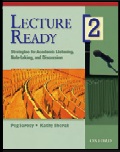 |
|
| Publisher: | Oxford: Oxford University Press | ||
| Pages | ISBN | Price | |
|---|---|---|---|
| Pp. viii + 114 | 0-19-430968-1 | £13 GBP; $24.95 U.S. | |
With increasing numbers of students applying for admission into English-medium universities and colleges, academic listening, note-taking and discussion skills in English are pivotal to their success. Research similarly suggests that these skills are what college students have to be equipped with to complete their academic studies smoothly (Flowerdew, 1994, 2005). Lecture Ready, Book 2 serves the purpose of preparing such students for academic study. As one text of the Lecture Ready series, Book 2 is made up of the Student Book, the Audio Program and the Video Program. It should be highly appealing to teachers considering adopting a text for honing students’ academic listening, note-taking and discussion skills. The Lecture Ready series comprises three books catering to students of different proficiency levels: while Book 1 and Book 3 are intended for low-intermediate and advanced students respectively, Book 2 is geared toward intermediate students.
Lecture Ready, Book 2 has several strengths by virtue of its systematic organization. It comprises five units, organized around topics such as social sciences, science, media studies and linguistics. For example, one of the units, Unit 2: Social Sciences, includes chapters on “Work Habits in the United States” as well as on “Leisure Time in the United States”. Each chapter has three components–Reading, Practice Lecture, Real Lecture– and consists of four sections. A set of “Chapter Goals” stated in clear language precedes each chapter, followed by “Build Background Knowledge”, where students are prompted and helped to “think about the topic”, “read”, “check their comprehension”, “expand their vocabulary”, “discuss the reading”, and “review what they know”.
The next section “Prepare to Listen and Take Notes” introduces listening strategies in context. Students are encouraged to pay attention to “big picture lecture language”, to “recognize lecture language”, to “listen for the topic”, and to “listen for the big picture” so that they become familiar with the expressions that signal how professors start, proceed with, and conclude their lectures. In “Listen and Take Notes” note-taking strategies are explained and illustrated. Students are shown how to take notes in outline form, make predictions, follow the lecture, assess comprehension, and summarize the lecture.
Discussion strategies are presented next. Students are told that contributing to discussion is an important aspect of classroom processes and should lead to success in college life. Typical formulaic language is provided for students to use in order to show that they are ready to contribute to discussion. For instance, students are provided with opening expressions such as “I think it was interesting that . . . “, “I noticed that . . . “, “I was wondering if _____ is a good example of ______”, “In my opinion, . . . “, “______ is really important because ________” (p. 20), “That’s enough about _____. Lets go to the next point”, and “What I want to discuss now is . . . ” (p. 27). Specific activities are also supplied for the book’s users, teachers as well as students, to exploit the material fully. These activities offer an ideal platform that scaffolds selected strategies such as making predictions and summarizing the lecture, among others, and supports students who are ready to practice articulating their views through the use of expressions recommended in the book.
There are several academically engaging features in the book. The primary one that caught my attention is that the book has incorporated a dual strategy for college-bound students, one that allows students to develop their academic listening proficiency while also developing study skills. This principle of designing language teaching materials through inculcating students’ studying skills in a gradual fashion is consistent with what has been promulgated in the literature about how ESL/EFL learners effectively learn to acquire a second or foreign language (see e.g., Chamot, 2005; Cohen, 1998; O’Malley & Chamot, 1989; Oxford, 1990, 2002).
The second commendable feature of the book is the complete and successful integration of listening and speaking skills throughout the book. In line with this, the writers have designed activities and tasks that make it highly feasible for vocabulary to be learned and consolidated in context. The integration of these skills is also fully supported by problem-based learning grounded in students progressively mastering terms on the Academic Word List (Coxhead, 1995). What is particularly noteworthy is that vocabulary is presented in the context of reading passages and then practiced through listening and speaking activities.
The third noteworthy feature is the use of audio and visual materials such as lectures recorded on CDs and DVDs. Using such technology brings students much closer to the academic listening, note-taking and discussion that go on in a typical college classroom. Students not only listen to the audio materials, they also can observe professors’ paralinguistic features and visual cues such as gestures, body movement, and board work. This innovative approach to academic listening is an integral part of the total enjoyable learning experience in each chapter’s “centerpiece lecture”. Just as the introduction of the book states, the audio-video materials on CDs, DVDs and VHS present typical features of real academic lectures, where natural language, pauses, backtracking, false starts, digressions, recapping, filler words, stalling, and other hallmarks of one-way communication are all vividly and realistically depicted. These spoken-language characteristics are not only presented in typical “lecture language” but they are also practiced in all the chapters.
Including the three above-mentioned features in Lecture Ready has also made a significant contribution to our understanding of how we language teachers can better help senior high school leavers or those in university prep-programs make a successful transition to college academic life. It has to be mentioned that, more often than not, students enter college without having the adequate skills needed for coping with academic materials, both visual and print. The severity of this deficit increases exponentially for ESL/EFL learners preparing for degree programs. So the publication of Lecture Ready should help fill that gap nicely.
Sarosy and Sherak have also kept teachers in mind in presenting materials. For example, audio programs and video programs are indicated by distinguishable audio or video icons. Furthermore, many of the photos offer immediately useful prompts not only for activating schema/background knowledge but also as input for students’ classroom discussion. These visuals also give EFL students a chance to glimpse other academic worlds in the form of buildings, advertisements, laboratories, office fixtures, street signs, university campuses, lecture/tutorial settings, etc.– sites otherwise unseen by those students studying English in their home countries. In a sense, Lecture Ready also might serve to prepare future international students to be ready to mingle with students of multiracial/multi-ethnic backgrounds, since the visuals do not show only white Caucasians in academic settings in English-speaking countries.
The value of Lecture Ready, Book 2 is without question. Yet, like many other wonderful textbooks of the same kind, Lecture Ready, Book 2 is not completely free from minor defects. One of the chapters entitled “Linguistics” is one about which I would like to raise some questions. The selected reading for chapter 10 (p. 101) is titled “International English”. With this title guiding me, I faced some difficulty processing the content. When I finished the reading, I realized that the authors had addressed issues about English becoming a language for international communication and interaction. So I wonder if a better title would not be “English as an International Language” (see e.g., McKay, 1999), since in the literature when the term “international English” or “world English(es)” is used, it refers to varieties of English around the world, reflecting differences in phonology, syntax, lexicon and formulaic use with reference to cultural norms and regional diversity (see e.g., Jenkins, 2003; Kachru, 2006; Trudgil & Hannah, 2003).
Taken as a whole, Lecture Ready, Book 2 will be a valuable addition to the available stocks of ESP/EAP textbooks. I anticipate that it will be widely adopted in many ESP/EAP programs in the Americas and Europe. It will become even more popular in the Asian-Pacific, where the largest populations of ESL/EFL students are preparing for entry into English-medium universities. The innovative use of multimedia in the book also encourages learner autonomy in self-access language centers where students who are ready to take the initiative can study the materials on their own. So I highly commend Sarosy and Sherak for having achieved such a level of success in presenting both teachers and students with a dynamic, colorful, and engaging textbook and other learning tools.
References
Chamot, A. U. (2005). Language learning strategy instruction: Current issues and research. Annual Review of Applied Linguistics, 25, 98-111.
Cohen, A. D. (1998). Strategies in learning and using a second language. London: Longman.
Coxhead, A. (2000). A new academic word list. TESOL Quarterly, 34, 213-238.
Flowerdew, J. (1994). Academic listening: Research perspectives. New York: Cambridge University Press.
Flowerdew, J. (2005). Second language listening: Theory and practice. New York: Cambridge University Press.
Jenkins, J. (2003). World Englishes: A resource book for students. London: Routledge.
Kachru, Y. (2006). World Englishes in Asian contexts. Hong Kong: Hong Kong University Press.
McKay, S. L. (2002). Teaching English as an international language: Rethinking goals, and approaches. Oxford: Oxford University Press.
O’Malley, M. & Chamot, A. (1989). Learning strategies in second language acquisition. New York: Cambridge University Press.
Oxford, R. L. (1990). Language learning strategies: What every teacher should know. New York: Newbury House.
Trudgill, P. & Hannah, J. (2003). International English: A guide to varieties of standard English. New York: Oxford University Press.
Lawrence Jun Zhang
Nanyang Technological University, Singapore
<lawrence.zhang nie.edu.sg >
|
© Copyright rests with authors. Please cite TESL-EJ appropriately. Editor’s Note: The HTML version contains no page numbers. Please use the PDF version of this article for citations. |