

December 2006 — Volume 10, Number 3
|
|||
| Author: | John Flowerdew and Lindsay Miller (2005) | 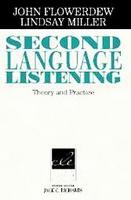 |
|
| Publisher: | New York: Cambridge University Press | ||
| Pages | ISBN | Price | |
|---|---|---|---|
| Pp. xiv + 223 | 0-521-78647-9 (paper) | $25.00 U.S. | |
Introduction
Listening has received increasing attention from ESL/EFL professionals in recent years. The digital revolution has made spoken language much easier to record, edit, and share. Digital communications and travel raise the chances of needing to communicate in a second language, making that language much less “foreign.” Still, despite being increasingly important, understanding what someone says in a second language remains a challenge. John Flowerdew and Lindsay Miller in Second Language Listening: Theory and Practice offer guidance to teachers who want to help their students meet this challenge. Their book can help teachers apply current listening theory.
Viewed broadly, Flowerdew and Miller’s “Pedagogic Model for Second Language Listening” forms the core of their approach to explaining and teaching Second Language Listening comprehension. Second Language Listening is divided into eleven chapters arranged into three broad sections covering (1) Second Language Listening theory and instruction; (2) the authors’ pedagogical model and its application to teaching materials and learning contexts; and (3) discussions about listening, comprehension questions, and testing. In effect, the initial chapters provide a context for their proposed model. The later chapters describe applications.
Looked at more closely, Flowerdew and Miller’s pedagogical model is an attempt to build upon and provide greater practical use for existing theoretical models of Second Language Listening comprehension. The historical context for their model is provided by their discussion of how listening has, or has not, been taught across a range of instructional methodologies ranging from the Grammar-Translation method, through the Audio-Lingual method, to current approaches (Chapter 1). The psycholinguistic grounding for their model includes considerations of the traditional “bottom-up” and “top-down” approaches to listening and the interaction between them (Chapter 2). Flowerdew and Miller also consider the nature of information embedded in speech (Chapter 3), spoken and written discourse (Chapter 4), and listening strategies (Chapter 5). In this first section, Flowerdew and Miller summarize what the profession knows about Second Language Listening. Teachers may find this summary helpful because it clarifies what is unique about listening and why listening presents difficulties for second language learners.
To these initial considerations of listening Flowerdew and Miller add their pedagogical model, in which they view listening as being, “Individualized, Cross-cultural, Social, Contextualized, Affective, Strategic, Intertextual, and Critical” (Chapter 6, p. 85, and pp. 85-97 for their discussion). They present their model as a pair of concentric circles: “Dimensions of Listening” surrounding a core of the traditional psycholinguistic “Processes” –top-down and bottom-up processes, and their interaction. Flowerdew and Miller explain that not every dimension of their model of listening need apply in every situation. Rather, teachers should expect to vary their approach to listening depending on the learners and the situation (p. 86). What this model offers teachers is a way to apply research on listening to their own practice.
The individualized and strategic dimensions of the model offer links between instruction and theoretical positions on learner variability, learner needs, and learner strategies. The cross-cultural, contextualized, and intertextual dimensions attempt to account for the broader environment of Second Language Listening, whether in the form of learners’ cultural prior knowledge, in the form of listening as it relates to other types of learner practices such as reading, or in the form of listening as it alludes to other types of texts and language. The affective dimension is helpful for teachers wanting to consider the emotional aspects of Second Language Listening, including motivation and goal setting. Critical listening encourages teachers and learners to think about the sociopolitical nature of the texts to which they listen, certainly an important consideration in an interconnected world.
Teachers may also find Second Language Listening helpful because of the guidance it offers in applying listening theory to particular student populations and instructional situations. Flowerdew and Miller illustrate this by showing how their model might be applied to materials selection and development (Chapter 7) and to an analysis of listening in different second language contexts ranging from younger learners in school settings through adults in higher education (Chapter 8). Applying Second Language Listening theory is one of the more challenging aspects of teaching, given that theories of listening tend to be presented as arguments based on explanations of particular data sets. Instructors face the difficulty of extending those arguments to specific problems in their own contexts, such as choosing, adapting, or developing materials for a particular group of learners. This pedagogical model provides helpful guidance in that area.
Using technology, developing listening comprehension questions, and evaluating listening all present other challenges for teachers, and Flowerdew and Miller demonstrate how their model might also be used in these areas. The discussion of technology in listening (Chapter 9) considers both more established technologies (such as radio and audiotape) and newer technologies, such as the computer. Teachers may find the authors’ application of the model in this area quite familiar, in that the blend of old and new technologies matches the instructional situation of many learners and teachers, a mix of the still serviceable and the new, depending on the budget. Chapter 10, which covers listening questions, and Chapter 11, listening tests, complement each other. Chapter 10 provides an analysis of standard question types, those following a fairly linear approach to classroom listening (before, during and after listening). Then, Flowerdew and Miller discuss question types in terms of their model. Where their model encourages teachers to approach listening along a variety of dimensions, their discussion of comprehension questions links these dimensions to practice. Their chapter on testing is an extension of their discussion of question types, with cautions to teachers to ensure that their listening tests follow a communicative approach and actually test listening.
Teachers and teacher trainers might find useful a number of the book’s features. In each chapter, the authors provide brief tasks for readers to complete. These might include transcribing speech in order to better understand it in terms of listening (p. 52), or evaluating textbook listening activities (p. 97). Discussion questions accompany each chapter; these can help readers apply a chapter’s concepts to their own experience. For example, following the chapter on technology, readers are asked to use Flowerdew and Miller’s pedagogical model to evaluate a technology used to teach listening. Finally, at the end of the text, the authors provide broader questions to help the reader extend and apply the pedagogical model. The questions ask the reader to complete such tasks as writing a 3000-word appraisal and application of the pedagogical model or designing a listening class for a large group of unmotivated, low-proficiency listeners (pp. 211-212). The various tasks set by the authors can help teachers focus their thinking about listening, and can help teacher trainers support discussions about how to teach listening. The references list at the end of the book could support further reading in Second Language Listening theory or practice. An index is also included for the teacher using the book as a professional reference.
The reader may find Second Language Listening most useful as a starting point in a number of areas. Flowerdew and Miller obviously chose a pedagogical focus for their book. For example, the treatment of listening and the nature of the spoken language are clearly pointed towards practical use. Those who want a broader discussion of listening theory should consider this book as a place to begin. The wide range of listening technology considered in the book is also of immediate practical use to teachers in many instructional contexts. That said, those listening teachers interested in CALL will find the treatment of this topic in the book helpful and concise, though also a first step. Lastly, as the authors acknowledge, their treatment of listening tests is concise. Readers in search of a more expansive treatment will likely find themselves consulting additional sources, as the authors advise. They point the reader to five sources for more detail on listening assessment (p. 198).
What Flowerdew and Miller offer is a framework for categorizing and using Second Language Listening theory. Second Language Listening is part of the Cambridge Language Education Series. As Richards notes in the Series Editor’s preface to the book, listening commands increasing respect in applied linguistics, particularly in second language teaching (p. ix). Understanding and applying the research in L2 listening is vital to the success of English learners in our interconnected world. Teachers can find clear guidance for doing that in this book.
John P. Madden
St. Cloud State University, Minnesota
<jpmadden stcloudstate.edu>
|
© Copyright rests with authors. Please cite TESL-EJ appropriately. Editor’s Note: The HTML version contains no page numbers. Please use the PDF version of this article for citations. |