

December 2006 — Volume 10, Number 3
|
|||
| Author: | Harriet Luria, Deborah M. Seymour & Trudy Smoke, Eds. (2006) | 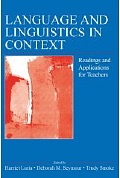 |
|
| Publisher: | Mahwah, NJ: Erlbaum | ||
| Pages | ISBN | Price | |
|---|---|---|---|
| Pp. vii + 427 | 0-8058-5500-9 (paper) | $49.95 U.S. | |
Overview
Harriet Luria, Deborah Seymour, and Trudy Smoke wanted to remake their introductory linguistics courses by “presenting readings from a variety of language fields that both introduce and clarify linguistic concepts” (p. xiii). This is exactly what they have done with Language and Linguistics in Context: Readings and Applications for Teachers, which contains over 30 chapters written by a variety of notable authors in the fields of Linguistics, Second Language Acquisition (SLA), Sociolinguistics, and Language Education, covering a range of language issues. Luria, Seymour, and Smoke’s book is divided into three units of eleven chapters each. Each unit starts with an introduction and ends with a series of questions about the ideas presented in the various chapters, an applicable teaching activity, and a list of relevant print and web resources for that unit. Likewise, each chapter ends with a short list of questions and an “Extending your Understanding” activity, as well as a list of relevant terms from the reading.
Unit 1
Authors appearing in the first unit, “What is Language and How is it Acquired?”, introduce, define, and build on important concepts relating to language acquisition, identity, and power, and discuss the issues critically.
| Chapter Author(s) | Title | Comments |
|---|---|---|
| Lila R. Gleitman | A Human Universal: The Capacity to Learn a Language | First language acquisition overviews with examples |
| Patricia K. Kuhl | A New View of Language Acquisition | |
| Susan Gass | Fundamentals of Second Language Acquisition | Introduces influential terms and theories and provides many examples |
| David S. Martin | The English-Only Movement and Sign Language for Deaf Learners: An Instructive Parallel | Overview of the English-only movement |
| Keith Gilyard | From “Let’s Flip the Script: An African American Discourse on Language, Literature, and Learning” | Debates teaching standard English to African Americans and Afro-Caribbean speakers of ‘Broken English’, as well as the importance of literature and multiculturalism in the language arts classroom |
| Ana Celia Zentella | Hablamos Spanish and English | Discusses the importance of teaching students the skills needed to facilitate code-switching |
| Josip Novakovich | This is no language. (Intimate Exile) | Three narratives on language and identity that bring to light the struggles non-native English speakers have with language and with being bilingual |
| Natasha Lvovich | Russian as a Second Language | |
| Meena Alexander | Language and Shame | |
| Ryuko Kubota | Unfinished Knowledge: The Story of Barbara | A concrete example of how your knowledge and attitude can affect your teaching |
| Alastair Pennycook | Sociolinguistics and Power | Critical theory in sociolinguistics |
Unit 2
Unit two, “How does Language Change?”, contains chapters covering topics such as the history of the English language and factors shaping language use.
| Chapter Author(s) | Title | Comments |
|---|---|---|
| Tamara M. Green | Language Families | A reference for the major families of human languages and the surviving branches of the Indo-European tree |
| R.L. Trask | Where Did English Come From? | Traces the history of the English language from Proto-Germanic to present day English |
| Charles Barber | The Norman Conquest | Brief discussion on how the Norman Conquest influenced the English language |
| Kate Parry | People and Language | Provides concrete examples of how language is acquired and can evolve through family and social interaction |
| Homi K. Bhabha | Queen’s English | Describes two speakers of non-standard English, touching on issues of judgment and prestige |
| Joshua A. Fishman | The New Linguistic Order | Discusses English dominance, globalization, regionalization, politics, and power |
| Chinua Achebe | The African Writer and the English Language | Argues that African writers should write in English rather than their regional language |
| Ralph W. Fasold | Ebonic Need Not Be English | Advocates that Ebonics should become a separate language in order to garner respect from linguists and other English speakers |
| John Edwards | Languages and Language Learning in the Face of World English | Discusses English dominance and the importance for English speakers to learn other languages |
| Deborah Cameron | Gender Issues in Language Change | Describes the role of women in linguistic change |
| James D. Armstrong | Homophobic Slang as Coercive Discourse among College Students | Reports on a research study investigating homophobic slang as used by male college students |
Unit 3
The third unit, “What is Literacy?”, builds on many of the ideas introduced in the previous two units, specifically language and power and how society shapes language use.
| Chapter Author(s) | Title | Comments | |
|---|---|---|---|
| Michael Newman | Definitions of Literacy and Their Consequences | Contains various definitions of literacy and advocates for a new way to think about literacy | |
| James Paul Gee | What is Literacy? | Builds on Krashen’s (1982) acquisition vs. learning distinction | |
| Lisa D. Delpit | The Politics of Teaching Literate Discourse | Encourages teaching the ‘dominant’ discourse to poor children and children of color | |
| Glynda Hull & Katherine Schultz | Literacy and Learning Out of School: A Review of Theory and Research | Calls for more research on students’ out-of-school literacy use and development | |
| A. Suresh Canagarajah | Understanding Critical Writing | Draws connections and makes distinctions between teaching literacy skills to both ESL students and native English speakers | |
| Sonia Nieto | Language, Literacy, and Culture: Intersections and Implications | Advocates student-centered learning and provides practical advice for ESL teachers | |
| Marianne D. Pita & Sharon Utakis | Educational Policy for the Transnational Dominical Community | Pushes for educational reform beyond bilingual education | |
| Gloria Nardini | Italian Patterns in the American Collandia Ladies’ Club: How Do Women Make Bella Figura? | Provides an ethnographic example of how culture impacts discourse | |
| Malini Ghose | Women and Empowerment Through Literacy | Focuses on issues of power and language while describing a literacy project in India | |
| Robert Ji-Song Ku | Confessions of an English Professor: Globalization and the Anxiety of the “Standard” English Practice | Describes the role of English in this English professor’s life | |
| Gary Tate, John McMillan, & Elizabeth Woodworth | Class Talk | Discusses issues of social class and encourages teachers to help their students talk about these issues |
Critique
This book has many strengths, most notably its comprehensive selection of quality readings. In particular, the balance of theoretical articles and personal narratives allows students to see the human side of issues such as language and identity, which can be very impersonal when presented in a strictly theoretical format.
The readings themselves are, for the most part, very accessible, with the exception of Kuhl’s chapter on language acquisition, which contains a high level of academic jargon. The inclusion of empirical studies, as seen in Nardini’s, Ghose’s, and Armstrong’s chapters, adds variety to the primarily narrative and theoretical chapters in the book, and the varying methodologies these authors use in their research would be of interest to any graduate student thinking of doing research on language usage. The book is most useful, however, for introductory linguistics or sociolinguistics courses, especially those offered within a teacher education program. Timely issues, such as the English-only movement and bilingual education, are introduced, which is useful for both those teaching K-12 teacher preparation courses and those who may become teachers in multi-cultural, multi-ethnic school systems. However, an in-depth view of SLA pedagogy is lacking, although the topic is mentioned briefly in many of the readings.
While the authors state that they use the book for their introductory linguistics courses, in the beginning of their book they also group the book’s chapters into alternative (to their unit) headings: second language acquisition pedagogy, the structure of language, and literacy. Such groupings are helpful for teachers who might consider using this book for a variety of courses. Also useful for teachers are the “Questions to Think About” and “Extending your Understanding” questions at the end of each chapter, which encourage students to reflect on concepts and ideas discussed in the readings and relate them to other readings in the book or their own views on language and/or language teaching. The list of “Terms to Define” following each reading encourages students to notice important words or phrases defined or discussed in the texts, such as pidgin, acquisition, and ESL/EFL/ESOL.
The end of each unit contains “Extending your Understanding and Making Connections” questions and “Applications for Teaching.” These segments encourage students to tie ideas from the unit together to create a more comprehensive picture of an issue, and use such ideas in their teaching activities. However, I felt that the guidelines for the “Applications for Teaching” were very broad, especially for pre-service teachers. Asking students with no prior teaching experience to, for example, “create a lesson plan for a second language class keeping in mind the second language acquisition theories and practices you have read about in the articles” (p. 124) can be daunting. Teachers using this book for a course will no doubt need to provide additional specifics on these assignments. The “Print and Web Resources” listed at the end of each unit provide easy reference to organizations such as the American Association for Applied Linguistics (AAAL) and agencies such as the U.S. Department of Education.
One noticeable deficiency of this book is its lack of research activities directly bearing on the readings: interaction with language in the form of small, hands-on research studies. Especially with regard to language acquisition, whether first or second, it is important for students to see for themselves the strategies learners use when acquiring language, how native and non-native speakers interact with each other, and how this interaction influences language acquisition. Similarly, students in a sociolinguistics course could observe a number of language varieties on their college campus and discover for themselves how social context influences the language that speakers use and hear. This type of interaction with language is seen very rarely in the questions and activities presented in the book and is something that, if included, would benefit both teachers and students.
This comprehensive selection of high-quality readings should stimulate and provoke thinking, what a compendium of perspectives should do. As a useful reference for issues germane to teaching, learning, and using English, both teachers and students in a variety of language courses could use it often to their advantage.
Reference
Krashen, S. (1982). Principles and Practice in Second Language Acquisition. Hayward, CA: Alemany Press.
Anne O’Bryan
Iowa State University
<aobryan iastate.edu>
|
© Copyright rests with authors. Please cite TESL-EJ appropriately. Editor’s Note: The HTML version contains no page numbers. Please use the PDF version of this article for citations. |