

December 2006 – Volume 10, Number 3
|
|||
| Author: | Uta Papen (2005) | 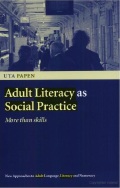 |
|
| Publisher: | New York and London: Routledge | ||
| Pages | ISBN | Price | |
|---|---|---|---|
| Pp. xii + 160 | 0-415-35377-7 (paper) | $39.95 U.S. | |
Papen’s book is motivated by the need to critically document the different discourses that surround the concept of language, literacy and numeracy (LLN), discuss their influence on policy making, and provide a brief introduction to LLN through an ethnographic lens. The book assumes no prior knowledge of the topic and will serve as invaluable background reading for both students and experienced workers in the fields of literacy, TESOL, social work, and other education programmes. The book is reader friendly on both an organizational and discourse level: the chapter aims are clearly stated, the tone is accessible, and all terms introduced are carefully defined and accompanied by practical examples. As an aid to further reading, a list of useful websites and journal titles is provided (for example, Journal of Literacy Research, Journal of Research in Reading, Literacy and Numeracy Studies).
The book consists of eight chapters within two sections: the first section provides theoretical background; the second outlines current and past literacy programmes in practice in Great Britain. Each chapter ends with four pages of selected readings, the majority of which are extracts from academic papers and policy documents. These are followed by a series of reflective tasks on the readings, which encourage a practical investigation into the chapter’s principal ideas and can well serve as student research topics.
Chapter one introduces the different understandings of literacy and the different discourses surrounding this emotionally and politically charged term. For example, within the political debate, literacy appears in the same contexts as discussions of changes to workplaces and technology leading to changes in employers’ educational demands. Deficiencies in LLN are correlated with social concerns such as unemployment, poor health, and social exclusion. Three distinct concepts of literacy are defined: functional, critical, and liberal. Functional literacy is primarily spoken of and measured in terms of identifiable skills required to perform efficiently in the workplace, and so, broadly speaking, contribute to the economic development of the country. Viewed as a set of discrete skills, LLN outcomes are readily measurable through testing.
The critical approach formulated by Paulo Freire views LLN in pedagogical and political terms from the perspective of empowering the oppressed to critically question the established discourses and so participate in a process of societal transformation. Literacy is thus viewed as a sociopolitical project. Lastly, the liberal tradition considers education as an individual’s right, and literacy is viewed beyond the limits of work-related and functional skills to embrace the wellbeing and personal development of all members of society.
A critical analysis of discourse allows us to unpack terms such as literacy (“deconstruct the ‘preconstructed’ notions”) and uncover underlying ideological assumptions. Papen introduces the idea of the power of discourses to determine who can speak about what, when, where, and with what authority, and how discourses influence the formation of beliefs. Further, discourses contribute to the social construction of identities: people have to define themselves as literate or non-literate according to the socially accepted understanding of the term.
Chapter two delves into the implications of the social practice view of literacy for setting policy and guiding practice in providing adult LLN and ESOL. The book’s central theme is debated here: the concept of literacy as a skill or as a practice. Literacy as a skill limits itself to the coding and decoding practices of the written word. Literacy as social practice (reading and writing) serves specific purposes and the existence of different ‘literacies’, each emerging from a different sociocultural context, are acknowledged. A practical example describes the scenario of buying a train ticket. This seemingly innocuous event involves various forms of literacy and numeracy, as well as an insider’s contextual knowledge of the sociocultural assumptions involved.
Chapter three explores dominant and vernacular literacy practices and the issue of power expressed by the degree of implicitness of text conventions, the language of texts, their layout and style, and the voices and choice of content. In addition, the chapter examines the dominance of particular literacy practices in certain domains, and how these, in turn, shape the interactions and objectives of the participants.
Examples of the power of texts include the practice of university essay writing as a dominant form of literacy in educational institutions (p. 45). Laden with implicit conventions, this test of social literacy can prove difficult to master. Similarly challenging, completing application forms sometimes involves a form of literacy requiring analytical skills to understand the hidden implications of some questions, serving as they do to regulate access to limited resources (p.46). In a further example involving doctor-patient interactions, the different roles that the interlocutors assume, in terms of their unequal access to texts and the right to interpret them, constitute a further expression of the power of a particular literacy; the domain serves to legitimize the knowledge to which the doctor has access (p. 47). Lastly, the topic of literacy and power is explored in terms of multilingualism (understood as the use of either different dialects or languages), where clearly unequal access exists to the privileged literacies (p.50). The reader will find the selection of examples of discourse practice from everyday life and the ensuing discussion illuminating as they provoke the reader to question the logic of certain routine behaviours, and shed light on the role of discourse practice in constructing and maintaining social inequality.
In chapter four Papen explores using ethnography to study literacy and inquires into the role this qualitative research method can play in the work and professional development of those active in LLN. Ethnographic research is presented as a close, in-depth, holistic examination of social activities as they occur in real life settings from the insider’s perspective through data compiled during interviews, observations, and document analysis. Since its original application in Malinowski’s field work in the Pacific, the method has been adapted to meet the needs of contemporary research and is now employed more selectively, focusing often on one aspect of the target culture as opposed to requiring participant observation of entire communities. It is sometimes used in combination with quantitative methods. This chapter is of particular interest to those wishing to pursue research into LLN as it provides a clear explanation of how one might conduct an ethnographic investigation.
Chapter five provides a historical perspective on the development of adult LLN and ESOL policy in Britain from the Middle Ages to the gradual, sporadic emergence of educational institutions in the 18th and 19th centuries, covering in the latter century the topical debates over the political consequences of the lower classes gaining literacy. Compulsory education in the early 20th century disguised literacy problems, and illiteracy was considered principally a concern of the developing world. Eventual recognition of a literacy ‘problem’ saw the eventual establishment of the Basic Skills Agency and the Right to Read campaign, both situated in the voluntary sector with part-time teachers and a flexible student-centered approach to teaching. From the 1980s, adult literacy was conceived more in terms of its contribution to the nation’s economic development. This led to the Higher Education Act of 1992 and the subsequent standardization of programmes now run through formal educational institutions, and oriented towards examinations and national qualifications (Numberpower and Wordpower). This chapter is an interesting summary of the development of a nation’s approach to LLN, which logically leads to a heightened awareness of the issues involved in the state’s present strategies and programmes. The non-British reader may come away curious to contrast these with his or her own country’s approach to LLN.
Chapter six describes the current context of adult LLN policy in England, in particular the Skills for Life programme. Chapter seven explores how Critical Discourse Analysis (CDA), chiefly Norman Fairclough’s CDA (2003) framework, can be employed to highlight the existence of presuppositions and claims in existing LLN policy. Chapter eight is a general summary of social literacy and ethnography, and exhorts teachers to enrich their understanding of LLN learners and conduct qualitative research to inform policy and practice.
Papen certainly achieves her aim: to illustrate how a view of literacy from a social practice perspective lends itself well to ethnographic research. Her message in support of a strongly reflective and participatory approach to research into literacy is convincing, as are the examples she uses to illustrate how theory and research can inform practice and vice versa. This text will undoubtedly prove its worth as a compilation of informative background reading for those anticipating working in LLN, as well as serve as an update for those experienced in the field.
Louisa Buckingham
Sabanci University (Turkey); Universidad de Granada (Spain)
<bucklj gmail.com>
|
© Copyright rests with authors. Please cite TESL-EJ appropriately. Editor’s Note: The HTML version contains no page numbers. Please use the PDF version of this article for citations. |