

March 2007 — Volume 10, Number 4
|
||||
| Author: | Roger Barnard and Antoinette Meehan (2006) |  |
||
| Publisher: | Oxford: Oxford University Press | |||
| Pages | ISBN | Price | ||
|---|---|---|---|---|
| Pp. v + 128 | 0-194538-17-6 (paper) | $17.95 U.S. | ||
|
||||
| Author: | Marjorie Rosenberg (2006) | 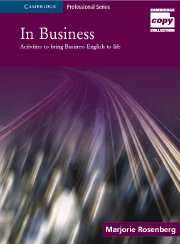 |
||
| Publisher: | Cambridge: Cambridge University Press | |||
| Pages | ISBN | Price | ||
| Pp. 96 | 0-521617-29-4 (paper) | $42.00 U.S. | ||
Both Writing for the Real World 2: An Introduction to Business Writing and In Business: Activities to Bring Business English to Life are designed primarily for pre-intermediate students of ESL. While each text offers a useful set of activities and tasks appropriate for a Business English course, neither text provides a comprehensive curriculum for such a course. Thus I position this review in terms of how these texts might serve as supplemental resources for a Business English class. Whereas Writing for the Real World 2 is intended as a complete textbook, In Business is a wide-ranging collection of exercises that can be used in any business writing course.
Barnard and Meehan’s book is a follow-up to their Writing for the Real World 1, but this second volume specifically addresses the kinds of tasks and texts generated in business contexts. The volume takes a task-based approach to teaching written business communication, focusing on common business tasks such as recommending, inviting, responding to orders, and discussing proposals. In these tasks students encounter typical business writing genres (such as email, memos, proposals, and several types of reports). The assignments follow the tenets of task-based instruction (as articulated by Willis [2004]): an organic process of language learning embodied in activities that focus on meaning and provide opportunities for learners to use the target language for real purposes.
Each chapter begins with a very brief list of learning objectives, followed by an example reading paired with comprehension and vocabulary exercises. A series of short activities follows (ranging from sentence completion tasks to matching and sequencing tasks that may serve as the initial basis for genre analysis assignments). Each chapter ends with more detailed writing tasks, many of which require interaction with classmates. Throughout each chapter appear eye-catching “language focus” call-outs that highlight specific vocabulary and grammatical structures appropriate for each lesson. Some of these “language focus” elements examine levels of formality used in various business situations. After each five chapters a review unit presents five activities that could serve as progress assessment tests, evenly spaced throughout a course.
One of the book’s features I find particularly useful is the way it endorses email as a primary workplace genre. Each chapter includes activities that require students to read and respond to (and often write) business-specific email communications. For example, chapter ten, “Complaints,” provides two emails, the first complaining about a product order and the second a response from the supplier, followed by a series of comprehension questions about those emails. Next is a series of exercises on the complaint and complaint-response genres and then opportunities for learners to practice these particular modes. This unit’s final writing task asks learners to write complaint letters (which may be print or email based), exchange the letter with a partner, and then write a response to the partner’s complaint letter. This focus on task-based instruction grounded in a genre approach to second language learning is a compelling approach to teaching Business English.
Writing for the Real World 2 also provides a handy reference section on pages 111-134, providing examples of formats for emails, letters, faxes, and reports; common features of written English (salutations, openings and closings); a brief overview of capitalization, punctuation, spelling, and abbreviations; and a brief overview of the differences between American and British English.
A strength of this book is the examples provided of both formal business genres and informal texts that reflect the full range of the social interaction in workplace cultures. The book also features a clean, engaging design and a sequence of activities that become progressively more complex. The authors also provide activities and assignments that engage all four of Savignon’s (2001) components of communicative competence (sociocultural, strategic, discourse, and grammatical context), although they do focus almost exclusively on written communication.
Although Writing for the Real World 2 appears to have been designed as a textbook that could meet the needs of a Business Writing class, it has some significant drawbacks. First, the text does not address students as users of the text: there is neither introduction nor pedagogical apparatus explaining the goals or methodological positioning of the text. Also missing are strategies for successful engagement with the text. For example, the text includes two pages of pair work dictation (with student A on one side and student B on the other), but there are no instructions or explanations of how to use this format [1]. Additionally, the examples in the text are not completely authentic: they invoke actual communication activities, but they are primarily pedagogically-designed examples rather than real-world samples. However, these drawbacks could be easily overcome by an experienced instructor (who could bring in authentic materials and also serve as a guide and facilitator for students as users of the text).
Rosenberg’s In Business: Activities to Bring Business English to Life, in contrast, is specifically aimed at teachers by supplying lesson plans with photocopiable activities to support a communicative approach to teaching Business English. A fuller range of communication activities (including oral presentations and telephone conversations) appears in this book, not one centered almost solely on writing. A goal of In Business is to promote elements of “fun and self-discovery” in the language learning activities of Business English students, based on the premise that these elements raise motivation and produce “longer retention of the material, leading to more effective learning” (p. 7).
Each lesson plan details the type of activity (e.g., role play, matching, information exchange, information gap activities) included. At the front of the text is a very useful “Map of the Book” that provides a chart that spells out each activity’s type, completion time, level, language focus, grouping (pairs, small group, whole class), and whether the lesson could be used in a one-to-one teaching context. The volume is spiral-bound, lending itself to simple and clear photocopying of the materials, and the lesson plans themselves are detailed and comprehensive, making them appropriate for both beginning and experienced instructors to use.
The second group of assignments, stressing the theme of organizations, provides lesson plans that work well within a genre-based approach to teaching English for Specific Purposes (where genre is seen as socio-rhetorical activity rather than based only on formal characteristics of document types; see Belcher [2006] and Bawarshi [2003] for a detailed explication of genre theory and second language instruction). For example, lesson 2.2, “Characteristics of Organizations,” uses a card-sorting and categorization activity to get students to examine various types of organizations (including private and public limited companies, public corporations, and non-profit agencies). Following this activity, learners are asked to “discuss the types of companies they work for . . . and decide which aspects of these firms [the organization types used in the activity] most closely apply to the companies they work for” (p. 20).
Rosenberg, in addition to providing activities for oral communication, includes units that focus specifically on marketing and finance as business fields, areas not addressed in Writing for the Real World 2. In fact, these two texts complement each other nicely, as each provides assignments and tasks missing from the other (primarily the difference in focus between written versus oral communication), and each also provides lessons that complement the activities in the other. These two textbooks, then, could form the basis of a Business English course for pre-intermediate to intermediate students, provided that the instructor takes care to bring in authentic materials (which, by the way, is one of the strengths of Grant and McLarty’s (2004) Business Focus Pre-intermediate Student’s Book, reviewed in TESL-EJ 9.2). While neither of these textbooks presents a comprehensive curriculum, each one provides well designed lessons and activities focused on the genres and personal interactions of business communication.
Note
[1] At the time of this review, the Teacher’s Guide for Writing for the Real World 2 was not provided to the reviewer; thus some of the important pedagogical support missing from the student text may be available to the instructor in that guide.
References
Bawarshi, A. (2003). Genre and the invention of the writer. Logan: Utah State University Press.
Belcher, D. (2006). English for specific purposes: Teaching to perceived needs and imagined futures in worlds of work, study, and everyday life. TESOL Quarterly, 40, 133-156.
Fang, F. (2005). [Review of the book Business focus pre-intermediate student’s book]. TESL-EJ, 9(2). Retrieved November 20, 2006, from http://tesl-ej.org/ej34/r1.html.
Savignon, S. J. (2001). Communicative language teaching for the twenty-first century. In Celce-Murcia, M. (Ed.). Teaching English as a second or foreign language (pp. 3-28). New York: Heinle & Heinle.
Willis, J. (2004). Perspectives on task-based instruction: Understanding our practices, acknowledging different practitioners. In Leaver, B. & Willis, J. (Eds.). Task-based instruction in foreign language education. (pp. 3-46) Washington, DC: Georgetown University Press.
Douglas Eyman
Michigan State University
<eymandou msu.edu>
|
© Copyright rests with authors. Please cite TESL-EJ appropriately. Editor’s Note: The HTML version contains no page numbers. Please use the PDF version of this article for citations. |