

December 2007 — Volume 11, Number 3
|
|||
| Author: | Rose M. Senior (2006) | 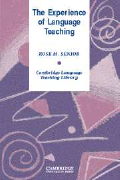 |
|
| Publisher: | Cambridge, UK: Cambridge University Press | ||
| Pages | ISBN | Price | |
|---|---|---|---|
| Pp. xiii + 301 | 0-521-61231-4 (paper) | $33.00 U.S. | |
The Experience of Language Teaching successfully takes the reader into the world of both experienced and novice language teachers. The book draws on five studies conducted over a 12-year period. The data were gathered through interviews with 101 native speakers of English. Thirty-eight percent of these teachers held the Certificate in English Language Teaching to Adults (CELTA); twenty-two percent held the Diploma in English Language Teaching to Adults (DELTA) ; four percent held both certificates, and eighteen percent of them had masters or doctoral degrees. Although at the time of the study the teachers were engaged in teaching adult English learners in the UK and Australia, they all had had overseas experience teaching in countries such as Malta, China, Japan and Argentina. In the last study, however, the author interviewed only native speakers of English who teach a foreign language, such as French, Japanese, Italian, Indonesian, German, or Spanish. The book is divided into 12 chapters of about the same length, and they all contain accounts of the teachers’ classroom practices from their own perspectives: sometimes through brief quotations but mostly in Senior’s words. She also generalizes based on her sample of language teachers. The chapters also contain a number of boxes in which the author provides suggestions for further reading, quotations from other authors to support insights provided by the teachers, and explanations of terms.
Senior creates her chapter framework based on the interviewed language teachers’ comments and insights in order to describe the experience of classroom language teaching. She opens by addressing why someone might want to become a language teacher and how, if they do, they gradually grow as a teacher. Then, she moves into the classroom and looks into student-teacher relationships, mainly those with adult learners. Next, she focuses on how language teachers balance pedagogic and social aspects of their classroom and how they maintain a successful learning environment. Later, she moves out of the classroom and looks at teachers’ worlds from another perspective: both the satisfactions and frustrations stemming from their profession. Finally, she presents a socio-pedagogic theory of classroom practice based on the experiences of interviewed teachers.
Early on, Senior describes the problems new teachers encounter in their teaching career, whether at home or abroad. She talks about “pull” and “push” factors. Those teachers in her interview cohort who completed their CELTA and DELTA courses were drawn into the profession for a number of reasons. Both young and older teachers see it as a “ticket to travel”, and women with young children have the opportunity to have a part-time job and remain in the workforce.
On the other hand, some from other professions are “pushed” into teaching because they have lost their jobs, or they have been bored with their current jobs and needed a career change. The author also talks about how novice language teachers develop professionally in time and become committed, reflective and self-directed learners and teachers. Many teachers said they take advantage of both formal and informal professional development opportunities, such as workshops and observing their colleagues. Many of them admit that these opportunities provided by their school have great influence on their classroom practices. Even the experienced teachers said that they are committed to ongoing development, and they do not rank themselves highly experienced since there is always room for improvement in their practice.
Another area that Senior covers is the diversity of learners in language classes. She refers to students as “raw materials” (her term or one of her informant’s? in any case it remains undefined). When students walk into a classroom on the first day, the teacher does not know what the mix of students will be: their countries of origin or their ethnic, linguistic and cultural backgrounds. Their past and current living conditions, learning expectations, personal circumstances, and personalities differ from those of their fellow students and their teacher’s. Collective opinion sees all these variables as unique ingredients that give each class a unique character.
But also touched upon is how these differences may create tension in class, a situation requiring teachers to be skilled in managing such potential conflicts. Some strategies and activities the experienced teachers use to manage difficult individuals or groups are offered. One example is a language teacher’s good intention to commemorate the dropping of the atom bomb in Japan in WW II in a class composed mostly of Japanese and Korean students. The teacher decided to end the lesson with a one minute silence so the class would remember the Japanese civilians who had died in Hiroshima. However, her good intention turned into a highly-charged situation when a number of Korean students pointed out that those Koreans who had been used as forced labor in Japan also died during the bombing; hence the tragedy was as much Korean as it was Japanese. ( At some point some Korean students packed up and left the class.) The teacher had to spend the rest of that class and the following lesson trying to rectify the situation by talking about how wars were tragic events for all nations and inviting everybody in class to share their viewpoints.
In the later chapters, the author emphasizes the importance of establishing a classroom rapport using icebreakers and of being, simultaneously, an approachable and professionally credible teacher. The relationship between teachers and their students cause a language class to function as a learning community with its specific and unique culture. In particular, the author describes the role of humor and teasing in class as a means to bring a class together. Teachers interviewed see humor as a way to draw people together, foster feelings of friendliness and unity since everyone is laughing. Examples are abundant of how teachers’ spontaneous jokes vitalize their classes and create a collective learning experience.
The author mentions the positive role of cohesiveness in group dynamics, but also cautions the reader that class cohesiveness may act as a coercive force pressuring individuals to act against their nature. In addition, she also mentions how paying attention to students learning needs and interests allows teachers to be flexible in terms of how to use textbooks and materials and make on the spot decisions in class to keep their students moving towards meaningful learning goals. One good example of this is one teacher’s on the spot decision to change the direction of the lesson. She had planned some pre-reading activities geared towards a specific grammar point; however, the students were so excited about the story that they were fighting against the activities wanting to find out the end of the story. Feeling the atmosphere in class, the teacher let the students’ excitement and engagement take control and turned the lesson into an intensive reading lesson rather than forcing them to do her pre-planned activities.
The author does not forget to mention both frustrations and rewards of being a language teacher. It shows how frustration can arise in schools driven by profit, which in turn may threaten job security. Low pay is also mentioned as a demoralizer, as is the public’s misconception of language teachers. This chapter is balanced by the testimony of language teachers stressing their freedom in the classroom and their professional and intercultural satisfaction since they have the opportunity to meet students from diverse cultural and linguistic backgrounds.
The final chapter presents a socio-pedagogic theory of classroom practice grounded in personal experiences of the teachers interviewed. In the first part, the author suggests that the key element controlling teachers’ instructional choices is balancing different aspects of their classrooms. She sees classroom as a complex organism that is in constant adaptation and change. Students and teachers in a classroom function together towards learning goals. Therefore, teachers both pedagogically and socially adjust their teaching practices in order to keep their class in a state of active balance. The author argues that based on the data she collected all classroom teachers value classes that “function as happy, responsive, cohesive groups” (p. 268).
The Experience of Language Teaching was very enjoyable to read, and has a substantial value for novice and experienced teachers, teacher trainers, researchers and administrators who would like to gain deeper understanding of language teachers’ world. However, since data were limited to only native speakers of English teachers in Australia and UK, the book excludes many other language teachers worldwide. Although I find that the chapters authentically capture the experiences of teachers, at times, they read like an advertisement for CELTA and DELTA programs because of the emphasis given to it. As an experienced and non-native ESL teacher, I was able identify with many points in the book. Therefore, I will dare to say it is not only native speakers of English who experience what is covered in this book. Non-native speakers of English have similar experiences in their teaching careers.
Aylin Bunk
Portland State University, OR
<abunk pdx.edu>
|
© Copyright rests with authors. Please cite TESL-EJ appropriately. Editor’s Note: The HTML version contains no page numbers. Please use the PDF version of this article for citations. |