

March 2008 — Volume 11, Number 4
|
|||
| Author: | Helmut Daller, James Milton & Jeanine Treffers-Daller, Eds. (2007) | 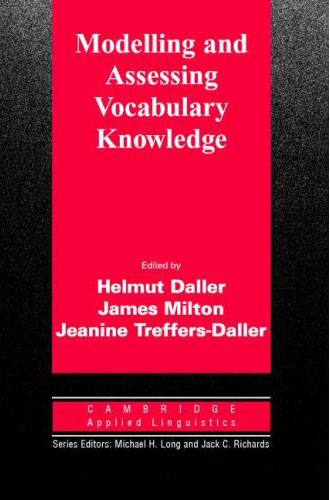 |
|
| Publisher: | Cambridge, UK: Cambridge University Press | ||
| Pages | ISBN | Price | |
|---|---|---|---|
| Pp. xiii + 274 | 978-0-521-70327-7 (paper) | £ £21.10; $41.00 U.S. |
|
As the introduction to this collection of papers points out, vocabulary research in foreign language teaching is far from the ‘Cinderella subject’ it was in the past; it is now recognised as both an important and extremely dynamic research area. Given this renewal of interest in the field and the rapidly growing number of contributions to it, Modelling and Assessing Vocabulary Knowledge is a timely publication. The central question addressed by the papers is how to assess the extent and richness of learners’ knowledge and use of vocabulary in a foreign language, given the multidimensional nature of lexical knowledge. This question has no easy answer, so we shouldn’t be surprised to find many different approaches in the studies presented. These studies are not all EFL/ESL focussed; a refreshing aspect of the book is that it pools insights from research into vocabulary learning in different languages.
One of the strengths of this book is how the initial chapters set a clear context for the studies that follow, with a very readable Editors’ introduction to basic terms and concepts. This opens up the book to readers less familiar with the topics. The introduction also includes detailed, but digestible, summaries of the studies in the remaining chapters. These capsules give an overview of the research and direct the reader to chapters of particular interest—a valuable function as some of the studies are comprehensive and contain a wealth of statistics which may be off-putting to the more casual reader.
By way of introducing the fundamental issues recurring throughout the book, Paul Nation in chapter 1 outlines the six main factors critical to accurately measuring vocabulary knowledge:
- learner attitude and individual variability
- appropriateness of frequency data
- the unit of counting used (word families/lemmas)
- language of instruction used in testing (L1/L2)
- the need to use multiple measures to reflect the multidimensional nature of vocabulary knowledge
- the need to use measures that focus on actual language use
The chapters that follow present the individual, very practical studies, which are situated in the ‘real world’ of language teaching and carried out by teachers/researchers trying to find answers to real problems. However, some of the studies are – necessarily – quite complex and technical, geared perhaps more to the specialist than to the general reader (and here’s where the summaries in the Intro can guide). They are grouped into sections reflecting Nation’s architecture as follows:
- vocabulary and learner differences
- the unit of assessment and multiple vocabulary measures
- metaphors and measures in vocabulary knowledge
- vocabulary measures in use
In the section on vocabulary and learner differences, Milton picks up on the paradox that test validity relies on the assumption that learners will behave in a reasonable and consistent manner, yet as we all know, learners in a test situation do not necessarily do so; they may be unmotivated and give up, or they may take a strategic approach, using guesswork. Such learner variability potentially compromises test validity. Milton’s study also investigates the assumption that there is a predictable relationship between word frequency and acquisition, i.e., learners learn the most frequent words first. This is important as many of the accepted tests of lexical size depend on this assumption. He concludes that this frequency model “appears to be a really very cogent model of learning as a whole” (p. 57), but that there is individual variation, particularly in the most frequent 2000 words, and this must be particularly considered with lower level learners. The following study by Eyckmans et al. examines learners’ response behaviour in yes/no tests in which learners explicitly report on their knowledge of given words. Following an extensive study considering whether a computer-based test can overcome validity problems, the researchers conclude that the validity of this format must be questioned, as it appears not to be suitable for all types of learners.
In the second section, Richards and Malvern begin by giving an overview of problems in vocabulary testing and discuss the now widely accepted need for multiple measures, going on to illustrate the model they have developed for assessing lexical diversity (D). Van Hout and Vermeer then compare measures of lexical richness, highlighting both the unsatisfactory performance of such measures and the need to draw on large-scale corpora for the frequency data they can offer. Fitzpatrick next looks at problems with tests, specifically Lex-30 (Meara and Fitzpatrick, 2000), a productive vocabulary test being adopted without sufficient validation. She also warns that in our zeal to find the perfect test, we may miss important insights that comparing performance on several tests might reveal, “about ways in which different learners might access lexical knowledge, information about the threshold at which receptively known items start to be used actively, the effect of different L1s on test performance and the relationship between aspects of word knowledge at different stages of learner development” (pp. 131-2). To conclude this section, the theme of lexical richness is taken up again in Chapters 7 and 8, this time in spoken language, with Tidball and Treffers-Daller exploring multiple measures in spoken French, and Daller and Xue looking at oral proficiency in Chinese EFL learners.
The third section moves from vocabulary breadth to depth. Both studies included address the concept of lexical networks. Wilks and Meara argue for a more formal approach to the vocabulary-network metaphor; their study applies graph theoretical principles to word association data. Shur also draws on graph theory, using small-world networks as a way of investigating word association networks.
The final section, looking at vocabulary measures in use, is perhaps most relevant to the working teacher. This begins with a Dutch school study by Hacquebord and Stellingwerf exploring the relationship between vocabulary knowledge and reading, followed by Lorenzo-Dus’s chapter stressing the importance of both quantitative and qualitative approaches in vocabulary research, as illustrated in her study of oral proficiency interviews in Spanish. Finally, Daller and Phelan look at teachers’ ratings of EFL essays, examining first their ratings on different linguistic aspects of the essays, then comparing these with the lexical richness of the essays according to three different measures (type token ratio, Guiraud’s Index, and D), in order to investigate how teachers may be influenced by lexical richness.
Modelling and Assessing Vocabulary Knowledge is a useful book. The introduction and initial chapter, with their summaries of basic terms and concepts and outline of fundamental issues are, an excellent starting point for the newcomer to the field. To those already conducting or embarking on such research, the detailed accounts of current studies are both informative and thought-provoking. However, since vocabulary acquisition is such a vast topic to explore, this book is necessarily limited. It follows the general research bias towards breadth in vocabulary studies, while the neglected area of vocabulary depth receives relatively little attention, and even this is from a particular viewpoint. Meanwhile, as the editors acknowledge (p. 9), fluency, or automaticity of access to lexical items, is not addressed in any of the studies. However, this too reflects the current state of research in the field, and it is hoped that future collections will redress this imbalance.
Rachel Allan
Applied Language Centre, University College Dublin
<Rachel_Allan alc.ucd.ie>
|
© Copyright rests with authors. Please cite TESL-EJ appropriately. Editor’s Note: The HTML version contains no page numbers. Please use the PDF version of this article for citations. |