

June 2008 — Volume 12, Number 1
|
|||
| Author: | Susan Stempleski (2007) | 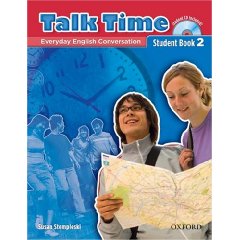 |
|
| Publisher: | Oxford: Oxford University Press | ||
| Pages | ISBN | Price | |
|---|---|---|---|
|
Pp. vii + 92 |
ISBN 978-0-19-439291-4 (Student Book with CD) | $20.95 U.S | |
Talk Time is a three level series of texts written by Susan Stempleski, an established author who has published several other ESL/EFL texts and resource books. For this review, I have examined the second level of the series. According to the author, the texts are designed for high beginning to low-intermediate students. Each level comes with three texts: a student book with CD, a teacher’s book, and a test booklet. In addition to the CD that accompanies the student book, there is a class CD (separate price) needed for the majority of class work. Although the text is written in American English, the CDs have a variety of English accents.
Even though the author never clearly states which age group she had in mind for her audience, her book appears to be primarily suited for young adults, as the pictures and topics center on this age group. There seems to be some attempt to address ethnicity, as the pictures and names represent various groups.
When looking at the table of contents, the reader will note that common themes–jobs, weekend activities, entertainment, hobbies, and travel–predominate. Moreover, on the next page, a more detailed table can be found which lays out each unit’s theme, and grammar and vocabulary focus. However, functions or other topics are not addressed. The text is oriented toward listening and speaking only, with the stated goal being developing fluency in spoken English. Students are supposed to find the material both fun and relevant, and where they can, express their feelings and opinions in response to it.
Each unit has two lessons, and each lesson has five parts: speaking, listening, grammar, conversation, and communication. There are a total of twelve thematic units, which according to the author should provide between 24 and 36 hours of classroom instruction. At the back of the student book is a unit by unit review quiz that tests each unit’s vocabulary and grammar focus. This is quite useful, especially when a teacher is rushed for time yet still wants to measure what students have learned by the end of each unit. Furthermore, each unit is independent, so there is no need to proceed in a linear fashion. If you have a class where students are sometimes absent, this lack of an incremental structure can accommodate that.
The second lesson of each unit has related vocabulary and grammar, but each lesson is self-contained. For example, Unit 4-Lesson 1 is entitled, “On the weekend.” Its grammar focus is on the past tense, and the vocabulary centers around the following activities: getting up late, going to a barbecue, going to a karaoke club, watching DVDs. Lesson 2, “On vacation,” has as its grammar focus, questions using the past tense. The vocabulary includes words one might use meeting friends, going camping, reading a book, visiting a museum, or seeing a movie. So while the lessons are independent, there is a loose theme that connects them within the unit.
The first activity in each unit is a warm-up, a speaking task. There are pictures that introduce the unit’s vocabulary, and a brief two-sentence dialogue as an example of what students are expected to learn. In addition, there is a bubble that illustrates briefly how a student might respond to a question. For example:
–What nationality are you?
-Korean.
or
-What do you do on vacation?
-I like to meet friends.
-What don’t you do on vacation?
The second activity is an identification task, either a ranking or multiple-choice exercise. The student listens, and then checks off what s/he hears.
The grammar-point focus is usually exemplified in a chart or table, then read aloud on the class CD, followed by students repeating what has been said. There are no formal exercises practicing any grammar points. On the other hand, the tasks that follow offer a free-form potential practice of the grammar points. For example, if the grammar of the verb “to be” is illustrated by “Are you Korean?” “Yes, I am/No, I’m not,” a more open activity follows, a conversation containing the usage of the verb “to be.” After practicing the conversation verbatim, the student is to create a similar conversation substituting their own information.
The conversation section is usually a brief dialogue and a picture. It can also be listened to on the class CD. Students just repeat the dialogue. The author suggests that some words could be substituted to vary pair practice. There is usually an extra bubble that offers students some additional ideas. Once again, these are usually brief tasks.
The communication task is often a group activity, but there is some pair work as well, both of which can take the form of various games, information gaps, surveys, and interviews. These are solid and useful classroom tasks. The tasks are sometimes personalized, with the content building on the grammar and vocabulary introduced in the unit.
The student CD that comes with the student book only provides listening for the conversation/dialogue sections. The class CD covers all sections except the communicative task, which has no listening element.
Beyond the student book, a test booklet comes with its own CD (also priced separately). Each unit has a conveniently designed test for scoring, with a transcript of the listening portion included. Each test takes about ten to twenty minutes to administer. Considering that many textbooks lack any kind of assessment, this is a big plus, especially welcomed I suspect by teachers with heavy workloads.
The teacher’s book comes with general guidelines for teaching vocabulary, listening and speaking–potentially useful for the novice teacher. In addition, there is also a unit by unit, section by section basic explanation to support the teacher. Supplementary handouts with directions can also be found, in the back of the book.
Talk Time is a listening and speaking book based on a task approach. It is very simple, and would be appropriate for those who need just a cursory exposure to basic conversational English. Scaffolding is minimal, which could be seen as a drawback. But if you like to supplement, this could be a positive feature. Another positive point is that the vocabulary is introduced in context, and there is plenty of review. Both the design and layout are pleasing to the eye–not too crowded, with plenty of charts and diagrams, as well as good pictures. And the quizzes and unit tests are quite teacher-friendly.
On the other hand, the listening material on the class CD is not authentic. The speakers are clearly trying to articulate what they are saying by speaking slowly, and therefore some of the language comes off as rather mechanical. Another drawback is the lack of attention drawn to pronunciation or intonation. Usually such textbooks would at least mention some of these points. Critical thinking skills and learning strategies are not addressed.
If your students are taking English as a requirement, then I would recommend Talk Time as a basic oral communication text.
Louis Butto
Hyogo Prefectural University, Japan
<louisbutto yahoo.com>
|
© Copyright rests with authors. Please cite TESL-EJ appropriately. Editor’s Note: The HTML version contains no page numbers. Please use the PDF version of this article for citations. |