

June 2008 — Volume 12, Number 1
|
|||
| Author: | Josephine O’Brien (2007) | 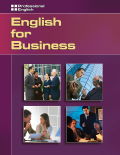 |
|
| Publisher: | Boston: Heinle / Cengage | ||
| Pages | ISBN | Price | |
|---|---|---|---|
|
Pp. iii + 106 |
ISBN 978-1-4130-2050-2 | $20.95 U.S. | |
Designed for intermediate level college students, English for Business is part of a five volume English for Specific Purposes series geared toward short term, intensive courses or specialized modules that help students prepare for using English in professional settings. With five units divided into thirty two-page lessons, plus team projects, review lessons, and vocabulary and grammar review sections in the back of the book, the text covers the following general business topics:
- Making your way: Time to make a decision, Following through, Filling out forms, Preparing your resume, Sending it all off, Finally, it’s time for the interview
- Selling is what it’s all about: Have you got what it takes? How do you do it? Sales have increased by 20%, Dealing with the customer, Dealing with complaints, Buying and selling on the Internet
- Marketing the product: Telling the world about your product, Brands, Finding out what appeals to the customer, You, too, can do it-having a plan, Getting it together and understanding it all, If you can make it, they can fake it
- Financial matters: Keeping a record of personal expenses, Starting out, Managing expenses, Economic issues, Investments, Changes in the way we do things
- Global concerns: Cultural issues, Corporate culture, Workplace changes, The other side of modern business, Global concerns in the business world, Ethical trading
The text uses an integrated skills approach to help students develop self-confidence by incorporating a bottom up (Savignon, 2001) sequence of activities to first, introduce the topic through discussion questions; second, present grammar and vocabulary related to the topic; and lastly, use the knowledge gained to complete written or spoken activities with group members. Grammar supplements and a glossary are arranged to correspond to the units’ order in the text and can be used to extend the lessons and aid students in grasping the content.
While unit review exercises provide a recap of specific material in the unit, team projects at the end of each unit are intended to help students synthesize the information and learn teamwork skills through a task that requires working in a group to research and present a project that incorporates listening, speaking, reading, and writing skills. For example, the task for unit 4, “Financial matters,” asks students to prepare a report about a retail store’s credit services and includes the following activities:
- Choose two or three large department stores that operate in your town or city.
- Find out as much as you can about how their credit cards operate.
- If possible, make appointments to speak with people from the relevant finance and credit departments.
- Find out the risks involved in doing business this way.
- Find out what abuses of the credit system can occur and what sort of losses can be incurred.
- Find out about any insurance and protection measures that have been implemented.
- Present your findings to the class.
The design of English for Business is simple, incorporating a two-tone burgundy and grey layout with textboxes to highlight vocabulary and certain activities and enough black and white visuals to break up the monotony of the page without distracting from the content. While each page has three to four activities, easy to understand symbols denote listening, speaking, and writing tasks, making each activity type clear for students. Each page also gives students a fair amount of room to write answers to questions and make notes.
Activities in each lesson require students to complete either collocation sets, sentences or charts, and write short answers to or discuss challenging questions, which together make the text suitable and stimulating for a variety of learning styles. Writing and speaking activities at the end of selected lessons in each unit give students an opportunity to use what they have learned by writing reports and delivering oral reports. Reading is confined to short, one to three paragraph realistic texts such as memos, job announcements, or short news articles, with comprehension and analysis activities following each. Listening tasks use one to three minute workplace conversations or lectures in a variety of accents and exercises to check comprehension or answers to some of the vocabulary activities. The speaking activities interspersed throughout each lesson provide an opportunity to practice incorporating new vocabulary and forms into short conversations or to share opinions with other students.
While English for Business combines implicit grammar and explicit vocabulary activities to familiarize intermediate level students with each lesson’s topic and reinforce important points, students seriously preparing to work in the business world might benefit more from a text that focuses as much on language output as on analysis and recognition. While giving students opportunities to read, listen, and complete spoken and written exercises related to the lessons, the text fails to provide an ample amount of tasks in each unit that would actually be of use in a real world business situation. For example, the first unit, “Making your way”, covers understanding job advertisements and job hunting techniques, simple job related telephone conversations, filling out forms, preparing your resume, cover letters, and interviewing. The focus is on analyzing the processes to complete each task, while performing actions like writing a resume, having a telephone conversation, or filling out a sample form are presented as asides at the end of a lesson, if at all. On the other hand, the team projects, such as the one outlined earlier, are hands-on, with the goal of bringing together the elements presented in the preceding lessons and teaching teamwork skills.
Overall English for Business provides a good, general introduction to using English in business situations through its integrated approach. Since most of the activities can be completed in pairs or small groups with little direct intervention from the instructor, the text should work as is in large classes. In a small class setting, the instructor can use supplementary photocopiables to extend reading, writing, grammar, and speaking exercises or add more individualized activities, making the class more output focused and relevant to real-world business situations, or students’ specific needs.
Reference
Savignon, S. J. (2001). Communicative language teaching for the twenty-first century. In M. Celce-Murcia (Ed.), Teaching English as a second or foreign language (pp. 13-28). Boston: Heinle.
Wendy M. Gough
St. Mary College/Nunoike Gaigo Senmon Gakko, Nagoya, Japan
<gisellenolet hotmail.com>
|
© Copyright rests with authors. Please cite TESL-EJ appropriately. Editor’s Note: The HTML version contains no page numbers. Please use the PDF version of this article for citations. |