

June 2008 — Volume 12, Number 1
|
Teaching Chinese, Japanese, and Korean Heritage Students: |
|||
| Author: | Kimi Kondo-Brown & James Dean Brown, Eds. (2008) | 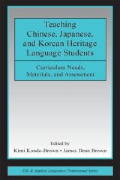 |
|
| Publisher: | New York: Routledge | ||
| Pages | ISBN | Price | |
|---|---|---|---|
| Pp. xvi + 346 | ISBN 978-0-8058-5878-5 (paper) | $35.00 U.S. | |
With 12% of the U.S. population foreign-born and the number of students from East-Asian backgrounds in schools across North America increasing, it is essential now more than ever for teachers to understand the needs of learners of Chinese, Japanese, and Korean ethnic heritages. Defining heritage language (HL) learners as those “who have acquired their cultural or linguistic competence in a nondominant language primarily through contact at home with foreign born parents and/or other family members” (p. 3), the editors maintain that foreign language education for HL and non-HL learners differs in significant ways. Focusing on current attempts to meet the needs of those of East Asian ancestry learning their ancestral language while residing in the West, this volume concentrates on three themes: curricular needs, teaching materials, and assessment. After summarizing how each is addressed, I will evaluate the volume as a whole.
Curricular Needs
One point emphasized by the 16 authors of this 12-chapter text is that HL learners are far from a monolithic group. Whereas some can operate effectively in their HL and English, a large portion are English-dominant partial bilinguals, with a smaller portion the converse. Alarmingly, a few HL learners lack proficiency in any language and could be termed “semi-lingual”. The curricular needs of these various groups vary considerably and few educational systems are equipped to meet the needs of all groups.
Another point underscored is that HL and non-HL learners seem to benefit from different types of instruction since their proficiency levels, processing styles, cultural backgrounds, and interests generally differ. For such reasons Kim (p. 99) cautions that teaching both groups simultaneously seldom serves the needs of either.
Not surprisingly, there is ample discussion of separate tracking for HL and non-HL students. Surveying 12 HL and 30 non-HL university students, Kondo-Brown and Fukuda (p. 125) point out how the two groups are sufficiently different to merit separate tracking. Despite the possible value of this, it’s often financially untenable. Yu (pp. 191, 192) therefore describes ways to accommodate HL and non-HL groups in one class by giving separate homework assignments, and providing individualized CALL instruction and peer-mentoring
Teaching Materials
With most foreign language textbooks designed for non-HLs, HL students are often unsatisfied. More challenging texts about topics such as the lives of Asian immigrants in the West are of special interest to many HL learners. Since HL learners frequently know vocabulary outside their textbooks, teachers need to be especially careful. Instead of discouraging them from applying their familial knowledge, Weger-Guntrap (p. 228) thinks teachers should acknowledge the wealth and diversity of linguistic information HL learners bring to class.
One cost-effective alternative to developing printed textbooks is to use web resources for HL learners. Wu (pp. 289-291) mentions some interesting online Chinese texts, accessible at http://ml.hss.cmu.edu/courses/suemei/82-337/. Internet keyboard chat rooms are another viable resource.
The mismatch of textbooks to the learning context is not limited to universities. Surveying 1,591 elementary and junior high school students at four one-day-a-week “supplementary schools” for Japanese HL learners, Kataoka, Koshiyama, and Shibata (pp. 48, 49, 67) found the texts used in such schools largely inappropriate because they were designed for students in school five to six days a week. This point was echoed by Douglas (p. 241), who warned that if materials are not well-integrated into the overall curriculum, demotivation is apt to occur. Since these schools are funded by the Japanese Ministry of Education, Sports, & Science and all textbook decisions are made by bureaucrats in Tokyo, it seems unlikely that special textbooks for HL learners by non-Japanese publishers will be adopted any time in the near future.
Assessment
The issue of how to screen HL learners in language programs is considered in depth. As HL learners often come from heterogeneous backgrounds, placement is prone to be tricky. Since the passive listening skills of many HL learners are often quite high, placement mistakes are common. Instead of relying solely on MC tests for placement, Kondo-Brown (p. 37) suggests careful oral diagnostic testing and essay writing evaluations for university placement. Due to the lack of validation of many children’s tests, it is much harder to make a recommendation.
Overall Evaluation
This volume has three strong points. As the first book on HL learners from East Asian backgrounds in English, many of the studies herein are pioneering. The large-scale study by Kataoka, Koshiyama, and Shibata in Chapter 3 is especially significant. Second, this book offers a good blend of theoretical and practical essays. Leading ideas about motivation, identity formation, and SLA acquisition are well-balanced with practical information about what language teachers do in class. Finally, by focusing on three groups of East Asian language learners together readers can notice the marked similarities that Chinese, Japanese, and Korean language classes share.
This volume is not without drawbacks. To tighten the focus, at times I wished that the editors had offered separate books on HL education for children and for university HL students. Second, the quality of the quantitative studies varies considerably. The study by Kondo-Brown and Fukuda (Chapter 6) is particularly sophisticated, analyzing dependent variables, power, and effect size when comparing NL and non-HL groups. In contrast, Yu’s study (Chapter 8) mentions only mean, max, min, and S.D., claiming, “Due to the relatively small sample size in this study, only descriptive statistics . . . were used” (p. 195). However, his sample size (n= 43) was actually larger than the one in Chapter 6 (n=42), making it hard to believe that limited sample size was the sole reason for the lack of sophisticated statistical analyses. Finally, it could be said that this book has an American focus. Nearly all of the studies are about students with East Asian backgrounds living in the U.S. Hopefully, at some point in the future a more global account of East Asian HL learners will be published.
Despite these concerns, this book provides a much needed contribution to the understanding of East Asian HL learners. Indeed, much of this work is relevant to foreign language educators in general. Those interested in needs assessment and curriculum development will particularly enjoy this text.
Tim Newfields
Toyo University Faculty of Economics, Japan
<newfields55 yahoo.com>
|
© Copyright rests with authors. Please cite TESL-EJ appropriately. Editor’s Note: The HTML version contains no page numbers. Please use the PDF version of this article for citations. |