

June 2008 — Volume 12, Number 1
|
|||
| Author: | Peter C. Murrell, Jr. (2007) | 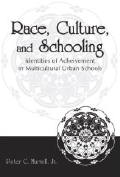 |
|
| Publisher: | New York: Routledge | ||
| Pages | ISBN | Price | |
|---|---|---|---|
| Pp. xvii + 180 | ISBN 0-8058-5538-6 (paper) | $24.50 U.S. ; | |
In recent years, the community-of-practice perspective has emerged as an increasingly popular approach for deconstructing the social and cultural dynamics that impact student participation and learning within educational settings. While the individual student within this community generally remains the motivation for and focus of investigations into learning, the analytical lens appears to have widened to consider the role that the learning environment can play in facilitating and/or inhibiting opportunities for students to meaningfully participate.
Race, Culture, and Schooling is a thoughtful examination of the tendency among schools, particularly those in large, urban settings, to underserve “students of color” by failing to create or support meaningful opportunities for participating in school practices. Rather than continuing to widen the lens, Murrell focuses it more sharply on the interaction between underserved students and the educational environments within which they participate, or, in many instances, fail to participate. Murrell argues that students are underserved when schools fail to create environments where students are motivated or encouraged to participate, primarily because the learning is not made meaningful. Of critical importance, Murrell suggests, is the development of students’ academic identities so that they can successfully “symbolize themselves in the cultural scenes that matter in the school” (p. 64). Murrell offers his “Situated-Mediated Identity Theory” as a framework for better understanding this identity development and its relationship to academic success within the educational community.
The Situated-Mediated Identity Theory, around which the book is structured, is based on six guiding principles:
- Identities are socially constructed.
- Identities are dynamic.
- Individuals assume roles within a community.
- Roles taken in academic contexts influence school success.
- When situated identities are shared, a local culture is established that influences identities and performance.
- School success can be achieved if/when the local culture seeks to build positive academic identities.
Essentially, Murrell suggests that student achievement is an activity occurring within a community, and that “school success is achievable for all students when learning is understood as the acquisition of a set of preferred cultural practices” and as we come to see teaching and learning as the “socialization of these cultural practices in educational settings” (p. 34). He argues that, as educators and students, we are all valuable members of this community and that we are all responsible for understanding how our position or sense of worth in the community has the potential to impact others’ position or sense of worth. The specific challenge for educators, therefore, is to develop a more reflective and responsive approach to the educational environment we create, and to the students with whom we share this learning space.
Murrell’s capacity to compel readers to evaluate (or reconsider) their relationship to the school cultures they inhabit is one of the great strengths of the book. I found myself cringing as he described several incidents between faculty and students, hoping that such incidents had not actually occurred, yet certain the interactions he portrayed were possible. Murrell’s description of a young practicum student who spoke of desperately trying to find ways to help unmotivated students “keep trying” so they can “get over” or “get through” material reinforced the notion that many educators are failing to connect students with course content in meaningful ways (pp. 11-12). And that we are accepting (and even promoting) students’ perceptions that academic tasks are obstacles successful students merely figure out how to get over.
While on the one hand it seems promising that the practicum student was eager to keep students from giving up, Murrell points out that teacher education must do more to equip new (and experienced) educators with tools to recognize and develop the academic strengths and cultural capital students bring to the classroom. It is not enough to help students get through the content, or over the obstacle that some think learning is. Murrell recommends that teachers must reconsider how to make content meaningful to students by determining how schools are failing to serve students and creating environments more responsive to identities, positioning, and interactions among participants in the educational community.
Murrell suggests that multicultural education and culturally relevant pedagogy have failed to effectively support teachers in applying that cultural knowledge in teaching and learning environments. Although Murrell suggests a critical difference distinguishing his theory from others is the “animation of theory into practice” or the “action theory” embedded in his framework (p. xiv, xv), he does not seem to offer substantial insights into how teachers would actually develop the tools necessary to create a reflective and responsive community. So, although Murrell delivers a strong presentation of theory that could be effective in motivating change, he left me, as a reader and teacher educator, eager for more substantial guidance as to how this change might be realized.
While it is understandable that a reader cannot expect a single prescription for implementing Murrell’s Situated-Mediated Identity Theory, or practicing cultural mapping, as a teacher educator I wanted some guiding questions, additional scenarios to consider, or even recommended fieldwork for directly applying the theory. For example, Murrell included short transcripts from an old Frontlines special titled “School Colors” as well as a “critical episode” (p. 152) from the opening scene of the film Boyz in the Hood in the final two chapters. These excerpts and Murrell’s discussion of how he used the excerpts in workshops promoting cultural competence provided glimpses of how scenarios could be used to support a stronger understanding of his theory. As such, they left me wishing more examples and discussions of this nature had been incorporated into the text.
Race, Culture, and Schooling is divided into two parts. The first part provides an overview of the theoretical foundations of situated-mediated learning. The second part is designed to provide insights into the framework’s application. While there appeared to be a disconnect between what Murrell described as a text with a “decidedly educational flavor” (p. xiv) enabling teachers, counselors, and a range of practitioners to “fulfill the function of secondary socialization” (p. xv) and the often dense presentation of theory and terminology, the book nevertheless stimulated reflection about what it means to act effectively as an educator in today’s classroom communities. To varying degrees, it also addressed the following questions:
- How does identity influence achievement, particularly among “children of color?”
- What do educators and other adults in influential situations need to be aware of in terms of identity and the context in which identity is developed if they are to create positive environments for learning?
- What should these environments look like?
Despite its many strengths, it was difficult to identify an ideal audience for this book. Clearly the topic is highly relevant for anyone working in educational settings. However, from my experiences, few pre-service teachers have the background experience that would make the material accessible and readily applicable, although reading the text would certainly guide them in establishing a foundation mindful of the necessity of cultural competence in education. Beyond that audience, Race, Culture, and Schooling would likely contribute to critical discussions among educational professionals with an interest in and at least basic knowledge and/or coursework in social and cultural theories of education.
Lindsey Hillyard
Flagstaff Unified School District, Arizona;
Northern Arizona University
<lhillyard fusd1.org>
|
© Copyright rests with authors. Please cite TESL-EJ appropriately. Editor’s Note: The HTML version contains no page numbers. Please use the PDF version of this article for citations. |