

December 2008 — Volume 12, Number 3
|
|||
| Author: | Jane Spiro (2007) | 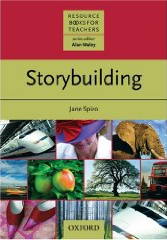 |
|
| Publisher: | Oxford: Oxford U. Press | ||
| Pages | ISBN | Price | |
|---|---|---|---|
| Pp. 164 | 978-0-19-442193-5 (paper) | $19.95 US | |
Stories have been a popular staple of language teaching for several decades. In the past, books for language teachers such as Morgan and Rinvolucri’s Once Upon a Time and Andrew Wright’s Storytelling with Children and Creating Stories with Children have used storytelling as their focus. Storybuilding is an Oxford resource book for teachers that can help guide students towards writing and sharing their own stories. This book is unique in that it is the first one directed at adult and teenage students, giving both a myriad of ways to create their own stories.
In the book’s introduction, the author gives an overview and also addresses some concerns teachers might have about using stories in the classroom. For teachers who fear that their students will consider the activities too childish, she reminds the reader that many stories reflect aspects of the real world, and a good story allows us to reflect on that world in ways that historical narratives cannot. For teachers and students who say they are not imaginative, she explains that one does not need a vivid imagination to tell a story, as many stories come from sources all around us, such as news stories, people we met briefly, and answers to problems. The activities in this book explore many of these everyday story sources and guide teachers in showing their students how to develop them into stories.
The book has an engaging structure. The first few chapters introduce the main aspects of a story, such as plot and setting, and later chapters introduce other important elements of storytelling, such as how to perform a story and how to edit a finished story.
Here’s a breakdown of the chapters:
| Chapter | Focus | Sample activity |
| One | Story building blocks (overview of main topics) | Producing a list of the main ingredients of a story |
| Two | Sources of stories | Using a picture as a prompt for writing a story |
| Three | Story stars (characters) | Listing adjectives to build up the description of a character |
| Four | A sense of place (setting) | Describing a setting using all five senses |
| Five | Something happened (plot) | Telling a story about leaving home |
| Six | Pattern stories | Using a chart of sentence frames to tell a story |
| Seven | Voices in stories | Composing a story through diary entries |
| Eight | Story games | Performing a story through mime |
| Nine | Performing story | Using sound effects to highlight the telling of a story |
| Ten | Publishing stories | Editing a story for characterization |
The book also features an appendix, which contains lists of generative plots, character types, and story types. Storybuilding concludes with an extensive reading list of books and websites for teachers who want to learn more.
One thing I like about the activities in this book is that they appeal to students’ creative side. Students who are fond of using language to produce something fun and entertaining will enjoy these activities. One good example is the activity titled “Changing time zones: Blue Denim and the security guard” from Chapter Four. In this activity, students are asked to take a familiar story, such as Red Riding Hood, and give it a 21st century setting. This activity gives students a lot of opportunities to use their imagination in rewriting the story.
Another winning aspect of the book is that Spiro constantly addresses language learning. For teachers who want to emphasize grammar and parts of speech in their classes, many of the activities have a specific language focus. For example, in the activity in Chapter Five, “The quest: the shepherd and the pyramids”, two language structures are listed: adverbial phrases of place (such as over and under) and “because” clauses. In addition, in the book’s introduction the author mentions several ways in which the book’s activities can help students develop their language skills.
Currently, I’m teaching a grammar course and was assigned a coursebook that predominantly features exercises asking students to fill in the blanks in decontextualized sentences. I’m planning to modify some of the coursebook’s activities based on Spiro’s in order to give my students meaningful use of the structures they’ve been learning. I expect they’ll find it a refreshing change of pace.
One more of the book’s strengths is its wide range of activities. Some activities would work well with elementary level students, an example being “Story stars: people in stories, people in life” from Chapter Two. In this activity students describe people in their own lives, and then use their descriptions to create a character. Other activities would be ideal for intermediate and advanced level students. “Editing for stylistic variety: Alphonse’s story”, from Chapter Ten, is one: students take a story and rewrite it using different sentence types, as well as coordinate and subordinate clauses. Storybuilding also contains stimulating kinaesthetic activities, such as “Mime a conversation” from Chapter Nine, where students attempt to use body language to get across a conversation. However, the book also features more sober, introspective activities, such as “Comfort and discomfort zones: the elephant in the bus station”, from Chapter Four, which asks students to close their eyes and imagine they are the story’s main character.
Storybuilding is a clever resource book, perfect for teachers and students who appreciate a good story.
References
Morgan, J. & Rinvolucri, M. (1984). Once upon a time: Using stories in the language classroom (Cambridge Handbooks for Language Teachers). Cambridge: CUP.
Wright, A. & Maley, A. (1997). Creating stories with children. Oxford: OUP.
Wright, A. & Maley, A. (1995). Storytelling with children. Oxford: OUP.
Hall Houston
Kainan University, Taiwan
<hallhouston yahoo.com>
|
© Copyright rests with authors. Please cite TESL-EJ appropriately. Editor’s Note: The HTML version contains no page numbers. Please use the PDF version of this article for citations. |