

December 2008 — Volume 12, Number 3
|
|||
| Author: | Keiko Koda, Ed. (2007) | 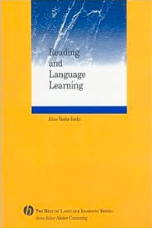 |
|
| Publisher: | Oxford, UK: Blackwell | ||
| Pages | ISBN | Price | |
|---|---|---|---|
| Pp. iv + 300 | 978-1-4051-7574-6 | £19.99 GBP | |
Reading and Language Learning is based on the relationship between knowledge of a language and reading. As the editor, Keiko Koda, says on the back cover: “reading necessitates linguistic knowledge [and] reading ability enhances linguistic knowledge expansion.” According to Koda, reading is a complex and multifaceted skill. The chapters in the book address some aspects of this skill, or what Koda calls “sub-skills,” emphasizing each one’s relevance and also stressing reading as a full construct. She has put together six significant papers that appeared in Language Learning between 2002 and 2005 and were later published in 2007 as a supplement to issue 57 of the same journal. Chapter 1 serves as Koda’s introduction.
In it she intends to shed light on current reading research and, in particular, explore its relationship with second language acquisition and what the constraints that influence L2 reading are within and across languages. The author states that these relations are sophisticated because reading is a complex construct in which goal language and mother tongue interact and interfere (p. 28). To address these constraints across operations in both languages, it is necessary to approach analytically the different aspects of this mental information-processing: linguistic knowledge in decoding, linguistic knowledge in text information building, linguistic knowledge in reader model building (the mental schema). According to the author, reading analysis requires not only identifying these components but also doing so in the learner’s L1 and L2. Next, this chapter addresses future directions in L2 reading research: (1) expanding and addressing more reading subskills, (2) exploring dual-language involvement, and (3) considering a wider variety of learners according to their L2 learning stage. Lastly, Koda announces how she selected the contributions that follow: “each represents a new approach to exploring critical issues in L2 reading” (p. 31).
According to Ellen Bialystok, in chapter 2, bilingual education looks at literacy from three research angles: competence with the oral language, understanding of symbolic concepts of print, and establishment of metalinguistic awareness. She also considers the research contributions and research implications for each of those skills, which are related to (but not the same as) the skills required by monolingual children to become literate. This chapter’s main goal is to observe whether these three skills are developed differently in monolingual and bilingual children.
The third article, by Hossein Nassaji, addresses knowledge representation in the mind and the role of comprehension and interpretation in discourse. Although major findings have emerged in the field of L2 reading lately, they are usually associated with Schema Theory [1], which Nassaji critically revises in the first part of his article. Afterwards, the author presents the construction-integration model of discourse comprehension (pp. 88-92)—and its application (pp. 92-101)—which “offers a fundamentally different and more detailed account of the role of knowledge and knowledge-based processes that L2 researchers had previously tried to explain within schema-theoretic principles” (p. 79).
The following chapter, by Marie Stevenson, Rob Schoonen and Kees de Gloper, is a study that compared two competing hypotheses about L2 reading: inhibition and compensation. The inhibition hypothesis states that in foreign language reading the lack of fluent linguistic processes inhibits the amount of attention devoted to conceptual processes. “In contrast, the compensation hypothesis states that readers in a foreign language are able to skirt around comprehension problems by actually devoting more attention to global, conceptual reading processes” (p. 115). The study compared the reading strategies of 22 Dutch high school students of EFL, using “a three-dimensional classification scheme that entails the following: Orientation of Processing; Type of Processing; and Linguistic Domain of Processing” (pp. 115-116).
The following chapter, “The Relationship between Text Comprehension and Second Language Incidental Vocabulary Acquisition: A Matter of Topic Familiarity?” by Diana Pulido, focuses on vocabulary learning in adult L2 reading comprehension processes. The paper also addresses the issue of previous knowledge, in this case in the relationship between passage comprehension and lexical input processing. Pulido concludes that L2 readers engage in more processing activities (specifically in subskills such as pattern recognition, letter identification, and activation of prior knowledge while reading) than they do in their first language.
In the last chapter, “Commonalities and Differences in Word Identification Skills among Learners of English as a Second Language,” Min Wang and Keiko Koda report on their study of word identification between ESL students from different language backgrounds (18 Chinese and 16 Korean students enrolled in the English Language Institute of the University of Pittsburgh). These English learners showed faster and more accurate naming performance with high-frequency and normal words than in the opposite kind.
Even though this book is a collection of previously published papers (except for Koda’s introductory survey of newer reading research), they may still be of interest–but they certainly are not new. Nevertheless, the reader can appreciate them in light of their having been fundamental material for other articles published after them. For instance, Koda has continued with research on the orthographic effect of L1 in L2 (Hamada & Koda, 2008) and Bialystok in cognitive control and age in bilinguals (Bialystok, Craik, & Luk, 2008; Craik & Bialystok, 2006). As a stimulus for future research, this article collection might serve as an introduction to the state of the art in cognitive processing in L2 and as a basis for further study. The research presented in the book has been commonly accepted as sound and has had great impact. As such, the book may also be used as a reference volume for those thinking of contributing to research in the field of L2 reading as well as for reading teachers hoping to apply the researchers’ insights in their own classrooms.
Note
[1] This theory is based on the fact that comprehension is preceded by a reader’s knowledge of the world and so readers understand reading (and communication) in light of their own previous experience and knowledge (Anderson, 1984). This connection is activated by the first part of a text (Wallace, 1992). Previous knowledge is considered of two kinds: ‘content schemata’ (background knowledge of the world) and ‘formal schemata’ (background knowledge of rhetorical structure). But it is also affected by the context (Swales, 1990). [This is a summary of the introduction of Stott, 2001; the citations are his.]
References
Bialystok, E., Craik, F., & Luk, G. (2008). Cognitive control and lexical access in younger and older bilinguals. Journal of Experimental Psychology: Learning, Memory, and Cognition, 34(4), 859-873.
Craik, F. I. M., & Bialystok, E. (2006). Cognition through the lifespan cognition: Mechanisms of change. Trends in Cognitive Sciences, 10, 131-138.
Hamada, M., & Koda, K. (2008). Influence of first language orthographic experience on second language decoding and word learning. Language Learning, 58(1), 1-31.
Stott, N. (2001). Helping ESL students become better readers: Schema theory applications and limitations. The Internet TESL Journal, 7(11). Retrieved November 1, 2008, from http://iteslj.org/Articles/Stott-Schema.html
Jesús García Laborda
Polytechnic University of Valencia, Spain
<jgarcial upvnet.upv.es>
|
© Copyright rests with authors. Please cite TESL-EJ appropriately. Editor’s Note: The HTML version contains no page numbers. Please use the PDF version of this article for citations. |