

December 2008 — Volume 12, Number 3
|
|||
| Author: | Roy Lyster (2007) | 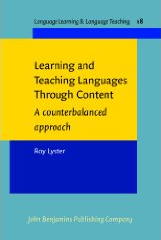 |
|
| Publisher: | Philadelphia: John Benjamins | ||
| Pages | ISBN | Price | |
|---|---|---|---|
| Pp. xii + 161 | 978-90-272-19763 (paper) | $49.95 U.S. | |
In recent years, content-based instruction (CBI) has gained recognition for its potential to address students’ language and content needs in a variety of educational contexts. However, this promising model of education is not without its challenges. At the forefront of this list of challenges is striking an appropriate balance between language and content. In this volume of the Language Learning & Language Teaching monograph series, Roy Lyster provides a succinct synthesis of classroom-based research, primarily from Canadian French immersion classrooms, “to enable educators in immersion and content-based classrooms to consider ways of integrating more focus on language” (p. xi). While he also encourages traditional language teachers to integrate more attention to content, his focus is clearly on the former—to identify avenues for systematic attention to language in content-based and immersion classrooms.
Finding time for professional development is challenging for busy pre-service and practicing teachers alike. Fortunately, this slim volume of five chapters can be feasibly read over a few days. Chapter 1 lays out a theoretical and empirical rationale for content-based education. It is particularly valuable for US educators (while we struggle with politically-charged bilingual versus English-only debates) to learn about the well-established and substantial body of Canadian research that has long supported the “2 for 1” approach, where language and content are learned simultaneously. Despite the success of content-based models, Lyster admits there is still work to be done, citing variable outcomes in learner language proficiency. Because negative outcomes indicate to him weaknesses not with the model itself but rather with the instructional practices associated with it, Lyster wants to highlight those instructional practices that promote optimal language learning in meaning-focused contexts.
In Chapter 2, which explores the role of instructional input in language learning, Lyster finds fault with those instructional strategies at the extremes of the language-content continuum. On the content-focused end, incidental focus on form neglects systematic attention to language, whereas on the language end, decontextualized grammar instruction fails to attend sufficiently to the communicative functions of language. Both, therefore, fail to adequately integrate content and form. A better alternative, Lyster suggests, is to incorporate both proactive and reactive form-focused instruction into more holistic approaches to literacy instruction. Additionally, he recommends increased and diversified language focuses in content-based settings. While these settings lend themselves to a semantic/lexical focus, they should also integrate attention to grammar, particularly those features problematic for learners due to non-salience or first language influence. In addition, grammar instruction needs to focus more on contextualized communicative function, whereas vocabulary instruction must be broadened to include more formal analysis. This call for more systematic attention to the form and function of language resonated with my own experience as a teacher in content-based settings. Teaching in an intensive English program, I use content as a vehicle for language learning; however, due to the engaging nature of the content, I often find myself giving short shrift to language in general, and particularly to the analysis of grammatical features in context. To my mind, then, Lyster’s notion of counterbalance is simple yet fundamentally important for planning and teaching in content-based settings.
The third chapter discusses the role of learner output. Here, Lyster emphasizes the importance of moving beyond comprehension-based activities alone, as such a singular focus can minimize opportunities for syntactic processing and production. Instead, he suggests incorporating both noticing and awareness activities to (a) draw attention to target features through such techniques as input enhancement, and then to (b) promote metalinguistic knowledge through rule-discovery tasks. For example, to encourage noticing and awareness of verb forms, students could compare a series of pictures illustrating the functional differences between those verbs. Students could then create their own pictures, describing the actions with the appropriate verb forms.
Drawing on skill acquisition theory, Lyster underlines the importance of production, both controlled and communicative, to promote the “proceduralization” of new knowledge. One problem he cites with many tasks in the content-based classroom is that they can be accomplished without appropriate attention to form. I found this to be true recently, with an activity intended as controlled practice for modal use—the desert island scenario. However, while students were extremely engaged in the task and used a lot of language to accomplish it, they incorporated modals minimally. In other words, the activity was engaging and communicative but it did very little to help students to use the target feature productively. Lyster provides an example of a language-focused task, a “collaborative jigsaw,” which he used in an immersion classroom. The students analyzed process texts of similar content but different modality (spoken and written) and formality level with a culminating presentation in which the students explained a process in each of the registers that they had analyzed. Lyster sees such a task as illustrative of “precise and appropriate uses of the second language that stretched learners to the leading edge of their interlanguage resources—without recourse to paralinguistic cues and over-reliance on all-purpose lexical items” (Harley, 1992, 1993, as cited in Lyster, p. 77). Stated succinctly, in order for tasks to attend to form as well as meaning, they need to push learners’ linguistic resources as well as their understanding of content.
Chapter 4 investigates teacher-student interaction, particularly reactive form-focused instruction, as a means of promoting learning. Embodying the spirit of counterbalance, Lyster casts aside the debate about teacher-centered versus student-centered interaction in favor of a focus on the quality of interaction itself. While many have criticized IRF (initiation-response-feedback) exchanges for constraining student language, Lyster recommends exploiting this common interactional structure, through principled use of diverse question types and follow-up moves, to push students to extend their responses and in turn, their linguistic resources. He also favors negotiation of form over meaning, arguing that the latter does more to promote comprehension and social rapport than it does to foster language learning. Turning his attention to the form, Lyster provides an exhaustive synthesis of corrective-feedback research. Despite the prevalent use of recasts in content settings, Lyster encourages other feedback techniques, especially prompts, which, by encouraging learner self-repair, facilitate language development because they force the retrieval of target forms and extend linguistic resources.
In the end, Lyster settles on a counterbalanced approach to corrective feedback, even incorporating those much-maligned recasts: “[I]nteraction about content with which students are unfamiliar is propitious for the use of recasts, whereas interaction about content familiar to students provides ideal opportunities for the use of prompts” (p. 123). I found this chapter disappointing in scope, due to the somewhat redundant discussions of research on corrective feedback. While this is an important area for teachers to consider, its predominance in this volume seemed overwhelming. Nevertheless, it introduces some useful guidelines for principled and systematic feedback.
In the final chapter, Lyster outlines a model for counterbalanced instruction and revisits his counterbalance hypothesis, which posits that “the destabilization of interlanguage forms, in the case of learners in immersion and content-based classrooms, is hypothesized to result from instruction that requires them to vary their attentional focus between the content to which they usually attend and target language features that are not otherwise attended to” (p. 126). Lyster illustrates the intuitive appeal of the model nicely. For example, on the content-based side, comprehensible input needs to be balanced with its form-focused counterpart, enhancing input through noticing and awareness. Negotiation should be used not only for scaffolding content, but also for providing feedback on form. And production tasks should promote both content learning and language practice.
For those of us who struggle to find an appropriate balance between content and language, this book contains some important reminders about how to attend to language in a meaning-focused environment. While it offers little in the way of practical strategies for incorporating content into the language classroom, it does provide some theoretical and empirical justification for doing so. Lyster manages to synthesize a sizeable body of research in fairly comprehensible ways, with a few exceptions. Some technical jargon and theoretical references (such as ‘transfer-appropriate processing’ and other information processing terms), while accessible to those at home in academic research settings, may be less transparent to practicing teachers. If the true intention of this volume is to enable educators to apply these findings, perhaps more practical illustrations of these principles at work in a variety of classroom settings would have been helpful. That said, I would recommend this book to anyone interested in identifying connections between SLA theory and research and content-based classroom learning and teaching.
References
Harley, B. (1992). Patterns of second language development in French immersion. Journal of French Language Studies, 2, 159-183.
Harley, B. (1993). Instructional strategies and SLA in early French immersion. Studies in Second Language Acquisition, 15, 245-259.
Erin-Kate Murphy
Peninsula College, Port Angeles, Washington
<erinm pencol.edu>
|
© Copyright rests with authors. Please cite TESL-EJ appropriately. Editor’s Note: The HTML version contains no page numbers. Please use the PDF version of this article for citations. |