

December 2008 — Volume 12, Number 3
|
|||
| Author: | Cynthia Lewis, Patricia Enciso, & Elizabeth Birr Moje, Eds. (2007) | 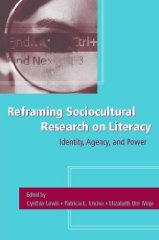 |
|
| Publisher: | New York: Routledge | ||
| Pages | ISBN | Price | |
|---|---|---|---|
| Pp. v + 205 | 0-8058-5696-X (paper) | $29.95 US | |
In Brian V. Street’s 1995 book Social Literacies, the author argues that “literacy practices are specific to the political and ideological context and their consequences vary situationally” (p. 24). Street goes on to say that we, as literacy researchers, are forced to “question whether the current framework in which such activities are conducted is the most fruitful” (p. 24). Over ten years later, the framework through which literacy research is explored is still being re-shaped to incorporate complex issues like power, identity and agency. The recent collection, aptly titled Reframing Sociocultural Research on Literacy, seeks to combine sociocultural and critical theory to develop a theoretical framework that is no longer narrowly defined by social context.
In his foreword to Reframing Sociocultural Research on Literacy, Street argues that this book is unique because it uses a sociocultural lens to explore power and identity. While the authors included in the volume do succeed in making a strong contribution to this global conversation, the book fails to offer a balanced look at the relationship between theory and practice. The book is divided into two sections: the first (chapters 1-4) is called “Rethinking Conceptual Frameworks,” and the authors intend here to “offer new theoretical lenses,” while the second section, “Rethinking Knowledge and Representation” (chapters 5-7), is meant to look specifically at “research knowledge” (p. xii). This divide seems more like an organizational technique based on necessity rather than one which emerged out of a delineation of the content of the chapters. Within each of the two sections, some chapters offer a broad, theoretical view, while others focus on specific incidences of literacy learning. Due to this lack of a coherent organizing principle, the intended audience of “scholars, researchers, and graduate students” (p. xi) might have difficulty trying to decipher which parts of the book are the best from which to glean key theories.
Several chapters offer a discussion of how conceptual frameworks are applied to research, but the one which provides the clearest overview of the relationship between theory and research is the first chapter, written by Moje and Lewis, two of the collection’s editors. They outline three key analytical methods in critical sociocultural theory: activity theory, critical discourse analysis, and a cultural studies approach, which when applied simultaneously, Moje and Lewis argue, will enable researchers to explore how power, identity and agency influence learning. For us to understand how these three combined analytical methods apply to a particular situation, the researchers chose an excerpt of classroom discourse from an eighth grade English language arts class and subsequently analyze the discourse using questions which combine activity theory, critical discourse analysis and cultural studies. Most useful in this chapter is the table on page 25, which offers examples of guiding questions for conducting critical sociocultural analyses. The authors successfully depict how sociocultural research can be reframed, as well as offer practical suggestions for implementing this type of research.
The chapter which follows, written by the third editor of the volume, Patricia Enciso, also provides an important perspective on how to reframe sociocultural theory but does not offer the same strong connection between theory and practice. Enciso explores “forms of historical knowledge in education” through the lens of poststructural and critical race theories (p. 52). The author argues that narratives of history in sociocultural theory enable one to look at “how these forms of cultural construction might be further expanded to name and address incommensurable and inequitable social visions” (p. 55). In order to analyze narratives, Enciso audiotaped and then transcribed a two-hour discussion she had with two pre-service teachers about gender representations in literature and educational practice. Although Enciso calls attention to the importance of using a historical lens in research, she does not address how her role as the students’ former professor may have influenced the data which informs her study. The result is a chapter which supplies a rich theoretical perspective but raises new questions about how narratives are produced.
In contrast, Rogers and Fuller’s chapter provides little theoretical background but offers a rich example of critical ethnography. The authors’ study explores how an adult literacy teacher (Fuller) and her students redesigned the community of practice in an Adult Education and Literacy (AEL) classroom. The authors argue that students’ history of participation in education is essential in the design, or creation, of a literacy classroom. The design of an AEL classroom is thoroughly explored and the authors offer a detailed explanation of how a classroom community is constructed. Rogers and Fuller provide useful insight into and practical implications for how to conduct critical sociocultural research in the adult literacy classroom.
Chapters 5 and 6 in the second part of the book diverge from the more focused discussion of literacy research offered by Rogers and Fuller to offer a perspective on how a critical sociocultural perspective may be used to explore learning in general. In these chapters, both Orellana and Guerra explore the transitional nature of contexts and refute the notion of a clear bifurcation between the contexts of home and school. Orellana’s research explores how the children of immigrants operate as translators for their parents. The author challenges “notions of the separability of individuals from their contexts, and of worlds from each other” (p. 126). She adeptly uses the example of children as mediators or cultural brokers to illustrate how the worlds of institution and family collide and further shape immigrant children’s identities.
Similarly, Guerra’s chapter provides a useful example of the researcher reflectivity necessary to conduct critical sociocultural research. His chapter, like Orellana’s, does not focus on literacy in the traditional sense, but does question “what methods . . . allow us to capture how people engage in rhetorical practices that allow them to reposition themselves across cultures to enact more productive and meaningful identities within” (p. 138). Guerra conducts auto-ethnographic work, in contrast to Rogers and Fuller’s critical ethnography. He explores the development of rhetorical practice in his own life in his move from a segregated housing project in the Lower Rio Grande Valley of South Texas to a multicultural university in Chicago. Guerra notes that he “wants to contrast how the two sociocultural contexts differed and influenced how he has engaged in transcultural repositioning” (p. 138). This researcher offers insight into how individuals move across physical and rhetorical space.
Wrapping up the section on sites of learning are Fecho and Meacham’s compelling examples of how research sites can be looked at as transactional spaces, “places where they [the researchers] expect to be shaped at least as much as they shape the community” (p. 170). The authors posit that “by embracing research in communities as transactional space, researchers open themselves and those communities to learning that is multidimensional, polyphonic, and mutually transformative” (p. 165). The authors offer detailed examples from their own research. While Meacham discusses his experience teaching literacy through hip-hop, Fecho reflects upon how as a teacher and researcher he began to see his classroom as a transactional space, or “one in which the lines between pedagogy and research blur” (p. 179).
One of Fecho’s final points in his chapter serves as an excellent summary of how Reframing Sociocultural Research on Literacy provides ways to think differently about the research experience. He notes, “As we continue to create our identities as researchers, of one point we are sure: researchers who enter any research site transact with the participants as the research progresses” (p. 183). The ongoing fluidity between sites of research, researcher, and participants is communicated clearly in this book. Thus, although the book’s organization is not optimal, the volume does serve as a valuable and thought-provoking resource for both students and scholars looking for ways to incorporate critical theory into their own sociocultural research.
References
Street, B.V. (1995). Social literacies. Harlow, England: Pearson Education.
Heather Bobrow Finn
New York University
<heather.finn nyu.edu>
|
© Copyright rests with authors. Please cite TESL-EJ appropriately. Editor’s Note: The HTML version contains no page numbers. Please use the PDF version of this article for citations. |