• Skip to primary navigation
  • Skip to main content

site logo
The Electronic Journal for English as a Second Language
search
  • Home
  • About TESL-EJ
  • Vols. 1-15 (1994-2012)
    • Volume 1
      • Volume 1, Number 1
      • Volume 1, Number 2
      • Volume 1, Number 3
      • Volume 1, Number 4
    • Volume 2
      • Volume 2, Number 1 — March 1996
      • Volume 2, Number 2 — September 1996
      • Volume 2, Number 3 — January 1997
      • Volume 2, Number 4 — June 1997
    • Volume 3
      • Volume 3, Number 1 — November 1997
      • Volume 3, Number 2 — March 1998
      • Volume 3, Number 3 — September 1998
      • Volume 3, Number 4 — January 1999
    • Volume 4
      • Volume 4, Number 1 — July 1999
      • Volume 4, Number 2 — November 1999
      • Volume 4, Number 3 — May 2000
      • Volume 4, Number 4 — December 2000
    • Volume 5
      • Volume 5, Number 1 — April 2001
      • Volume 5, Number 2 — September 2001
      • Volume 5, Number 3 — December 2001
      • Volume 5, Number 4 — March 2002
    • Volume 6
      • Volume 6, Number 1 — June 2002
      • Volume 6, Number 2 — September 2002
      • Volume 6, Number 3 — December 2002
      • Volume 6, Number 4 — March 2003
    • Volume 7
      • Volume 7, Number 1 — June 2003
      • Volume 7, Number 2 — September 2003
      • Volume 7, Number 3 — December 2003
      • Volume 7, Number 4 — March 2004
    • Volume 8
      • Volume 8, Number 1 — June 2004
      • Volume 8, Number 2 — September 2004
      • Volume 8, Number 3 — December 2004
      • Volume 8, Number 4 — March 2005
    • Volume 9
      • Volume 9, Number 1 — June 2005
      • Volume 9, Number 2 — September 2005
      • Volume 9, Number 3 — December 2005
      • Volume 9, Number 4 — March 2006
    • Volume 10
      • Volume 10, Number 1 — June 2006
      • Volume 10, Number 2 — September 2006
      • Volume 10, Number 3 — December 2006
      • Volume 10, Number 4 — March 2007
    • Volume 11
      • Volume 11, Number 1 — June 2007
      • Volume 11, Number 2 — September 2007
      • Volume 11, Number 3 — December 2007
      • Volume 11, Number 4 — March 2008
    • Volume 12
      • Volume 12, Number 1 — June 2008
      • Volume 12, Number 2 — September 2008
      • Volume 12, Number 3 — December 2008
      • Volume 12, Number 4 — March 2009
    • Volume 13
      • Volume 13, Number 1 — June 2009
      • Volume 13, Number 2 — September 2009
      • Volume 13, Number 3 — December 2009
      • Volume 13, Number 4 — March 2010
    • Volume 14
      • Volume 14, Number 1 — June 2010
      • Volume 14, Number 2 – September 2010
      • Volume 14, Number 3 – December 2010
      • Volume 14, Number 4 – March 2011
    • Volume 15
      • Volume 15, Number 1 — June 2011
      • Volume 15, Number 2 — September 2011
      • Volume 15, Number 3 — December 2011
      • Volume 15, Number 4 — March 2012
  • Vols. 16-Current
    • Volume 16
      • Volume 16, Number 1 — June 2012
      • Volume 16, Number 2 — September 2012
      • Volume 16, Number 3 — December 2012
      • Volume 16, Number 4 – March 2013
    • Volume 17
      • Volume 17, Number 1 – May 2013
      • Volume 17, Number 2 – August 2013
      • Volume 17, Number 3 – November 2013
      • Volume 17, Number 4 – February 2014
    • Volume 18
      • Volume 18, Number 1 – May 2014
      • Volume 18, Number 2 – August 2014
      • Volume 18, Number 3 – November 2014
      • Volume 18, Number 4 – February 2015
    • Volume 19
      • Volume 19, Number 1 – May 2015
      • Volume 19, Number 2 – August 2015
      • Volume 19, Number 3 – November 2015
      • Volume 19, Number 4 – February 2016
    • Volume 20
      • Volume 20, Number 1 – May 2016
      • Volume 20, Number 2 – August 2016
      • Volume 20, Number 3 – November 2016
      • Volume 20, Number 4 – February 2017
    • Volume 21
      • Volume 21, Number 1 – May 2017
      • Volume 21, Number 2 – August 2017
      • Volume 21, Number 3 – November 2017
      • Volume 21, Number 4 – February 2018
    • Volume 22
      • Volume 22, Number 1 – May 2018
      • Volume 22, Number 2 – August 2018
      • Volume 22, Number 3 – November 2018
      • Volume 22, Number 4 – February 2019
    • Volume 23
      • Volume 23, Number 1 – May 2019
      • Volume 23, Number 2 – August 2019
      • Volume 23, Number 3 – November 2019
      • Volume 23, Number 4 – February 2020
    • Volume 24
      • Volume 24, Number 1 – May 2020
      • Volume 24, Number 2 – August 2020
      • Volume 24, Number 3 – November 2020
      • Volume 24, Number 4 – February 2021
    • Volume 25
      • Volume 25, Number 1 – May 2021
      • Volume 25, Number 2 – August 2021
      • Volume 25, Number 3 – November 2021
      • Volume 25, Number 4 – February 2022
    • Volume 26
      • Volume 26, Number 1 – May 2022
      • Volume 26, Number 2 – August 2022
      • Volume 26, Number 3 – November 2022
      • Volume 26, Number 4 – February 2023
    • Volume 27
      • Volume 27, Number 1 – May 2023
      • Volume 27, Number 2 – August 2023
      • Volume 27, Number 3 – November 2023
      • Volume 27, Number 4 – February 2024
    • Volume 28
      • Volume 28, Number 1 – May 2024
      • Volume 28, Number 2 – August 2024
      • Volume 28, Number 3 – November 2024
      • Volume 28, Number 4 – February 2025
    • Volume 29
      • Volume 29, Number 1 – May 2025
      • Volume 29, Number 2 – August 2025
      • Volume 29, Number 3 – November 2025
  • Books
  • How to Submit
    • Submission Info
    • Ethical Standards for Authors and Reviewers
    • TESL-EJ Style Sheet for Authors
    • TESL-EJ Tips for Authors
    • Book Review Policy
    • Media Review Policy
    • TESL-EJ Special issues
    • APA Style Guide
  • Editorial Board
  • Support

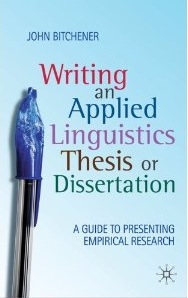
Writing an Applied Linguistics Thesis or Dissertation: A Guide to Presenting Empirical Research

September 2010 – Volume 14, Number 2

Applied Linguistics Thesis or Dissertation: A Guide to Presenting Empirical Research

Author: John Bitchener (2010)  
Publisher: London: Palgrave
Pages ISBN Price
pp. 216+xi 978-0-230-22454-4 $26.95 U.S.

In Writing an Applied Linguistics Thesis or Dissertation: A Guide to Presenting Empirical Research, Bitchener, adopting an ESP approach, investigates the process of writing the genre of thesis providing practical suggestions for Applied Linguistics graduate students. As dissertation writing can be considered as one of the relatively under-researched areas in second language writing, this step-by-step guide can be very useful for graduate students not only in Applied Linguistics but also in other disciplines.

Chapter 1, “Background”, introduces the goals of the book and its intended audience. In this guide-book, Bitchener provides first time thesis writers with guidance on how to present their research. In this respect, the target audience of this book is primarily Masters and Honors students who want to write a thesis, but those doctoral students who have not completed a thesis requirement before can also benefit from this guide. An overview of the content of the book is provided for those readers who might wish to have a quick summary of the contents. Each chapter of the book is titled according to one part-genre of the genre of thesis, such as abstract, introduction, and conclusion. The structure, content and requirements of these part genres are explained with the help of a sample thesis entitled “Willingness to communicate in a second language classroom” by Katherine Cao, who won the Applied Linguistics Association of New Zealand Best Master’s thesis award.

The remaining chapters, namely, Chapter 2, “Abstract”, Chapter 3, “Introduction”, Chapter 4, “ Literature review”, Chapter 5, “Methodology”, Chapter 6, “Results”, Chapter 7 “Discussion and results,” and Chapter 8, “Conclusion” all have the same format. They all started with a short introduction to the part-genre that is explored throughout the chapter. For instance, in this introductory chapter in Chapter 2, the thesis abstract is explained briefly. Later, the functions are analyzed. In the functions section of Chapter 3, the functions of a thesis introduction are listed. Some of the functions which are explained here included a description of the problem, a review of the background and context and an identification of gaps. Following this is “the content and the structure part” which involves the Swalesian moves analyses of the focus of the chapter. For instance, the content and structure section in Chapter 4, the main moves of the literature review of a thesis are explained as follows:

(1) establish some aspect of the knowledge territory relevant to your research
(2) create a research niche/gap in knowledge
(3) announce how you will occupy the research niche/gap (p. 67)

This is followed by a sample analysis of a section of a masters’ thesis. For these parts, Bitchener presents some portions from the sample master’s thesis with moves explained later in detail sentence by sentence. In Chapter 5, this section includes an analysis of the methodology section. Following this is usually key linguistic features that can help graduate students when they write their masters’ theses or dissertations. In the “Results” chapter, this section included some detailed information such as tense usage in the reporting of quantitative results, hedging, presenting qualitative results visually, etc.

It might be fair to say the use of “sample” thesis has advantages and disadvantages for such a guide. It is not distracting to read only one sample from the very beginning to the end of the book, as the reader becomes familiar with the topic of the same thesis. By the same token, having one and only example to refer to might also bring some issues. For instance, novice writers might take this sample and reproduce it as if it is a one-and-only template for thesis writing. This might impede and undermine second language writers’ creativity and individual voice in their writing. In addition, novice writers might take and generalize Cao’s individual style that is present in this sample thesis.

In the analyses sections which included moves analyses of the different parts of the masters’ thesis, the author provided two boxes of the same text, the first one being without the moves, and the second one being with the moves and an explanation of them. For those readers who are looking for a “how to” book, these parts can provide some exercises. But for those readers who are interested in the moves analyses of these sections, the parts without the moves can be redundant.

Still, the book includes frequently asked questions sections at the end of each chapter that deals with such important questions as “How long should the abstract be?” and “Should I write introduction before other chapters?” In addition, suggestions for further activities and further reading are included at the end of each section. These suggestions might not only help graduate students reflect on their writing practices about the issues discussed in each chapter of the book, but also help mentors, advisors and professors facilitate discussions about different parts of the thesis.

Reviewed by

Nur Yigtoglu
The Georgia State University, USA
<dasnyyatmarklangate.gsu.edu>

© Copyright rests with authors. Please cite TESL-EJ appropriately.

Editor’s Note: The HTML version contains no page numbers. Please use the PDF version of this article for citations.

© 1994–2026 TESL-EJ, ISSN 1072-4303
Copyright of articles rests with the authors.