

March 2012 – Volume 15, Number 4
Bridging the Cross-Cultural Gap: Listening and Speaking Tasks
|
|||
| Author: | Russell Arent (2009) | 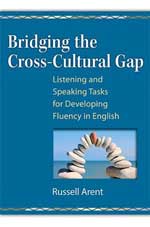 |
|
| Publisher: | University of Michigan Press | ||
| Pages | ISBN | Price | |
|---|---|---|---|
| 145 pages | 978-0-472-03357-7 | $26.50 USD | |
Bridging the Cross-Cultural Gap: Listening and Speaking Tasks for Developing Fluency in English by Russell Arent is a textbook designed for use by both teachers and students. It aims to develop communication between cultures by viewing multi-cultural movies and doing related activities, thereby building general listening and speaking skills. This book is not intended to offer activities for explicit language instruction. Instead, it makes students aware of cross-cultural differences in languages and lifestyles. The author hopes that, as a result, students will develop fluency in listening and speaking. In writing the text, Arent assumes that “Students have already received instruction on such matters [the mechanics of listening and speaking]” (p. v). While Arent does not clearly specify the intended audience, the language throughout the book suggests that students must have moderate, if not high, levels of English proficiency.
The book is structured into six themed chapters, each with three to seven subtopics. For example, Chapter 2’s theme is “Perceiving, Understanding, and Adjusting to Culture” and has subtopics such as “Ethnocentrism” and “Stereotypes, Prejudices, and Discrimination.” Under each topic there are two to five “Tasks.” These tasks typically refer to a specific movie clip, which reflects the theme of the chapter. Movie examples from Chapter 2 include Mona Lisa Smile (2003), from the United States and I’maarat Yaquubeean/Yacoubian Building (2006), from Egypt. Other tasks suggest ideas for conversation between partners or in small groups, all of which relate to the chapter’s theme. One concern might be that the book has some large passages of text—up to three pages—of topic-related prose, which provide theoretical background and vocabulary. If teachers wish to include this information, they may have to modify the material to reflect students’ proficiency.
Cross-cultural awareness is crucial for effective language learning and Arent provides many interesting, stimulating, and unique ideas, such as building discussions around movies or interviewing people in the community. Additionally, the book suggests topics for class presentations, and thought-provoking questions are provided for group discussions. As mentioned, this textbook is not designed to be used for traditional language instruction, or as the sole textbook. As a result, teachers may need to outline the structure of some tasks and should be prepared to provide additional guidance. For example, Task 4 in subtopic 2.1 suggests that students give a 10-minute oral presentation. In order to prepare this activity, however, it is the teacher’s responsibility to put together additional ideas and scaffolding. Instructors may also need to consider whether Arent’s activities correspond with the class curriculum and make adjustments accordingly.
Also, depending on the class, teachers may need to be aware of other potential concerns. For instance, the majority of tasks refers to and relies on watching specific movie clips. One problem that could be faced is that teachers and students may not have direct access to these movies, especially as titles from all over the world are featured. Arent does not supplement the textbook with a DVD, nor does he suggest an appropriate website with these clips; teachers should be prepared to look outside of the classroom for materials. The textbook suggests purchasing these particular movies—up to ten movies per chapter—however, if teachers have different movies, it is possible to adapt the lessons to use with these. This option may help those teachers who cannot afford to purchase the suggested movies. Using alternative movie selections also guarantees that teachers have a personal understanding of the material. For example, Arent does not address whether foreign movies are in English, dubbed, or subtitled, a problem that could be solved by using movies already familiar to the teacher. Whether or not the teacher chooses to follow the guidelines of the book or to adapt the selections, Arent provides creative and stimulating ways to use media in the classroom. Because this book provides a large variety of supplementary material, teachers can easily adjust the activities to suit the particular needs of their students.
Throughout the text, Arent draws in readers by using metaphors and poetic language to illustrate the themes of each chapter. For example, in Chapter 1, intercultural communication is likened to a “beautiful beach” which may be suddenly disrupted by a miscommunication or “storm” (p. 1). The emotional appeal of the book’s language is apparent in this textbook. For teachers and students used to colorful, visually-stimulating materials, however, this book may at first seem dull, especially as the few pictures are in black-and-white. In addition, the directions for each task are verbose, which could prove problematic for students.
As previously mentioned this book best serves as supplemental material. It would be difficult to plan whole lessons around this book, as there are no estimated times given for activities and guidance is limited. In addition, tasks relate to the overall theme of the chapter, but content and language material are generally not recycled. The time-consuming nature, too, of watching the suggested number of movies needs to be considered and may not be feasible for many classes; the amount of time necessary to watch even a few of the suggested clips will take up a large part of the typical one or two hour class period.
Overall, Bridging the Cross Cultural Gap: Listening and Speaking Tasks for Developing Fluency in English should only be used for supplementary materials, and not be used as a primary textbook for learning listening and speaking skills. Teachers need to be aware that while the activities and movies are stimulating, the suggested media is not provided, tasks may need further development, and the book would best serve students who have advanced proficiency. Arent’s book presents an often-overlooked aspect of language learning, cross-cultural components. The activities are engaging and unique and thoroughly involve the students. This book, if used to supplement an ESL curriculum, could give variety to the lessons, which may result in higher learner-motivation.
Reviewed by
CeAnn Myers
CBI Coordinator, Program in Intensive English
Northern Arizona University
<CeAnn.Myers nau.edu>
Melissa Squiers
Horseheads, New York
<mbs79nau.edu>
| © Copyright rests with authors. Please cite TESL-EJ appropriately.Editor’s Note: The HTML version contains no page numbers. Please use the PDF version of this article for citations. |