

March 2012 – Volume 15, Number 4
Interrogating Privilege: Reflections of a Second Language Educator |
|||
| Author: | Stephanie Vandrick (2009) | 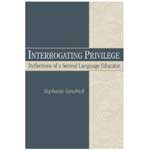 |
|
| Publisher: | University of Michigan Press | ||
| Pages | ISBN | Price | |
|---|---|---|---|
| 182 pages | 978-0-472-03394-2 | $23.95 USD | |
Vandrick’s Interrogating Privilege: Reflections of a Second Language Educator mixes theory with research to investigate the concept of privilege in the field of second language education. While each chapter can be read as a part of whole book that continuously seeks to focus on the privilege in different settings, it is also possible for readers to explore these chapters as individual essays.
Chapter 1, “An introduction”, starts with an appeal to the reader that explains the overall goals of the text and its division into three sections: (i) social class in interaction with other types of privilege, (ii) personal narrative in academic writing and (iii) overall structure of the book.
Teachers’ own experiences as children might play some roles in their teaching practices. In Chapter 2, “ESL and the Colonial Legacy: A teacher faces her ‘Missionary kid’ past”, the author deals with Vandrick’s childhood experiences as a child of Christian missionaries in India. Reflecting upon her childhood experiences, she connects those experiences with her choice of becoming an English teacher. For instance, she notes that for many ESL teachers, the West, more specifically, the United States, has become the reference point. In the light of postcolonialism, Vandrick concludes that teachers need to be aware of the impact of the colonial history on their teaching and perception of learners.
Certain concepts and their associations differ in various contexts. Chapter 3, “Tea and TESOL”, traces the complex underlying meanings of tea and its relationships with TESOL. Vandrick starts with the implications of tea in her personal life and literary discoveries. For instance, while in her childhood, tea had connotations of femininity, collectivism and community, some of the literature presented tea as colonial legacy, power, and luxury. She concludes that, ESOL students also come with their own conceptions of tea drinking traditions and links her experiences with the privilege ESOL students studying in the United States.
Chapter 4, “Shifting sites, shifting identities: a 30-year perspective”, is a revised version of an essay published in Vandrick (2006). Touching on both positive and negative aspects of both herself and her institution, the University of San Francisco (USF), Vandrick illustrates the identity construction of the program, faculty and students from the perspective of the privilege. Different people play important roles in different stages of our lives.
In Chapter 5, “Fathers and mentors,” the author not only discusses her own father who supported her, but also her academic fathers’ that helped her throughout her academic career. She concludes the chapter by acknowledging the link between these kinds of mentorships and the concept of privilege as follows: “Throughout academe, there is still much to be done regarding equity of women, minorities, and less-established academic fields . . . . Although much of what needs to be done can only be done at the societal and institutional levels, we as individuals can also press for change” (pp. 79, 80).
The balance between work and family in the lives of women in academia is one of the most discussed topics in academic circles. In Chapter 6, “Gender, class and the balanced life”, the author deals with this issue exemplifying the life of one of her Korean graduate students, Valerie. After problematizing the works on and the issues of gender, class and the privileges in different cultures (e.g., European versus American, etc.) as well as different fields (e.g., TESOL versus composition) she concludes the chapter by stating that there is still a clear divide between the privileges of men and women. Another controversial issue, sexual identity, is explored in chapter 7, “Sexual identity and education”. By reflecting on such issues as privileges imposed by cultural differences, gender identity, religion and social class, Vandrick advocates for lesbian, gay, bisexual and transgender people.
The very act of writing most of the time gives privilege to people. The next two chapters, Chapter 8, “On beginning to write at 40”, and Chapter 9, “The power of writing groups”, explores the issues surrounding research and writing that gives privileges to some people in academia. In Chapter 8, Vandrick reflects on her own experiences of writing and concludes by calling her women colleagues not to be intimidated but to publish their work in spite of their ages. Chapter 9 takes on the issue of writing from a more general point of view by focusing on writing groups. By elaborating on different types of groups such as online versus in-person groups, and long-term versus short-term groups, she concludes with her own reflections as an “aging educator” in the TESOL field.
Vandrick closes the text with questions for reflection and discussion to allow teacher-learners to check their own comprehension of issues discussed in the book and help facilitate discussions in teacher training programs. Mixing the theory with personal experience, Vandrick fills a gap in the area of language teacher education. It is full of useful information compiled through years of teaching and learning in the teaching profession.
References
Vandrick, S. (2006). Shifting sites, shifting identities: A thirty-year perspective. In P.K. Maksuda, C. Ortmeier-Hooper, & X. You (Eds.), Politics of second language writing: In search of the promised land (pp. 280-293). West-Lafayette, IN: Parlor Press.
Reviewed by
Nur Yigitoglu
Okan University, Istanbul, Turkey
<nuryigitioglu gmail.com>
| © Copyright rests with authors. Please cite TESL-EJ appropriately.Editor’s Note: The HTML version contains no page numbers. Please use the PDF version of this article for citations. |