

December 2012 – Volume 16, Number 3
Sociocultural Theory in Second Language Education:
|
|||
| Author: | Merrill Swain, Penny Kinnear, and Linda Steinman (2011) | 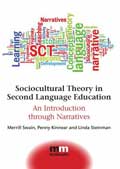 |
|
| Publisher: | Multilingual Matters | ||
| Pages | ISBN | Price | |
|---|---|---|---|
| 174 pages | 9781847693303 | $109.95 USD | |
In the midst of increasing numbers of new and alternative approaches and theories in the field of second language acquisition, Vygotskyian sociocultural theory (henceforth, VSCT) has firmly established its major role in the field in the last 30 years. However, it is widely perceived that the concepts and constructs of VSCT are not easy to grasp by language teachers, undergraduate and graduate students, and novice researchers in the field of second language education. Sociocultural theory in second language education: An introduction through narratives is an innovative and timely addition to the second language education field which has succeeded in making the key VSCT concepts and constructs very accessible to the reader via use of real narrative stories told by language teachers, students, and researchers in the very field. Using real narratives to elucidate VSCT concepts and constructs has not only proven successful to make them easier to understand in real contexts but also, according to the authors, make those key concepts and constructs ‘stick’ in our minds.
The book is organized into eight chapters in addition to a brief life story of Vygotsky and an introduction to sociocultural theory and narratives. It also includes a complete bibliography and index at the end of the book. What is strikingly terrific about this publication is the organization of each chapter. Each chapter deals with one or several key concepts of VSCT (e.g., mediation and zone of proximal development (ZPD)) along with a narrative story. The first page of each chapter introduces the title, key SCT tenets related to the target concepts/constructs, setting of the narrative, and key terms in the chapter, which help inform the reader what each chapter is about. Each chapter then opens with a brief introduction followed by a narrative; an explanation of the target concept in the narrative; current controversy of the target concept; key research articles, books and/or book chapters; and questions to explore for research and pedagogy. As stated in the introduction, the authors envisioned the book to be used as a textbook in undergraduate and graduate courses; thus, the organization of each chapter is designed to be teacher friendly.
The overall content of the book is the following. The first chapter introduces the key concept of mediation with a lifestory about the Chinese immigrant Mona. The narrative introduces various material and artifact tools which Mona used to mediate her English learning, becoming an English teacher, and coming to a Canadian university to receive a Ph.D. degree in TESOL.
The second chapter introduces the concept of ZPD with a retrospective narrative by Sarah from the time when she was a fourth-grade student in a French immersion classroom. The narrative illustrates that in and out of the classroom students interact with each other in French to extend the space of ZPD without conscious effort. The authors alternatively interpret ZPD as an activity rather than space which is a more conventional interpretation.
The third chapter deals with the concept languaging which is not original to the VSCT idea; however, according to the authors, it encompasses the VSCT concepts of private speech and collaborative dialogue. Jody, a Chinese-Canadian who tried to retrieve the Chinese terms for directional words (i.e., north, south, east, and west) when asked by a Chinese man at a bus stop, uses private speech to retrieve, organize, and refresh her memory of Chinese directional words. As for collaborative dialogue, Sophie and Rachel, who are fourth-grade French immersion students, successfully recreated a French model dialogue by a dictogloss pair-activity.
The fourth chapter compares and contrasts everyday and scientific concepts with a written narrative by Thaya. He translates a story told by his Sri Lanka friend from Punjabi to English and retells the story. During the process of translation and retelling of the story which was heavily culturally embedded, Thaya and his classmates tried to interweave both everyday and scientific concepts.
The fifth chapter introduces interrelatedness of emotion and cognition by using an oral narrative by Grace who does not identify herself with either Greek or Canadian. Her undefined identity is strongly based on her self-perceived language abilities in Greek and English as well as cultural differences. Grace’s narrative explicates how emotion towards languages and cultures affects her cognition which, in this case, refers to her language abilities.
The sixth chapter deals with activity theory accompanied by Sandra’s narrative of a teacher dilemma. Her dilemma as a teacher is a power relationship between teacher and student; she struggles with what she learned in her critical pedagogy course and her students’ expectations of her as a teacher.
The penultimate chapter presents how language assessment is viewed in VSCT’s lens vis-á-vis traditional (psychometric-based) assessments. A narrative is told by an adult ESL student Yang who experienced two different formats of oral English tests: interacting with an examiner and interacting with another ESL student. The narrative clearly elucidates that assessment entails both social and cultural activities. This chapter also deals with one of the popular language assessment methods proposed by the sociocultural theory, dynamic assessment.
The last chapter contains narratives that are intentionally stripped of explanations by the authors; they are provided for the reader to consider and possibly discuss any of the VSCT concepts/constructs discussed in this book. The first narrative is written by Maria, an ESL teacher, who plans her lesson through discussions with her co-worker. The second narrative is written by Jean-Paul, another ESL teacher, who tells his experience in the virtual world of Second Life.
Overall, the book demonstrates the authors’ superb skills in extracting the key concepts of VSCT from real life stories and explicating them in an accessible manner for the general public. It also shows the authors’ extensive knowledge of VSCT across disciplines, as the list of further reading in each chapter comes not only from the field of second language education but also from the various fields such as science education, psychology, and educational research. The only weakness is that the book may not be suitable as a main textbook for an undergraduate/graduate SCT course, since it is organized based on the individual key concepts. Nevertheless, the book is a perfect fit as supplementary material for introductory SCT courses.
Reviewed by
Shogo Sakurai
School of Languages and Cultures, Purdue University
<ssakurai purdue.edu>
| © Copyright rests with authors. Please cite TESL-EJ appropriately.Editor’s Note: The HTML version contains no page numbers. Please use the PDF version of this article for citations. |