

December 2012 – Volume 16, Number 3
What Should I Do?: Confronting Dilemmas of Teaching in Urban Schools |
|||
| Author: | Anna Ershler Richert (2012) | 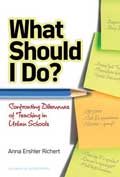 |
|
| Publisher: | New York: Teachers College Press | ||
| Pages | ISBN | Price | |
|---|---|---|---|
| 144 pages | 978-0807753255 | $29.95 USD | |
What Should I Do?: Confronting Dilemmas of Teaching in Urban Schools (2012) presents an insightful commentary on the myriad of issues facing 21st century educators. Written by Anna Ershler Richert, this quick read (just over 100 pages) highlights the problems characteristic of the U.S. urban teaching experience using four major themes: teacher identity, student-teacher relationships, curriculum and instruction, and the urban context. This book is specifically targeted towards novice teachers working in urban settings in North America. I am a third year literacy teacher working in an inner-city public school in the U.S. South. I know first-hand the complex dilemmas that urban teachers face. Likewise, I’m familiar with the ever-present frustration that comes with the uncertainty that burdens each of my professional decisions. I chose to read this book because I hoped that I might find at least a few solutions to my growing list of concerns.
The book is arranged into six chapters, each a balance of commentary that addresses a specific issue facing urban educators and true case narratives that illustrate these issues in real-life scenarios. Chapter One provides an introduction to the urban context and an overview of common dilemmas that arise in schools with high levels of diversity. Chapter Two underscores the challenges facing novice teachers in particular. Richert examines and discusses the ways in which these teachers struggle to form professional identities while negotiating the often-vast contrasts between their own backgrounds (race, language, economic status, etc.) and those of their students. Chapter Three continues this discussion, this time placing the emphasis on the student. Case narratives reflect the importance of strong student-teacher relationships as well as the struggle that many urban teachers face when attempting to relate to their diverse populations of students. Chapter Four focuses on dilemmas of curriculum and instruction. Richert highlights the challenges that teachers face in engaging students, presenting culturally relevant content, and negotiating the demands of standardized testing for students who may have conflicting instructional needs. Chapter Five discusses the complexities of ensuring clear and fair assessment when taking into account the many differences in knowledge and experience among urban students. The final chapter offers a concluding analysis, assuring readers that there are no clear solutions to any of the dilemmas discussed throughout the book, only opportunities for reflection that can eventually lead to successful management of such problems.
I found the most valuable asset of the book to be the detailed case narratives provided in each chapter. Each narrative introduces the reader to a novice teacher working in an urban, U.S. K-12 setting. These snapshots clearly illustrate the complex and often emotional dilemmas common in urban public schools. For example, one narrative recounts the struggle of an African-American teacher working to overcome stereotypes in order to relate to her African-American students. Her students dismiss her because her social class and life experience do not render her “black enough” to warrant their respect. In another case, a bilingual middle school teacher is conflicted over whether or not to speak in Spanish for the benefit of her Latino students. Given the diversity within the classroom, the teacher questions whether or not it is fair to supplement instruction in an alternate language for the benefit of only a few, especially given that the official language of the classroom is English. Yet, she struggles to come to a conclusion given that she understands that utilizing Spanish will be highly beneficial to her Latino population. These narratives, and others like them, provide the reader with opportunities for reflection without the conflict or stress of encountering such problems first-hand. In fact, Richert points out that teachers who investigate and reflect upon the decisions and experiences of colleagues are more likely to be prepared when faced with complex dilemmas of their own. Reading these case narratives was also therapeutic. The understanding that the urban context often presents these issues as norms rather than irregularities can be a great source of relief for novice teachers in particular.
While the book was both interesting and thought provoking, I was somewhat disappointed by its lack of clear advice. I had hoped Richert might offer a few. I felt the title was somewhat deceptive—or perhaps I naively expected an answer to the question What Should I Do? However, Richert is clear in her conclusion that the dilemmas she presents are much too complex for neat answers. In fact, even solutions that work well for one teacher may very well prove useless to another. This understanding is the book’s true message. While frustration and uncertainty are inevitable byproducts of the urban teaching experience, the combination of reflective practice and flexibility can ultimately allow one to manage these dilemmas within the context of his or her own classroom.
Educators working outside the U.S. might find some value in reading this book, particularly if they are new to the profession. However, I would not recommend this book to new teachers in general. Not all schools, either in the U.S. or abroad, include diverse populations of students. Teachers who share similar cultural, racial, and linguistic backgrounds with their students are unlikely to relate to many of the issues that Richert presents. However, teachers who engage diverse population or whose backgrounds differ significantly from those of their students may find insights that are useful for professional growth. Further, any reader who simply seeks the means for comparison between their own teaching experiences and those of American urban teachers might find this book to be an exceptional tool.
Reviewed by
Jada Deiderich
Charlotte Mecklenburg Public Schools, North Carolina USA
<jdeideri uncc.edu>
| © Copyright rests with authors. Please cite TESL-EJ appropriately.Editor’s Note: The HTML version contains no page numbers. Please use the PDF version of this article for citations. |