

December 2012 – Volume 16, Number 3
A Call to Creativity: Writing, Reading and
|
|||
| Author: | Luke Reynolds (2012) | 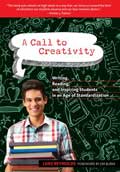 |
|
| Publisher: | New York: Teachers College Press | ||
| Pages | ISBN | Price | |
|---|---|---|---|
| 105 pages | 978-0-8077-5305-7 | $26.95 USD | |
Luke Reynolds’ short narrative on creative classrooms in an age of standardized tests takes us on a journey through the author’s experiences in three levels of teaching—middle, secondary and college. A Call to Creativity is a hands-on guide for the classroom teacher including activities, handouts, and detailed explanations for a variety of reading and writing lessons. Reynolds’ objective is a simple one: to demonstrate to the readers that we can create highly creative classrooms while more and more emphasis is being placed on standards, testing and scores.
A Call to Creativity is brilliantly written in a relatable way that makes the reader strive to become a more creative teacher. Reynolds approaches his writing as if he is sitting in a teacher’s lounge discussing successful lessons or lamenting over increased pressures with colleagues. Along with Reynolds’ approachable dialogue and passion for his craft is infectious. The book presents a number of activities and lessons that will challenge the students and teacher alike. However, Reynolds has such a passion for words that any student would (and does) love the creative exercises. At various points in the book, as well, Reynolds gives his personal e-mail address so that readers can ask him about a lesson or share with him an idea.
As an educator and graduate student of comprehensive scholarship in a public university in the Southeastern United States, I felt invigorated while reading A Call to Creativity. As Reynolds documents his years of teaching through various projects and assignments, I found myself wishing that he was my 8th grade English teacher and hoping that one day, my children were lucky enough to have an English teacher as ardent about the writing process as Reynolds is.
A Call to Creativity is organized into six sections—five chapters and an extensive set of appendices. Each chapter actively builds on the previous section, further expanding the readers desire to incorporate less standard-driven work and more creative assignments into the classroom. Like any great teacher, Reynolds provides citations and explanations for every claim he makes and ends every chapter with guiding questions, engaging the reader and inspiring deeper thought into an often foreign land—the land of creativity.
In Chapter One, Reynolds first introduces the frightening idea of incorporating creativity in the standards-driven classroom. He starts with a very common scenario—an English teacher, at home on a Sunday night trying to decide whether they should use the standards-driven worksheet or try something creative in class the next day. Ultimately, as most of us would, the teacher chooses the former option. Reynolds starts with this example in order to lay the groundwork for the book. Later in the chapter, he proposes that teachers reject the either-or dualisms of teaching and embrace many tools and methods for educating students.
In Chapter Two, Reynolds encourages his readers to show their vulnerabilities and weaknesses to their students. In doing this, he states that teachers are better able to connect with their students, thus allowing creativity to flow through the lessons. Reynolds clearly illustrates his point by using two personal stories—one from his days of student teaching and another describing how he uses one of his favorite movies, “A Few Good Men”, to begin a thesis essay. By asking the students, and ourselves (the educators), to interject passion and personally connect to the assignments, then we grow as readers and writers.
Reynolds’ Chapter Three is, perhaps, the most daring part of A Call to Creativity. In Chapter Three, Reynolds introduces his novella project. I say that this chapter is the most daring because Reynolds, successfully, asks his high school students to write a 50-page novella, which boastfully goes against any standards-driven lesson or activity. I believe that this assignment is successful, the students complete the novellas and their standardized test scores increase, because Reynolds is passionate about it.
Chapters Four, Reynolds describes the importance of allowing students to experience reading and writing creatively outside of the classroom. Through both chapters, Reynolds recounts an anthology project he does at the middle school level that he and his students use to raise money for charity and a field trip that he and his high school students take to a nearby university to learn more about Mark Twain. Both of these projects expose Reynolds’ students to creativity in the world around them.
Finally, Reynolds includes an appendix of 18 activities that he has successfully used throughout his teaching career, thus far. Throughout the book, Reynolds introduces each activity as it relates to the topic he is writing about. As teachers, collaboration and “borrowing” ideas and activities is how we learn to become better educators. Including these assignments in the appendix makes the thought of incorporating creativity in the classroom much less daunting. Personally, I have already begun to think about using at least 10 of the activities in my own classroom!
Because Reynolds’ approach to writing and incorporating creativity into the classroom is so approachable, international educators around the world would absolutely benefit from reading this book. With the exception of one activity that is based on a historical event in the United States, every activity is easily adaptable to any level, content area or language. Every project has been used in diverse environments, and lesson plans are included for a variety of creative writing assignments. Luke Reynolds is a classically trained English teacher; nevertheless as a pre-service teacher to English Language Learners, I am eager to use some of his activities in my classroom. Educators who pick up this book, both local and international, can feel comfort in knowing that Reynolds is accessible and willing to answer any questions we may have.
Reviewed by
Katie Wagner
The University of North Carolina at Charlotte, USA
<kwagne20 uncc.edu>
| © Copyright rests with authors. Please cite TESL-EJ appropriately.Editor’s Note: The HTML version contains no page numbers. Please use the PDF version of this article for citations. |