

December 2012 – Volume 16, Number 3
Digital Teaching Platforms: Customizing Classroom Learning for Each Student |
|||
| Author: | Edited by Chris Dede and John Richards (2012) | 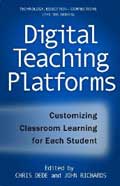 |
|
| Publisher: | Teachers College, Columbia University | ||
| Pages | ISBN | Price | |
|---|---|---|---|
| 207 pages | 978-0-8077-5316-3 | $31.95 USD | |
Digital Teaching Platforms (DTP’s) takes the form of a collection of research-rich articles that address new topics in digital education, specifically the use of Digital Teaching Platforms in the digitalization of the classroom. Features of DTP implementation are discussed from all angles of policy, pedagogy, student management, program capabilities and customization, and student achievement. DTP Time To Know is extensively discussed, and other relevant DTP’s are featured. Features are broken down and defined accordingly, creating a concrete framework for the future of DTP’s.
Digital Teaching Platforms is a collection of articles that were a result of a conference in technological trends in education held at Harvard University in 2010. Given the variety of the collection of articles and the numerous writers, the audience of the text is might include educators, administrators, and educational technology developers, and education policy makers. This text can and should be interpreted as a call to action for its audience to envision DTP’s and make them an accessible reality in school. By highlighting the specific features of existing DTP’s and building off their framework, the authors begin to set a concrete standard for their future development, improvement, and real classroom needs, and support. Likewise, the authors emphasize the need for educators to become immersed and familiar with technology, and to receive appropriate training in order to make DTP’s successful. Finally, for the interested administrator or education reformer, the text provides specific examples of how DTP’s work within different content areas, and what is needed for successful implementation backed up by relevant and tried research.
There are twelve articles (or chapters) summing up to 208 pages of content. They are categorized by four sections: Part I, Framing the Innovation; Part II, Content and Pedagogy; Part III, Personalization; and Part IV, Implementation. Prior to each section, a couple of summative pages give a conceptual outline of each chapter and contextualizing them within the broad theme. The contributors have been long-term educators, administrators, editors of several journals, founders of educational technology, and otherwise involved with the featured DTP’s. A history of achievements and related work of each contributor is provided prior to the index.
Each chapter follows a similar pattern that roughly includes: topic presentation and prior research, features of the featured DTP, challenges, and a reflective paragraph. Each article ends with a section called “The Future of Digital Teaching Platforms” which wraps up the article’s focus and looks to the future for possibilities of improvement. Due to limited prior knowledge of DTP’s, the beginning and ending sections of each chapter offer related reflections.
Part I, Framing the Innovation: The first section takes a look into the DTP’s emergence and early roles of technology in schools around the world. It sets the stage for in-depth exploration of featured DTP’s by defining the concepts that DTP’s have been created upon to maintain a constructivist (focus on the process of learning; student-centered and teacher-led) teaching and learning agenda: customization, practice, and assessment. A comparison chart places and evaluates the key features of DTP’s alongside other types of 21st century education systems such as “course platform learning management systems,” (online course delivery, customization by teacher), “course delivery learning management systems” (for use outside of class, no teacher customization), “textbook,” (traditional text) and “e-book” (digital book). These introductory chapters give a detailed depiction of many aspects that these 21st century learning environments provide such as: teacher and student administration tools, curriculum integration, assessment features, classroom support, and pedagogical support. Beyond its numerous benefits, some of the challenges are addressed in terms of classroom management: attention, momentum, space and time, routines, and discipline.
Another focus of this section is on student achievement. Discussing research findings from Project Red 2010 (achievement and cost in the 1:1 classroom; 1 digital device per student) the writers reflect on why there have been mixed results about one-to-one computing programs. They identify factors that result in high performance of students. Defining “first-order change” (doing old things in new ways) and “second-order change” (doing new things in new ways), is important to the evaluation of technology use and effectiveness of student achievement.
Part II, Content and Pedagogy: Each chapter in this section focuses on specific features and implementations of DTP’s across different contents (science, reading, math). The DTP’s featured are Web-based Inquiry Science Environments (science), Coh-Metrix (reading), iSTART (reading), ASSISTments (math), and SimCalc MathWorlds (math). Each article goes on to focus on the technical infrastructure or accessing, organizing, managing, and customizing materials, as well as provide examples through images and case vignettes of each program.
Part III, Personalization: The chapters in this section explore the various customization features that DTP’s can offer in the area of formative and diagnostic assessments. The benefits and challenges of immersive learning environments (explorative digital worlds) are addressed in terms of immersive learning and student performance data gathering. The later chapters focus on cutting edge forms of assessment through computer technology designed to increase analysis, feedback, efficiency, and validity.
Part IV, Implementation: This final section centers in on one specific DTP pilots implemented in a few schools in the United States: Time To Know. Calling on prior research about Time To Know, the writers discuss its customization abilities, and the ways customization can be made to support any teacher’s personal teaching practices and needs, as well as meeting the learning needs and of their students.
Being very interested in educational technology, I was able to find in this text a multitude of resources and research that supports the technology-driven classroom. I was able to gain a thorough understanding of the features that DTP’s implement, as well as find out about existing DTP’s and what their capabilities and limitations are. As a secondary (grades 9-12) English Language Arts teacher I found that the Time To Know DTP would be easily integrated into a 1:1 classroom, and would love to take the necessary steps to bring it to my own classrooms. The history of technology emergence in the classroom put into perspective the changing abilities and features that technology can bring and what needs to happen in order to make this a wide-reaching reality.
Universities across the world have a wider acceptance of the use of digital devices in the classroom, and K-12 schools have lagged in keeping up. While some areas in the United States are quicker in adopting digital technology as part of K-12 schooling, there are several schools across the world that already have a 1:1 ratio of computers per student, all of which could take advantage the support system of DTP’s. Challenges and opportunities in effective pedagogy, classroom management, customization and differentiation posed by DTP’s can cross cultural boundaries. The challenges discussed in the book (attention, momentum, space & time, routine, and discipline) are issues encountered by educators everywhere on a daily basis. As DTP’s encourage transferability of many concepts and skills, the customized learning and teaching experience can be created for teachers to address each student’s needs more efficiently and with more customization.
Reviewed by
Lidia Argentina Paun
The University of North Carolina Charlotte, USA
<lapaun uncc.edu>
| © Copyright rests with authors. Please cite TESL-EJ appropriately.Editor’s Note: The HTML version contains no page numbers. Please use the PDF version of this article for citations. |