

December 2012 – Volume 16, Number 3
Identity, Agency and the Acquisition of Professional Language and Culture |
|||
| Author: | Ping Deters (2011) | 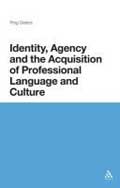 |
|
| Publisher: | London: Continuum International Publishing Group | ||
| Pages | ISBN | Price | |
|---|---|---|---|
| 229 pages | 978-4411-0544-8 | $140.00 USD | |
In Identity, Agency and the Acquisition of Professional Language and Culture, Ping Deters, a Professor at the English Language Institute, Toronto, Canada, presents an in-depth qualitative research study on the integration of high-skilled immigrant teachers into professional contexts. The focus of Ping Deters’ research is the acculturation of foreign-born teachers—Internationally Educated Teachers (IETs)—who moved to Ontario, Canada as adult immigrants. She tells of the struggles IETs experience as non-native, English speakers in procuring and keeping employment as educators. Her study explores the “relationships between identity, agency, and IET’s acquisition of professional language and culture” (p. 54). Nations throughout the world are experiencing increasing in-migration of educated professionals; Deters’ study provides insight into possible affordances and constraints to successful acculturation of both the professional immigrants and the host society.
Using the narratives of 33 IET participants, Deter tells their stories of how they achieved varying degrees of professional acculturation and integration. As part of her research Deters also interviewed 15 educational professionals, such as administrators, who work with IETs. Her stated goal is to understand “the affordances and constraints to the successful acculturation of internationally educated teachers” (p. 15).
Identity, Agency and the Acquisition of Professional Language and Culture is a clearly written and well-organized study; even though Deters’ study is underpinned by post-modern and socio-cultural theories, her writing is quite accessible to non-academics. The first chapter discusses the problems of adult professional immigrants. Due to globalization, the professional classes are now much more internationally mobile, which makes adult language and professional acculturation especially salient issues. Deters also discusses Canada’s need for a multicultural workforce, especially teachers. She refers to the low PISA scores of first and second-generation students in Canada and believes that IETs, because they share similar cultural backgrounds as their immigrant students, could positively impact their students’ achievement.
In the next chapter Deter makes clear theoretical connections between identity, motivation, and acculturation through explaining theoretical approaches introduced by Wenger’s and Lave’s research on participation in communities of learning (Wenger, 1991; Lave & Wenger, 1998). She highlights the ways in which participation in communities of practice shapes learners identities and their agency—the ways in which they participate in the community. She discusses various language socialization and socio-cultural theorists who propose that learning is a process of becoming an active and full participant in a particular community. She further explains that the degree to which an immigrant is able to participate, especially in a professional community, is determined by their language proficiency. Language proficiency, as she explains it, includes an understanding of cultural behavior and norms. She makes the case that language proficiency is an important piece in an individual’s ability to interact in the world, and the degree to which they are able to competently interact with the world impacts how IETs see themselves.
Chapters Four through Seven are devoted to a discussion of her findings from her research highlighted by transcripts from her IET interviews. As she discusses her participants’ experiences, Deters seems to use the terms integration and acculturation synonymously. She defines successful professional integration as, proficiency in the official language, the ability to find work, and participation in the civil society. A benefit of conducting research with IETs is that as professionals they are able to articulate the psychological tensions between identity maintenance and identity change as they professionally acculturate into their host society.
A main thrust of her book is identifying the affordances and constraints to successful acculturation of IETs. It is not surprising that the restraints have to do with language and cultural differences. The main constraints she identified through her interviews had to do with differences in “interactions with students and parents, differences in professional beliefs and behaviors, and discrimination” (p. 120). As professionals the IETS interviewed did not always feel competent as teachers, which directly impacted their sense of self, “a person’s identity is fundamentally constituted through forms of competence” (p. 120). The affordances that helped IETs feel competent and successful were connected with support from peers and administrators, “various forms of social support, resources, observation and practice, and beliefs and practices” (p.120).
Deter brings up some interesting points regarding identity and acculturation in her conclusions. She touches upon the idea of dual acculturation—the need for both newcomers and the host society to accommodate and adjust (p. 221), which as she points out, hasn’t been applied to Second Language Acquisition theory. Too often the onus for acculturation is put solely upon the English language learner. Her research makes the case that the mainstream society needs to make adjustments and accommodations in order to assist language minority immigrants in the integration process so that they can feel part of a community of practice.
As a teacher of high school English Language learners and a researcher of issues pertaining to school culture and Long-term English Language Learners, I found Identity, Agency and the Acquisition of Professional Language and Culture provided persuasive insights into the importance of the host community providing accommodations, or as Deters would put it affordances, for English Language Learners. ELLS and IETs need social support in order to feel like full participants in their communities. Deters makes clear the connections between validation of English language learner’s identity by their professional and learning communities of practice and their psychological well-being. As she reiterates throughout the book, individual identity of English language learners is mediated by their social experiences and their social experiences are mediated by their language and cultural competencies. I recommend Identity, Agency and the Acquisition of Professional Language and Culture to educators, administrators and others, who are interested in ways to improve the integration and acculturation of English language learners into our professional communities, schools and other communities of practice.
References
Lave, J. & Wenger, E. (1991). Situated learning: Legitimate peripheral participation. Cambridge: Cambridge University Press.
Wenger, E. (1998). Communities of practice: Learning, meaning and identity. Cambridge, MA: Blackwell.
Reviewed by
Maureen Ray
Portland State University, USA
<mray2b1 yahoo.com>
| © Copyright rests with authors. Please cite TESL-EJ appropriately.Editor’s Note: The HTML version contains no page numbers. Please use the PDF version of this article for citations. |