

May 2013 – Volume 17, Number 1
Reaching and Teaching Diverse Populations:
|
|||
| Author: | Mary Bellucci Buckelew & Andrea Fishman (2011) | 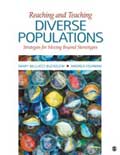 |
|
| Publisher: | California: SAGE Publications, Inc. | ||
| Pages | ISBN | Price | |
|---|---|---|---|
| 176 pages | 978-1-4129-7736-4 | $42.95 USD | |
Reaching and Teaching Diverse Populations is a book designed to be a comprehensive guide for both novice, veteran US-based and non-US-based educators or professional developers. Mary Bellucci Buckelew is Associate Professor of English at West Chester University in Pennsylvania and the Associate Director of the Pennsylvania Writing and Literature Project. She used to live in New Mexico where she taught high school English. Her experience might affect her research; she has also published books on how to teach and handle diverse populations in classrooms. Andrea Fishman is Professor of English at West Chester University in Pennsylvania and the Director of the Pennsylvania Writing and Literature Project. The strategies in this book come from their work in K-12, undergraduate, graduate, and professional development settings. Their various experiences in dealing with issues that arise in diverse classrooms are found in the forty reflective activities in this book.
The authors argue that regardless of how students are labeled, they are complex individuals. Teachers can engage the rich complex identities of their students in ways that promote learning in and outside the classroom. There is a way to reach them, identify their personalities, lead them to acknowledge each other, and create their own individuality while connecting with other personas in the classroom.
The purpose of this book is to lead each individual in classroom or group setting to identify himself or herself, to interact with each other to be aware of multicultural existence, to introduce classroom/group inquiry, and finally to create the original classroom ecosystem. This book has four sections with forty strategies to offer educators and professional developers to conduct education with diverse and multicultural participants.
According to the authors, this book is designed for four audiences. First this book is for undergraduate and graduate students for their coursework. Second, this book is for novice and experienced teachers for their daily materials to go beyond the stereotypes they see in their daily lives. Third, this is the book for professional developers to reflect on their perceptions. Finally, this book is for anyone conducting a workshop on community outreach. Since Reaching and Teaching Diverse Populations is the book for many varieties of usage, it is a very valuable book. At the same time, I would like to add that this book is designed for non-US language educators, too. Step-by-step strategies in this book are easy to follow and apply to our own classrooms, whether they are diverse and multicultural or less-diverse and monocultural. I was an English teacher at the high school level in Japan, and from my experience I can recommend the activities from this book in high school English classes. I am teaching Japanese language undergraduate students at the University of North Carolina, Charlotte, and I used one of the activities in my basic Japanese class to encourage my students to identify themselves with Japanese words. I believe anyone will be able to use activities from this book in any language situation at many levels of proficiency in widely diverse settings.
Reaching and Teaching Diverse Populations is divided into four main sections. There are forty strategies throughout the book to develop an equal, fair environment, and to be aware of diversity and multiculturalism. Each strategy has a rationale, systematic instructions, looking back and looking ahead, content-area extensions, and additional applications. The modules are straightforward, easy to understand, and easy to apply. They are written in plain English and do not use any ESL jargon, so I believe it will guide non-US language educators easily into ESL settings or diverse multicultural settings.
Section 1 illustrates how to reveal and explore the complex identities of individuals in a diverse classroom. The authors emphasize that each student is a complex individual with the potential to both contribute to and benefit from interactions with others. The authors mention every student is influenced by societal and cultural structure and he or she becomes an individual, beyond a stereotype. This section begins with individual identity and developing self-awareness for all students. There are eleven strategies in section 1, starting from recognizing students’ identity to finishing with accepting their own identities. Educators or professional developers can use this section as an icebreaker or introduction at the beginning of a class/group session.
Section 2 addresses intercultural interaction among students. Students who accept their individual identities in Section 1, move towards recognizing other members as individuals with multiple identities. Eleven strategies in this section are designed to foreground the connectedness and interactions in the classroom. The authors emphasize that educators or professional developers can talk about stereotypes and explain the source of them for providing students the ability to move beyond the limited category.
Section 3 provides the opportunity to practice classroom research before educators teach and lays an important foundation for future professional life. After learning the material in Sections 1 and 2, students realize the multiculturalism of other individuals around them. Then they move on to classroom inquiry. There are ten strategies in this section. Educators or professional developers can encourage students to experience inquiry strategies and processes beyond stereotypes.
Section 4 elucidates why it is important to analyze pedagogy. In this section, readers can review “best practice” strategies that we have learned at universities or we have experienced when we were students. In this section, educators will analyze the implications of a beyond-stereotypes approach for creating their own successful classrooms, no matter how diverse their students may be. After educators or professional developers have experienced sections 1, 2, and 3, they learn four ways to analyze the cultural responsiveness of these strategies, and decide how they might use them to create and sustain their own beyond-stereotypes classrooms.
Overall, Reaching and Teaching Diverse Populations is a must-have for US language educators as well as non-US language educators who face not only diverse multicultural classroom settings but also less diverse and monoculture classroom settings. Since this book focuses on individual awareness of creating our own classrooms, educators can easily follow the information and apply strategies to their students. At the same time, one of the strongest points of this book is we can pick up any strategy from the forty presented here and use them any time during the semester. Since I am a non-US language educator and have an experience in less diverse and single culture classrooms, I can recommend this book to my previous co-workers who are struggling to find more effective materials for their students. Even novice educators can use the simple systematic strategies to create their own materials or just follow the items provided. For veteran teachers, this book is full of ideas that they can apply in their classes.
Reviewed by
Tomoko Okimoto
The University of North Carolina at Charlotte
<tokimoto uncc.edu>
| © Copyright rests with authors. Please cite TESL-EJ appropriately.Editor’s Note: The HTML version contains no page numbers. Please use the PDF version of this article for citations. |