

November 2013 – Volume 17, Number 3
Listening Power 2 Student Book and Classroom Audio CDs |
|||
| Author: | David Bohlke & Bruce Rogers (2011) | 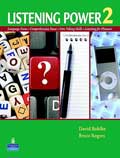 |
|
| Publisher: | Pearson Longman | ||
| Pages | ISBN | Price | |
|---|---|---|---|
| 151 pages | 978-0-13-611425-3 | $49.33 USD | |
Listening Power 2 Teacher’s Pack |
|||
| Author: | David Bohlke & Bruce Rogers (2011) |  |
|
| Publisher: | Pearson Longman | ||
| Pages | ISBN | Price | |
|---|---|---|---|
| 105 pages | 978-0-13-611426-0 | $18.33 USD | |
Listening is often described by students and teachers as one of the most difficult aspects of second/foreign language teaching and learning. This is in part because, historically, listening has been comparatively neglected in second language research and pedagogy (Flowerdew & Miller, 2005; Morely, 2001), resulting in a lack of materials specifically related to that critical skill. However, recently, there has been an increase in research related to second language listening and, by consequence, practice-oriented classroom texts.
Listening Power 2 is the second in a series of three textbooks dedicated to the development of second/foreign language listening skills and strategies. The Student Book is intended for intermediate-level young adult learners and is designed to prepare students for listening in both academic and nonacademic environments. It includes a set of four audio CDs, which are used extensively in the activities found in the text. In addition, teachers have the option of acquiring the Teacher’s Pack—a useful manual that includes quizzes, audio transcripts, and guidelines for developing additional activities for the listening course.
The book is divided into four sections, rather than comprehensive chapters, which are intended to be used concurrently. The four sections consist of the following: Language Focus, Comprehension Focus, Note-Taking Skills, and Listening for Pleasure. Each section is then broken down into units (and sometimes subsections) targeting specific features and functions of aural language. The organization of the units generally follow the pattern of warm-up, pre-listening, during-listening, and post-listening activities. Briefly, I will describe each of these sections and provide some examples to give an idea of their content.
Language Focus
The Language Focus section narrows in on aspects of aural language that are often troublesome for intermediate-level learners. In Unit 1, “Understanding Questions”, students are made aware of the types of words that denote specific kinds of questions (such as modal verbs for yes/no questions). For each of these question types, there is an explanation of what kinds of information or responses are required, followed by audio examples for students to practice.
A particularly unique feature in this section is the inclusion of information about pronunciation features (mainly suprasegmentals—e.g., intonation, stress, pitch) that pertain to listening comprehension. Since different languages exploit pronunciation for different communicative purposes (Celce-Murcia, Brinton, & Goodwin, 2010), such information can help students better understand the meanings signaled by the speech patterns they hear, thus enhancing their overall listening ability and comprehension.
Comprehension Focus
This section is divided into two subsections—Building Skills and Applying Skills—and helps students learn to listen for specific purposes. Units in the Building Skills subsection begin with a specific listening skill (for example, understanding main ideas) and proceed with a practice section of several listening activities to help students hone the skill in question. In the Applying Skills subsection that follows, students use the various skills they have learned in the previous units in order to complete activities related to new listening passages. The practice with these passages helps to reinforce and synthesize the previously learned material. The units end with a post-listening activity where students discuss and expand on the topics discussed in the unit.
Note-Taking Skills
Like the Comprehension Focus section, the Note-Taking Skills section is also divided into Building Skills and Applying Skills subsections. The Building Skills subsection introduces various note-taking skills (such as using abbreviations, symbols, and omitting unnecessary words) and highlights several useful points to help students understand the purpose and complexity of taking notes in academic (i.e., lecture-based) listening situations. Then in the Applying Skills subsection, a variety of note-taking tasks that simulate academic listening situations require students to consolidate the skills they have learned in the previous subsection. The subsection also includes activities where students evaluate and self-monitor their own note-taking, which helps to foster autonomy in learners and give them a greater sense of self efficacy.
Listening for Pleasure
In this section of the textbook, students practice with extensive listening passages that are fun and interesting. The activities included are useful because they synthesize material presented throughout the book and encourage creative, meaningful responses from students. Each unit contains several listening activities that teachers can easily exploit for a number of different purposes. In addition, the audio transcripts included in the Teacher’s Pack can be utilized for other activities beyond those included in the textbook. Unfortunately, there are only two units in this section, which limits the range of listening material. However, the Teacher’s Pack offers many suggestions for involving students in gathering additional extensive listening materials, as well as activities that can be developed using such materials. In so doing, teachers individualize the teaching-learning process and actively involve students in their own learning.
Each section described above possesses many useful features, and overall, there are several positive attributes of this textbook, including its organization, its clear focus on the listening skill, and its use of various listening genres/registers. The flexibility that is afforded by the organization of the textbook is useful because it allows teachers to pick and choose (or skip) which skills they would like students to focus on, rather than having skills embedded in comprehensive chapters. At the same time, each listening skill is presented in a contextualized manner where students get a clear idea of how, when, and why such skills are important.
Although other language skills are introduced when they pertain to developing a particular listening skill in question (for example, learning transition words to facilitate listening for main ideas), the majority of activities featured in Listening Power 2 focus specifically on the listening skill itself. As a teacher, this is ideal when teaching a course that is focused primarily on listening, as is common in many intensive English programs with separate discrete skills courses.
Many of the activities encourage learners to analyze the register (i.e., the situation of language use) they are listening to by identifying such situational features (Biber & Conrad, 2009) as the purpose of the communication, the intended audience, and the setting. Such activities not only help students become more active listeners but also raise students’ awareness of some of the pervasive language features that occur in particular registers.
While the general content of the textbook is theoretically and pedagogically grounded, a potential drawback of the book is that the listening activities are all based on material created by the author. That is to say, the listening activities are not authentic—and do not represent many of the aspects of listening that learners will encounter in the real world (e.g., rapid speech, false starts, diverse regional accents). Thus, teachers would be advised to supplement their listening courses with authentic materials in order for students to get exposure to and practice with such language phenomena.
Nevertheless, the inclusion of a variety of listening genres/registers helps to make up for shortcomings in authenticity, as students can practice with these various types of listening in a scaffolded, low-stakes environment. Overall, the textbook is very useful and would be recommended for intermediate listening courses or as a compliment to an integrated skills course.
References
Biber, D. & Conrad, S. (2009). Register, genre, and style. Cambridge: Cambridge University Press.
Celce-Murcia, M., Brinton, D. M., & Goodwin, J. M. (2010). Teaching pronunciation: A course book and reference guide (2nd ed.). Cambridge, UK: Cambridge University Press.
Flowerdew, J., & Miller, L. (2005). Second language listening: Theory and practice. New York: Cambridge University Press
Morley, J. (2001). Aural comprehension instruction: Principles and practice. In M. Celce-Murcia (Ed.), Teaching English as a second or foreign language (pp. 69-86). Boston: Heinle & Heinle.
Reviewed by
Kerry Pusey
University of Macau, Macau S.A.R.
<kpusey umac.mo>
| © Copyright rests with authors. Please cite TESL-EJ appropriately.
Editor’s Note: The HTML version contains no page numbers. Please use the PDF version of this article for citations. |