

August 2014 – Volume 18, Number 2
Focus on Vocabulary 1: Bridging Vocabulary |
|||
| Author: | Diane Schmitt, Norbert Schmitt & David Mann (2011) | 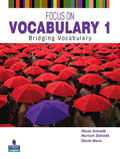 |
|
| Publisher: | Pearson Education, Inc. | ||
| Pages | ISBN | Price | |
|---|---|---|---|
| 255 pages | 978-0131376199 | $41.66 USD | |
The Focus on Vocabulary series consists of two books: Bridging Vocabulary and Mastering the Academic Word List. Focus on Vocabulary: Bridging Vocabulary focuses on vocabulary that the authors described as “bridging”—words located between high frequency vocabulary (most commonly used in writing and speech and presenting the basis of interpersonal communication) and less frequent vocabulary (used in different registers and communication on a wider range of subjects).
Bridging Vocabulary teaches 504 target words, with 24 words per chapter. The total number of mastered words, however, is significantly higher considering that the book is designed to expose learners to the word families of the target vocabulary (e.g., perceive, perception, perceptible, perceptibly).
The volume would be the most appropriate for intermediate English learners. By mastering the words included in Bridging Vocabulary, they will be prepared to read and speak on a wider variety of topics and in different social and workplace contexts. Bridging Vocabulary can also be considered a necessary step for acquisition of academic vocabulary.
The book has a simple-to-follow organization. It consists of seven units, with each of them centered on a particular topic, such as Happiness, Environment, and Technology. Each unit has three main chapters, whose thematic focus is connected with the major subject of the unit, and a Strategy Practice chapter that allows students to recycle the target vocabulary, as well as learn and practice a variety of strategies.
This thematic organization, in my opinion, is a great feature of this book because it gives students exposure to several different issues related to the same theme and provides them with the opportunity to practice the words learned in the previous chapters of the unit. To give an example, the chapters in Unit 7—Environment—have the following titles: “Eco Fashion”, “Hunting the Hunters”, and “High-Tech Trash”.
At the beginning and the end of each chapter, there are two similar activities: Assessing Your Vocabulary Knowledge and Knowledge Check 1 (at the beginning of the chapter) and Revising the Target Words and Knowledge Check 2 (at the end of the chapter). The purpose of these activities is to help learners assess their previous knowledge of the target words as well as give them a chance to evaluate the effectiveness of the target vocabulary acquisition.
The core of each chapter is a reading passage followed by reading comprehension questions, which are created not only to assess students’ understanding of the text, but also give them the opportunity to express their opinions about the issues addressed in the reading. To help students pay special attention to the new words and notice the particular contexts in which they are used, the target vocabulary items in the readings are given in bold. The reading passages also indicate word counts, which can be useful for time-reading purposes.
Focusing on Vocabulary — the section in each main chapter that features activities for practicing the target vocabulary — has three parts. Word Meanings provides various activities that help students internalize the meanings of the target words. Some of these activities include locating the words in the reading passage, completing sentences with the target words, and matching the target words with their meanings, to name a few. In Word Families, learners will find exercises that will facilitate the acquisition of different forms (derivatives) of the target words belonging to the same word family. In my opinion, these exercises are great vocabulary-building tools. In addition, they also allow the instructor to teach about the word formation rules and patterns. Finally, Collocation aims at developing learners’ intuition about the collocations of the target words.
To help students practice the target vocabulary in communicative activities, opposed to controlled exercises included in Focusing on Vocabulary, each chapter includes Expanding the Topic section. The activities in this section include questionnaires, discussion tasks, writing prompts, and other types of speaking and writing activities that allow students to use the target vocabulary in meaningful contexts as well as deepen their knowledge about the topic of the chapter and perhaps even relate it to their personal experiences.
Another interesting feature of Bridging Vocabulary is Word Tip found in some of the main chapters. These tips provide additional explanations on particular usage of a target word or indicate the most common mistakes that English learners may have with the meaning or the usage of the word.
Strategy Practice chapters at the end of each unit aim at teaching students a variety of skills that facilitate their vocabulary building techniques and help them correctly use the words in written and oral communication. Some of these skills include using context to understand words, working with dictionaries, understanding and using synonyms, to name a few. The activities in this chapter are also designed to give learners the opportunity to recycle the target vocabulary of the unit.
My favorite feature in Bridging Vocabulary is the Expanding the Topic section. First, the tasks in this section are designed to help students use the target vocabulary in meaningful ways, and many of these tasks allow learners connect the topic of the chapter with their personal experiences as well as exchange their opinions. Second, teacher can creatively use these activities for a variety of purposes for both in-class tasks and for homework assignments.
What I also like about Bridging Vocabulary is its “right” amount of information. The chapters are not overloaded with activities; rather, they provide clear exercises that are targeted at developing specific skills and parts of word knowledge.
All in all, Focus on Vocabulary 1: Bridging Vocabulary is a well developed and nicely organized textbook that will help your students increase their vocabulary arsenal beyond the basic English words.
Reviewed by
Elena Shvidko
Purdue University
<elenashvidko gmail.com>
| © Copyright rests with authors. Please cite TESL-EJ appropriately.
Editor’s Note: The HTML version contains no page numbers. Please use the PDF version of this article for citations. |