

February 2015 – Volume 18, Number 4
Speak English like an American (Book and CD) |
|||
| Author: | Amy Gillett (2013, Fifth Edition) | 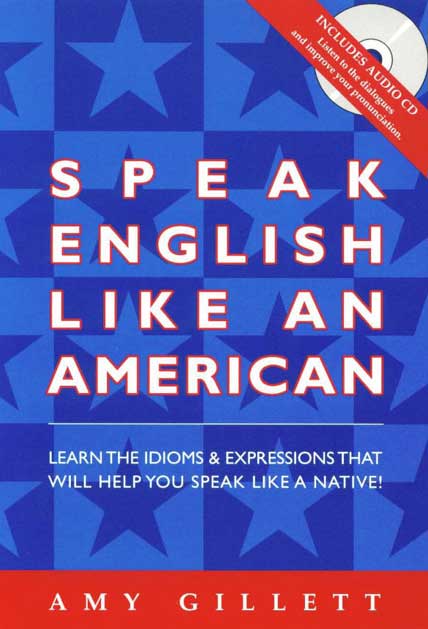 |
|
| Publisher: | Ann Arbor, MI: Language Success Press | ||
| Pages | ISBN | Price | |
|---|---|---|---|
| 173 pages | 978-0-972-53003-3 | $24.95 USD | |
Beneath the cover title, Speak English like an American is the subtitle: Learn the Idioms & Expressions that will Help You Speak like a Native! This book achieves this entitled aim by providing opportunities to learn and practice literally hundreds of idioms and expressions from American English. Gaining ability in using idioms is no easy task; idioms are one of a number of language characteristics for speaking that are quite complex. Yet, it is critical for students to work with idioms because, as aspiring interlocutors, students must be able to grasp the workings of idiomatic speech utterances to maintain conversation. The study of idioms and expressions will aid in the improvement of speaking both fluently and accurately; speech may be improved in terms of fluency because knowledge of idioms helps conversation to flow smoothly and naturally, while speech may also increase in terms of accuracy because a student who hears an idiom will know how to respond appropriately. Thus, attention to Gillett’s idioms and expressions will certainly help learners to improve their speaking skills for several reasons.
Speak English like an American is user-friendly for English language learners because the idioms and expressions are presented through dialogues. This interactive approach to the material mirrors authentic speech and turn-taking. In addition, by using dialogues, the author effectively situates the targeted idioms and expressions within an appropriate context. The attached CD offers learners a chance to follow along with each of the full dialogues. Students can focus on pronunciation and fluency aspects of using the targeted language in context.
In the Introduction, the main characters of the book are displayed in a cartoon drawing—The Johnson Family. The members of the family are Bob (father), Susan (mother), Ted (son), and Nicole (daughter). Other characters are introduced throughout the book, starting in the first lesson. The Johnson family’s story is scripted into a series of twenty-five dialogues or lessons. The plot development of the story is continuous, and flows across the textbook. The twenty-five dialogues cover themes from everyday life, such as Bob at work, Ted and Nicole at school, Ted finding a new girlfriend, and Susan starting a business. The lessons are common situations that adult learners may likely encounter in an English-speaking environment. As a whole, the twenty-five dialogues/lessons together create an overarching storyline that is useful to students because it provides cohesion to the lessons while students are guided through the individual idioms and expressions.
The format is formulaic, which is helpful for students navigating new material. Each lesson begins with a cartoon and a dialogue between two or three characters—a presentation of the new idioms and expressions to be covered. After the dialogue, there is a dictionary-style listing of all the idioms and expressions contained in the dialogue. This listing gives a definition of the idiom or expression, one or two example sentences of how the idiom or expression can be used, and sometimes a note on appropriate uses of the idiom. For example, the author writes this note for the expression shut up, “NOTE: Remember that telling somebody to “shut up!” is rude. It’s better to say “Be quiet!” or more politely, “Please be quiet!”’ (Gillett, 2013, p. 29). This notation provides a pragmatic roadmap for learners of idioms and expressions so that they can use their new knowledge appropriately. Next, the lesson offers exercises to practice using the idioms and expressions. The author entitles this section, Practice the Idioms.
The most common practice activity is a fill-in-the-blank exercise where students must choose the best idiom among four choices. Sometimes the practice asks students to choose the best substitute for the idiom; three definitions for the idiom are offered as substitutes. The author also includes another type of practice, which is excellent for students. This is a usage-based practice focusing on pragmatic responses. The directions state, Choose the most appropriate reply to the following statements. One character (for example, Bob) is quoted with a phrase containing an idiom. Students must then choose what Susan’s reply to Bob’s utterance should be. This type of practice is highly applicable to real-world functionality as students can discern which response is most appropriate to a phrase containing an idiom. This is information that students certainly can use outside of the study sphere. Finally, for some lessons, the author includes Bonus Practice, which can be any of the previous practices discussed. After each set of five lessons, there is a Review section, which offers either a fill-in-the-blank practice or choose-the-best-substitute practice, and a crossword puzzle. The crossword puzzle is a fun way for students to think creatively about how to use an idiom within a sentence or phrase. An Answer Key provides correct answers to all practices and reviews. An Index follows the Answer Key, providing easy access to pages that contain a target idiom or expression.
This book would probably be best for adult language learners because some idioms and expressions (e.g., shut up) must be treated with some pragmatic care, and adults are generally more socially aware and culturally sensitive to understand this. However, teens may encounter idioms through media and therefore could certainly benefit from studying this book so that they might have a deeper understanding of how idioms function beyond dramatic movie scripts. This book might prove to be quite challenging for beginner-level students, as the definitions of the idioms and the practices contain intermediate- to advanced-level language. Yet, teachers of American English can easily adapt selections from this book for beginner students. Certain idioms and expressions are accessible and appropriate for all levels, and the inclusion of the CD is very helpful for beginners who wish to listen to American English pronunciation.
The CD that accompanies the book features a recording of each dialogue for all twenty-five lessons. The actors have American English accents and speak at a normal rate of speech. The recordings are helpful for students who may wish to listen closely to an American English accent; in this way, this book may prove useful to teachers and learners in an EFL context. Adult EFL learners who are studying American English for work purposes and find themselves interacting with American interlocutors will benefit from Gillett’s efforts. Students studying English outside of the United States have, in Gillett’s volume, a handy set of dialogues containing idioms and expressions that they can listen to repeatedly. The CD that accompanies the book affords intensive listening practice, where students can examine discrete language items, such as idioms, through repeated listening opportunities. Alternately, this book could also be effectively used in an ESL context for international students or immigrants studying English in the United States who want to know more about how idioms and expressions function in American culture. Finally, students who wish to improve in the area of pronunciation may appreciate the use of the book and CD as tools to listen to utterances, repeat the utterances, and compare the sounds of the utterances with the written form. Ultimately, there are many uses for Speak English like an American; the decision to use the book in one way or another depends entirely on the needs of the students.
Overall, this is a useful and accessible book and CD set. The notes on the pragmatic usage of idioms, and the practice activities centered on pragmatic responses to phrases containing idioms, are particularly outstanding. This book will certainly increase students’ abilities to understand and use idioms and expressions appropriately in an American context.
Reviewed by
Melinda Cuyul
Northern Arizona University
<mec384 nau.edu>
| © Copyright rests with authors. Please cite TESL-EJ appropriately.
Editor’s Note: The HTML version contains no page numbers. Please use the PDF version of this article for citations. |