

February 2015 – Volume 18, Number 4
Interactions Access Listening/Speaking Sixth Edition |
|||
| Author: | Emily Austin Thrush, Robert Baldwin & Laurie Blass (2013) | 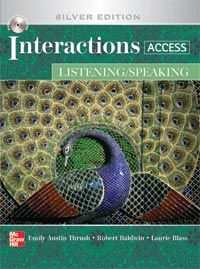 |
|
| Publisher: | New York: McGraw Hill | ||
| Pages | ISBN-13 | Price | |
|---|---|---|---|
| 250 pages | 978-0073545349 (paper) | $56.25 USD | |
Listening has a crucial role in language acquisition as stated by Winitz (1981), and it is a natural precursor of speaking (Nation & Newton, 2009). Therefore, the importance of listening and speaking lessons should not be neglected. On the other hand, just exposing learners to audio materials (the “sink or swim” method) is not effective. Learners should be taught how to be effective listeners. For example, raising the awareness of strategies for listening and speaking is one way of being an effective communicator.
Interactions Access Listening/Speaking is the first book of the Interactions series aimed to develop listening and speaking skills of students who study or are planning to study at the tertiary level in the USA. It is a learner-friendly book with bright colorful photos, and easy to understand designs and templates for the activities. However, taking the targeted learners (i.e., young adults of elementary level) into account, it is not overloaded with illustrations and activities.
The book is divided into ten chapters, each of which is centered on different aspects of everyday life (e.g., neighborhood, shopping, health care) and student academic life (e.g., work and lifestyles). Each chapter has four parts: conversation, using language, listening, and speaking. The listening and speaking activities are accompanied by language activities that focus on vocabulary and grammar as well as general academic skills (e.g., searching for information) and functional language (e.g., how to open or finish a conversation). Although the main aim of the book is to help students improve their listening and speaking skills, some activities also help develop reading and writing skills (e.g., reading instructions on how to do things, or filling out a chart).
One exemplar chapter is ‘Neighborhoods, Cities and Towns,’ which focuses on some survival skills, such as understanding directions, giving and asking for personal information, as well as some academic skills, such as finding information on the Internet. In addition, a number of listening strategies are also included in a few exercises. For instance, students are taught to visualize directions while they are listening to them as a strategy to better understand directions.
The first part of the first chapter begins with a few listening tips. Each listening activity in this chapter is divided into pre-, while- and post-listening stages. The ‘Conversation’ part begins by introducing useful strategies that may help students listen better. This is followed by activities that provide students with opportunities to use these listening strategies as well as to learn and practice new vocabulary. Then, learners get an opportunity to practice different types of listening in the activities that require them to listen for main ideas or details. Learners also review vocabulary that they have learned and focus on some suprasegmental features, such as word stress and linking. Like every other chapter, it includes some tips on how to use the Internet and activities that ask learners to practice what they have learned. This part ends with a conversation activity requiring students to talk to their friends to get information about them.
The second part of the first chapter, ‘language use’, focuses on the functional language of giving, asking, and confirming personal information. After explaining how to do so and teaching some strategies, the book asks students to complete some real life tasks like filling out a form, or practicing exchanging information with a partner. Vocabulary teaching is incorporated in listening activities. In this part, some real life tasks like understanding directions and reading a map are also included.
In the last part of the chapter, speaking, reading, understanding, and talking about a map is dealt with by using an American campus map. This part mainly focuses on improving speaking skills through partner/group activities and discussions. A self-assessment log is integrated at the end of the chapter, which allows students to evaluate their own learning. This helps learners become more aware of their own progress and increase the level of their autonomy.
As can be seen in the aforementioned example chapter, the book adopts the ‘three stage approach’, which follows pre-during and post listening stages. According to Field (2008), the listening in class should procure its differences from real life conversations. In real life, the listener has the opportunity to compensate for not understanding or misunderstanding a conversation. However, while listening in class, none of these is available. Therefore, preparing learners for listening in stages not only compensates for this lack, but also contributes to the overall listening skill development. In addition, especially tasks in the post listening stage encourage learners to use the information learned and to think critically, helps clarify the meaning, and provides opportunity to practice real-life tasks.
An English as a Second Language (ESL) teacher using this book would appreciate listening tasks with various focuses (e.g., listening for specific information or listening for guided note-taking), explicit teaching of listening and speaking strategies (e.g., guessing the meaning of new words from the context), as well as giving students the opportunity to practice these. In the post-listening stage, critical thinking is encouraged through some discussion questions. The bottom-up approach of the book can be appreciated by most teachers as teaching words, stress, reduced forms, and some aspects of grammar is valuable at the beginner level (Peterson, 2001).
Not only ESL teachers, but also ESL learners will benefit from the activities that touch upon teaching pragmatic knowledge, which is crucial especially for ESL learners as it affects their real-life interactions (Hinkel, 2013). Cultural information specific to the USA is covered in the book, which is beneficial for learners who are going to study in the USA and will need to adapt to the culture.
This book is motivating for learners because they can relate to the characters in the book and make use of practical, real life tasks. It allows students to talk about themselves through individual questions. In addition, the topic in each chapter is appropriate for the target audience (i.e., young adults). For instance, incorporating social networks such as Facebook or Twitter, which are very popular among current young generation, can help learners get motivated, as they will be talking, listening and learning about something that they are already interested in.
The language and tasks reflecting the real life situations are another motivating factor. Learners are not only exposed to native speakers’ speech, but to a variety of accents in the recordings. This is important in the era of ‘World Englishes’ because target ESL students will interact with other international students or international professors who may speak with an accent. In addition, teaching survival skills and providing practical tips for real life listening and speaking tasks, this book prepares learners for their life in the USA.
As mentioned above, ‘Interaction Access’ integrates some reading and writing activities as part of listening tasks; however, being a listening and speaking book, it should be complemented with reading and writing books so as to better develop learners’ reading and writing skills as well. The teacher may also want to use a pronunciation book or supplementary materials to work on students’ pronunciation, because pronunciation is not a focus in this book.
This book is a great guide for both teachers and beginner level ESL learners as it is well structured and designed for its target learners. Both ESL learners in the USA and students who are planning to study in the USA in the future can benefit from this book.
References
Field, J. (2008). Listening in the language classroom. New York: Cambridge University Press.
Hinkel, E. (2013). Culture and pragmatics in language teaching and learning. In M. Celce-Murcia (Ed.), Teaching English as a second or foreign language (pp. 394-409). Boston: Heinle & Heinle.
Nation, I. S. P., & Newton, J. (2009). Teaching ESL/EFL listening and speaking. New York, NY: Routledge.
Peterson, P. W. (2001). Skills and strategies for proficient listening. In M. Celce-Murcia (Ed.), Teaching English as a second or foreign language (pp. 87-100). Boston: Heinle & Heinle.
Winitz, H. (Ed.). (1981). The comprehension approach to foreign language instruction. Rowley, MA: Newbury House.
Reviewed by
Ozge Yol
Northern Arizona University
<oy8 nau.edu>
Tatiana Shulyateva
Northern Arizona University
<tds245nau.edu>
| © Copyright rests with authors. Please cite TESL-EJ appropriately.
Editor’s Note: The HTML version contains no page numbers. Please use the PDF version of this article for citations. |