

February 2015 – Volume 18, Number 4
Classroom Instruction that Works with
|
|||
| Author: | Jane D. Hill & Kirsten B. Miller (2013) | 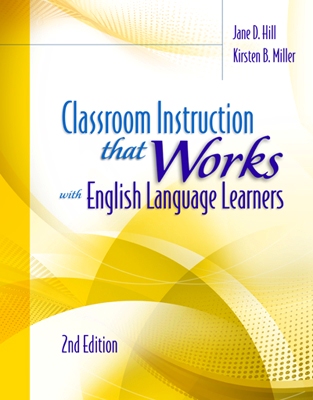 |
|
| Publisher: | Alexandria, VA: ASCD | ||
| Pages | ISBN | Price | |
|---|---|---|---|
| 182 pages | 978-1-4166-1630-6 (Paperback) | $29.95 USD | |
The challenge of meeting the educational as well as linguistic needs of English Language Learners (ELLs) in U.S. K-12 contexts is a daunting task. Classroom instruction that works with English Language Learners is a treasure trove of useful, practical strategies relevant and applicable to teaching ELLs across grade and language proficiency levels. Instruction that works is broadly grounded in nine categories of effective instruction: Setting objectives and providing feedback; Using non-linguistic representations; Implementing cues, questions and advance organizers; Utilizing cooperative learning; Summarizing and note taking; Providing homework and practice; Reinforcing effort and providing recognition; Generating and testing hypothesis; and, Identifying similarities and differences.
Jane D. Hill and Kirsten B. Miller begin this highly practical handbook with an overview of the various stages of second language acquisition that provide something of a framework for the remainder of their book to connect the strategies to instruction of ELL students. For example: a content objective for a lesson might be to help students learn the skill of summarization, using the story of The three little pigs as a tool, but should be adapted to meet students at their level of language proficiency. Students at the preproduction phase of second language acquisition who–(typically would not verbalize responses, but instead utilize non-verbal cues such as nodding or pointing) would be asked by the teacher to “Show me the house in the picture.” A student at the speech emergence phase who (can answer why and how questions in short sentences) might be asked to “Explain why the third pig built his house out of bricks”. This approach–using knowledge about the phases of language acquisition to adapt instructional strategies–is characteristic of instructional methods promoted throughout the book.
Classroom instruction that works with English Language Learners also offers a concise review of current best practices in ELL education. Tried and true strategies such as reciprocal teaching, paired reading, cooperative learning, sentence frames and advance organizers are all introduced and explained in ways that are very helpful for the novice teacher. The authors provide a summary of the research in which the specific strategy is grounded—with detailed examples of how to modify the strategies for use with ELLs in mainstream classrooms as well as teacher accounts of implementation of the practices. Because ELLs in U.S. K-12 contexts face cultural hurdles as well as linguistic ones, this book also shows teachers how to glean insight into students’ backgrounds and address the cultural biases inherent in many classrooms practices.
For example, Hill and Miller ask teachers design classrooms that send messages about diversity, relationship building and communication. Desks are arranged in clusters of four with students facing one another. The teacher’s desk is in the back corner of the room. The authors argue that thoughtful classroom physical space can support participatory engagement in practice and as a value.
As a novice teacher of ELLs myself, the most valuable resource of the ideas presented in the book is the application of Thinking Language matrix, a tool Hill and Miller propose for appropriate cognitive challenges for all students of various language proficiency levels. Their matrix aligns the levels of thinking from Bloom’s Taxonomy to the stages of second language learning. The authors argue that a students’ developing English language proficiency is not indicative of their cognitive ability. All too often teachers unwittingly assign English language learners tasks that fall on the lower levels of Bloom’s taxonomy, denying them the opportunity to practice higher-level thinking such as evaluating and synthesizing. As a result, my biggest take away from the book was the book’s concrete matrix and plentiful examples of the application of the matrix into the lesson design across grade levels and content areas.
Another important topic addressed in this book is the need of ELL teachers to plan explicit language objectives for their students. The authors demonstrate why teachers need to attend to language functions and structures in order to help students acquire the academic English they need to be successful at school. To achieve that objective, Hill and Miller have devised the
“academic language framework” that breaks this complex process into manageable steps. Again, they provide practical and concrete examples of how to do this, including previewing key vocabulary and concepts, using sentence starters, and teaching mini grammar lessons. In particular, I found the graphic organizers in the appendices particularly useful to help students with various skills such as how to summarize different types of texts as chronological, description, compare/contrast and the like.
Overall, Classroom Instruction that works with English language learners is a valuable text for educators looking to improve their practice and to employ effective pedagogical strategies such that ELLs are challenged to think at high levels with the support of appropriate scaffolding. The book would be a good addition to any pre-service teacher-training course or recommended reading list. The book could also be used for round table discussions—a starting point for groups of teachers to analyse and apply the theories and learning matrices presented. However, the book’s strength is the manner in which the content readily lends itself to the busy practitioners. It is a refreshing review for veteran teachers and an excellent resource for those new to the field. Novice teachers are provided detailed information of the process of second language acquisition, describing the attributes and characteristics of each stage, necessary teacher prompts and pedagogical methods, and developmentally appropriate expectations of ELL students at the preproduction, early production, speech emergence, intermediate fluency and advanced fluency levels. Strategies are presented in lesson examples dealing with math, science, language arts and social studies so that teachers can understand their implementation across content areas. The lessons are presented in a teacher friendly format that includes annotated bullet points, interactive activities and step by step questioning guides such as ‘reciprocal teaching strategies’ which require the teachers to prepare lessons that encourage students to summarize, question, clarify and predict information. Classroom instruction that works with English language learners should be in the libraries of all those who are dedicated to improving the academic achievement of ELLs.
Reviewed by
Tanaya Kapoor
The University of North Carolina, Charlotte
<tkapoor uncc.edu>
| © Copyright rests with authors. Please cite TESL-EJ appropriately.
Editor’s Note: The HTML version contains no page numbers. Please use the PDF version of this article for citations. |