

August 2015 – Volume 19, Number 2
Word Nerds: Teaching All Students to Learn and Love Vocabulary |
|||
| Author: | Brenda J. Overturf, Leslie Montgomery, & Margot Holmes Smith (2013) | 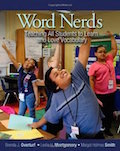 |
|
| Publisher: | Stenhouse Publishers | ||
| Pages | ISBN-10 | Price | |
|---|---|---|---|
| 184 pages | 1571109544 | $19.00 USD | |
Word Nerds is an indispensable resource for any elementary educator seeking to initiate or improve vocabulary instruction for students. With former University of Louisville professor Brenda J. Overturf writing as the insightful guide, this book takes the reader into the third, fourth, and fifth grade classrooms of Leslie Montgomery and Margot Holmes Smith to learn a practical yet effective approach to enhancing students’ word knowledge. Admittedly inexperienced and unknowledgeable at first, these two teachers share the professional development, challenges, and evolution of their program that has yielded higher student achievement, confidence, and classroom community. Drawing on the work of experts in the field of vocabulary development, Montgomery and Smith describe the adaptations, modifications, and refinements they used to create a systematic program that infuses music, art, movement, drama, writing, comprehension skills, test-taking skills, and technology. While the text material is applicable to students of all elementary schools, the authors passionately portray why and how their program meets the needs of children of poverty in particular, demonstrating the power of vocabulary and advocating for rich and rigorous pedagogy that leads to empowerment and success.
Structured into eight comprehensible chapters, the book explains each step of establishing and integrating a vocabulary development program within the typical elementary school day. Within these quick, readable chapters, Overturf weaves pertinent current research along with practical explanations to equip readers with the professional development equivalent of a conference or week-long training. Simultaneously providing explicit details, diagrams, photographs, examples of student work, and student narratives, she presents the reader with a seemingly “live” version of the practices in action. The chapter titles and section headings divide the content into clear, concise topics that can easily be referenced during a second, third, or fourth read (as the reader utilizes the information in his/her own classroom).
Chapter 1 sets the purpose of the book, emphasizing the importance of vocabulary development with research showing its correlation to reading comprehension, overall literacy achievement, and future academic success. The authors advocate the need for robust vocabulary development for children of poverty. Additionally, they make their program relevant to teachers of English Language Learners (ELLs) as it powerfully combines acquisition of concept knowledge with language development. Finally, they demonstrate quite clearly that vocabulary is a vital part of the elementary reading standards of the Common Core; providing a condensed summary of the work of the most recent and influential leaders in vocabulary, they equip their reader(s) with a foundation of understanding how their blended program applies and systematizes effective practices in order to meet the academic demands of today’s education standards.
Having armed their readers with the theoretical underpinnings of the saliency of explicit vocabulary instruction, the authors begin to show readers how to establish a program in Chapter 2, “Creating Classrooms that Foster Word Confidence.” Beginning by advocating the establishment of a classroom environment that encourages risk-taking and offers a playful attitude towards words and language, the authors then highlight the importance of introducing routines and procedures to provide students with a structured yet flexible learning environment. Management of behaviors and materials are crucial to effective execution; the reader receives a detailed tutorial, including rich descriptions of the strategic layout of each teacher’s room so that it comes to life for the reader and can be easily replicated as desired. This chapter also includes a model of classroom literacy design with various components to suggest how to structure, schedule, and incorporate vocabulary instruction within other literacy topics so that it is not taught in isolation. The authors explain how to choose words within individual parameters of school context, using the materials, resources, and curriculum available to the teacher. Finally, a routine “vocabulary cycle” is introduced to offer a clear understanding of the planning process needed for the program, including a very helpful graphic organizer and flow chart that demonstrate how to appropriately build in activities and procedures.
The following four chapters delve into this vocabulary cycle. Chapter 3 showcases the strategies behind introducing new words, as Montgomery and Smith spend time with their class in a variety of multisensory experiences, examining the critical attributes of new words, discussing their parts of speech, examples, and non-examples using routines and discussions with cloze activities and journals that foster/increase familiarity. Synonyms and antonyms are explored in the next step of the cycle, as described in Chapter 4, helping students see how words are related and helping them clarify definitions by understanding the nuances and particularities of words. Chapter 5 then offers ideas for active vocabulary practice, presenting whole group and small group activities that incorporate art, movement, technology, movement, drama, public speaking, and more; these experiences not only motivate students to learn but also ensure that they remember more. Readers will undoubtedly bookmark, highlight, or tag their favorite activities described in this section, ready to implement/try them out with their own class the next day. Finally, the vocabulary cycle closes with the celebration of learning described in Chapter 6. All of these suggested activities include an “air of celebration” and offer opportunities for open-ended conversation, encouraging students apply and expand their networks of words. Additionally, these “parties” hold all students accountable for their learning and allow for informal and formal assessment opportunities to inform the teacher of students’ mastery levels with words.
The book concludes with Chapter 7, “Spreading Vocabulary Wings”, providing readers with additional strategies that can be used to deepen students’ word knowledge, including attending to their morphemic awareness, using background knowledge to expand connections with vocabulary, and incorporating children’s literature into content areas to practice academic and domain-specific vocabulary. Finally, Chapter 8 is devoted to assessment, as the authors recognize the realities of teaching in an era of high-stakes testing and accountability. Explaining the importance of both formative and summative assessments, Montgomery and Smith demonstrate a systematic approach to practices that help them identify gaps in knowledge, plan accommodations and supplementary experiences, and reteach if necessary, all the while preparing students for the standardized tests in which they will undoubtedly encounter.
Word Nerds is an engaging and informative text particularly suited to the elementary school contexts facing teachers today. Overturf, Montgomery, and Smith speak to the most pressing issues of education, designing effective and culturally relevant pedagogies that meet the needs of diverse learners, including students of poverty and English Language Learners. The resources provided in this book make possible the successful integration of vocabulary instruction allows for the scaffolds and accommodations needed in classrooms today. Most admirably, the authors advocate a greater purpose for robust vocabulary instruction, calling teachers to action on behalf of their students. Readers will be left equipped with numerous effective strategies and rejuvenated to tackle instructional demands the very next day.
Reviewed by
Laura Handler
The University of North Carolina at Charlotte
<lkhoeing uncc.edu>
| © Copyright rests with authors. Please cite TESL-EJ appropriately.
Editor’s Note: The HTML version contains no page numbers. Please use the PDF version of this article for citations. |