

February 2016 – Volume 19, Number 4
Co-Teaching That Works:
|
|||
| Author: | Anne M. Beninghof (2012) | 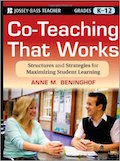 |
|
| Publisher: | Jossey-Bass | ||
| Pages | ISBN | Price | |
|---|---|---|---|
| 272 pages | 978-1118004364 | $23.60 USD | |
Co-Teaching That Works is a valuable resource for teachers seeking to enhance their co-teaching experience. This book provides readers with tools and practical ideas for educators to make co- teaching effective and more importantly their own. Anne Beninghof has a background of over thirty years of experience both in public and private settings. Due to her expertise in education, she has successfully published various books and videos in which she shares her vast knowledge with other professionals in the field. Additionally, Beninghof has provided staff development in forty-nine states and worked with varied state agencies to include diverse practices. Her experiences include being a special education teacher, a faculty member of the University of Hartford and the University of Colorado. In her book, the author recognizes the challenges faced in co-teaching settings and the varied models for co-teaching. Furthermore, she meticulously divides the book into different co-teaching scenarios providing information on how to successfully teach with an abundance of designated specialists in varied areas such as Special Educators, Technology, Speech/Language, English as a Second Language and Gifted Education.
The text is structured into four sections. Part One: Putting Together The Pieces, Part Two: Looking Through the Co-Teaching Kaleidoscope, Part Three: Creating A Unique Design For Working Together and Part Four: Wrapping It Up. The publication also features an Appendix with valuable instructional strategies for classroom use. These include easy systematic directions that are user friendly for rapid classroom implementation. The Reference and Index section are found on the back of the book.
Part One focuses on defining co-teaching and discussing relationship building while guiding readers through the implementation process. Chapter One sets the tone for the book by providing readers with the definition of co-teaching; it explores various research on co-teaching while acknowledging the benefits. Chapter Two sets the climate and provides guiding questions to establish communication among both teachers and it explores roles and responsibilities. Chapter Three refers to the managing of classroom duties like creating a designated planning time, grading and evaluations. In conclusion Chapters Two and Three, inform the readers about common challenges while providing actual solutions. This section is of particular importance because it sets the stage for co-teaching by providing essential information, critical to understand this particular art of teaching. These Three Chapters ensure that teachers are on the same page before they start co-teaching.
Once readers understand what co-teaching is, Part Two allows them to explore nine co-teaching models. The following chapters discuss the roles and responsibilities for each teacher involved and provide specific pros and cons for each model. Detailed descriptions of each model give teachers a full insight on each model. Teachers can pick and choose the best teaching model according to student needs and staff allotment. Additionally, Beninghof includes sample lesson plans for each model. This provides readers the opportunity to visualize how this might look in their classroom. Checklists are provided to facilitate the implementation of the models in the classroom. These checklists name specific responsibilities and break them down into four categories. The four categories are broken down by teacher A, teacher B, shared responsibilities, and side comments. These models are addressed later in Part Three.
Part Three allows readers to choose between specialists according to their classroom needs and staff allotment. Chapter Thirteen through Chapter Twenty concentrate on co-teaching with eight different specialists. Each section offers a description of the particular specialist strength and what they contribute to each co-teaching setting. Furthermore, the author provides her opinion on the best model to use with the designated specialist. Possible challenges are also addressed in each section. This frontloads the reader on the challenges that may arise. Ultimately, the author also provides tips and strategies essential for success. Part Four, the shortest section leaves readers with a heartfelt conclusion. Beninghof states that successful co-teaching takes time. Generally, it takes about three years for teachers to solidify the foundation allowing them to create strong partnerships. In this section, the Appendix is included and provides readers with different instructional strategies for all learners. Some strategies include connection puzzles, board relays, brain bookmarks, colored acetate strips, discussion chips, group graffiti, RAFT strategy and many more strategies which are equally as interesting.
I am a first year teacher at a Title 1 Elementary School located in the Piedmont region of North Carolina. As a first year teacher, there are many things that you have to learn throughout the year. There are some things that student teaching does not necessarily prepare you for one of those being co-teaching. We attend orientation, staff meetings, and for those of us that are lucky enough we have mentors to help us at our school. However, every day you are faced with varied obstacles in the classroom weather it is classroom management, incorporating the Common Core standards into your lessons, or co-teaching. As an English as a Second Language teacher and coach, my role is to teach English Language Learners (ELL) and to provide teachers with the tools needed to better improve their instruction for ELL students. A typical day consists of pushing into the classrooms to co-teach with teachers and pulling groups of students out of their class for small group instruction. I co-teach with teachers particularly in third and fourth grade. My preference is to co-teach because students are not missing out on instruction and you can also help others students in the classroom.
This book met my goal of understanding the theory and practice of co-teaching. But due to diverse teacher personalities and the different grade levels there is a wide-range on how and what co-teaching is. The book allowed me to gain insight into varied co-teaching models and help me find my best fit. To my surprise, I found several teaching models that I engage in like the Lead and Support Model, the Speak and Add Model, and the Stations Model. Conversely, the book introduced me to their formal names. I learned that the best model to use in the ELL field is the Duet model, which I plan to incorporate. Also, I gained clarity on specific roles and responsibilities, pros and cons, and a checklist created for each specific model. I learned a lot about other models that I did not even know existed. I envision teachers using these great co-teaching models to maximize services in the classroom. The first three months, I struggled with the identity of my role as a specialist because I am a first year teacher and I was unsure if I was co-teaching the “correct” way. Based on my student teaching experience, I was lucky enough to co-teach and was drawing on this experience to help me. I learned that there is not a specific manual on how to effectively co-teach. Nonetheless, no two experiences are similar. All teachers possess varied teaching styles, personalities, and have a set classroom culture. When you push into different classrooms, you have to be aware and respectful that not every teacher operates the same way. Additionally, I did not feel experienced enough to co-teach due to the extensive complexities that it entices. But as Beninghof mentions effective co-teaching is changing, accommodating and flexible. Prior to reading this book, I felt uneasy about co-teaching due to the structure and the varied teacher personalities. After reading the book, I have become more comfortable with co teaching and feel confident in my specific role. I feel that I am more able to assist and support new teachers.
I encourage all specialist/coaches and teachers involved in co-teaching to read this book as a book study. In doing so it can help build or strengthen school culture, especially at the beginning of the year when there are several new staff members. However, veteran teachers can also benefit from this reading because co-teaching is a newer approach in teaching. Both teachers and specialists can create their own vision of co-teaching in their classroom. There are various tools such as rubrics, checklists, surveys and observation tools that aid teachers in establishing a defined working relationship. Having defined roles in the beginning will bring clarity throughout the year. The book even shares strategies on how to find planning time, how to distribute grading, and which models to follow. I really enjoyed how Beninghof makes the information practical and easy to digest. This is a great book that should be required to read in Teacher Preparation Programs. As a result, this book has been incredibly handy; I have increased my knowledge on the practice of co-teaching.
Reviewed by
Azucena Ramirez
Kannapolis City Schools
<azucena.ramirez kcs.k12.nc.us>
| © Copyright rests with authors. Please cite TESL-EJ appropriately. Editor’s Note: The HTML version contains no page numbers. Please use the PDF version of this article for citations. |