

May 2016 – Volume 20, Number 1
Content-area Conversations: How to Plan
|
|||
| Authors: | Fisher, D., Frey, N., & Rothenberg, C. (2008) | 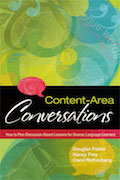 |
|
| Publisher: | ASCD, Alexandria, VA | ||
| Pages | ISBN | Price | |
|---|---|---|---|
| 175 pages | 978-1-4166-0737-3 | $23.95 USD | |
Speaking and listening challenge students and teachers in the language classroom. Teachers routinely spend considerable time planning and delivering reading and writing lessons while they often grapple with developing students’ oral skills. The former are concrete in nature while the latter are abstract and often more nuanced. Moreover, this issue is compounded since students, especially older learners, are often more hesitant to engage with listening and speaking activities among peers.
Content-Area Conversations by Fisher, Frey, and Rothenberg is a useful and comprehensive approach to integrating oral discourse into teaching and learning via “content-area conversations.” An insightful look into the nature of talk, especially academic talk, the book provides easy to understand perspectives on the fundamental role of discourse in language and learning. The authors address a variety of issues surrounding talk in the classroom that will both help educators understand challenges and how to plan for and implement meaningful opportunities to support oral discourse. In short, Content-Area Conversations provides an instructional framework and practical, easy-to-use tips to foster discourse in the classroom with diverse language learners.
I used this publication with graduate students to demystify complexities of developing and managing oral language activities. However, this book is also appropriate for pre-service educators as they also benefit from learning myriad approaches to teaching and learning. Many students not only struggle with learning a new language but also with academic vocabulary, especially in the context of dense, difficult textbooks. Fisher, Frey, and Rothenberg argue that planning for “purposeful talk” fosters academic discourse.
Chapter One: Why Talk Is Important in Classrooms
The initial chapter provides a brief history of talk in the classroom and why traditional teaching approaches have realized limited success with fostering oral language. In short, they point out that classrooms typically are characterized with “teacher talk” which reiterates the teacher-knowledge but falls short in engaging students. Aptly, the authors make a compelling case that “talk, or oracy, in the foundation of literacy” (p. 8). They also address differences among students and language proficiency levels and describe when and how talk facilitates learning.
Chapter Two: Fostering Academic Discourse
Fostering discourse is the keystone of this publication. Chapter Two looks at second language acquisition and explains why fostering discourse serves to enhance language learning. Examples are included to explain how students can develop a variety of language registers, “ways of describing the relative formality of speech” (p. 26). In addition, the authors provide an overview of social and academic language and how such language is developed in content areas. A well-defined and practical chart to support understanding the differences between social and academic language proficiency is included and addresses language domain, approximations, functions, cognitive demands, sentence structure, and vocabulary. This resource is an instructional aid teachers can reference when planning activities that require both social interaction and academic discourse.
Chapter Three: Planning for Purposeful Talk
This chapter is perhaps the heart of this publication. Fisher, Frey, and Rothenberg posit here that “purposeful talk” is how students learn new concepts. This chapter speaks to the importance of intentional planning to promote oral language among students. It is rich and replete with teacher tips for planning meaningful interactions, examples of robust questions, and ideas for building background to engage students with talk in authentic and meaningful ways. An important feature of this chapter is the authors’ look into three classrooms where teachers integrate oral language. All three examples are examined through the following lens: anticipatory set, instruction and modeling, guided practice, collaborative task, independent practice, assessment, and reflection. This is a powerful model teachers can follow to begin their own practice with planning for and implementing oral language.
Chapter Four: Creating an Environment for Talk
Talking in class will be a new experience for many students. Creating an environment that promotes oral language is essential to success with promoting purposeful talk. Language teachers will glean ideas in order to create physical spaces that foster collaborative work in which students consider, discuss, and explain ideas from the lesson with each other. Like Chapter Three, here the authors explain teachers must be intentional in planning for physical spaces and social interactions to promote discourse. Again, they provide myriad tips and techniques to achieve these goals.
Chapter Five: Procedures for Classroom Talk
Logistics are an important part of teaching and learning. Chapter Five provides a variety of interesting and novel ways for teachers to manage the dynamics of oral language activities. The authors take on important issues such as managing noise and time of talk, group work, and overall considerations of classroom management. Examples of collaborative learning approaches and using charts to support students’ self-regulation are included.
Chapter Six: Assessments of Classroom Talk
An overall review of the role of assessment frames this chapter on assessing oral language to guide instruction. Influential assessments such as the Student Oral Language Observation Matrix (SOLOM) and a variety of other oral language assessment ideas equip teachers to not only plan and implement oral language activities but also to measure students’ emerging discourse skills.
Conclusion
The final chapter reassures teachers that concerns are natural with a shift from a classroom in which a majority of time is spent with reading and writing to a dynamic, rich classroom characterized with student talk. Final thoughts serve to remind teachers that instructional shifts take time and require troubleshooting.
In sum, Content-Area Conversations extends teaching and learning in classrooms to include oral language as a key component of lesson design and delivery. It illustrates teachers can foster discourse with intentional planning, cultivating physical spaces, and engaging students with social interactions to support “purposeful talk.” Importantly for busy educators, this publication provides myriad examples of language charts to guide student talk, robust questions to engage students, and practical, easy-to-use ideas for student grouping practices and lesson activities. An underpinning value of the book is the exhaustive, informative, and rich list instructional routine appendix provided at the conclusion. This instructional resource transcends age and grade levels and gives easy to understand directions for teachers. This text is valuable resource for any language and content area teacher. It makes the difficult area of oral language easier to manage with practical approaches to planning, implementing, managing, and supporting discourse as an integral part of classroom instruction and community. Upon reading this publication, teachers are equipped with theoretical underpinnings of discourse in the classroom and myriad ideas and tips for implementing “purposeful talk” to transform classrooms heavily dependent on reading and writing.
Reviewed by
Bobbi Siefert
Furman University, South Carolina, USA
<bobbi.siefert furman.edu>
| © Copyright rests with authors. Please cite TESL-EJ appropriately.
Editor’s Note: The HTML version contains no page numbers. Please use the PDF version of this article for citations. |