

* * * On the Internet * * *
November 2016 — Volume 20, Number 3
Dave Winet
American Language Program
California State University East Bay
<david.winet csueastbay.edu>
Abstract
Messaging apps such as WeChat, Whatsapp and Facebook Messenger turbocharge writing by increasing students’ motivation, their production, and the quality of their writing. What’s more, the apps are conducive to getting students actually reflecting on, and thereby learning from, their errors, in ways that traditional pedagogical methods, by their very nature, cannot. In this article I will show how writing and grammar teachers can, simply by adopting one of these, accelerate the learning process and increase students’ satisfaction with that process.
Background
The value of mobile learning for TESL has been well documented. For example, Godwin-Jones (2011) wrote, “We know that learning becomes more real and permanent when tied to learners’ lives outside the academic environment. Mobile devices are a great way to achieve that goal,” while Zaki and Yunus (2015) wrote that “mobile learning can be integrated into academic writing by using it with several writing approaches which complement the pedagogical advantages in mobile devices.”
On the other hand, the usefulness of mobile instant messaging (mIM) is less well documented, perhaps because the wide availability of smartphones with sophisticated messaging apps is a comparatively recent phenomenon. At present that situation may be changing; instant messaging is increasingly popular, at around 2.8 billion accounts for just the top three instant messaging apps WhatsApp, WeChat and Facebook Messenger.

Figure 1. mIM accounts in millions of users (Statista, 2016)
Of particular interest for the author is that instant messaging apps lend themselves particularly well to use in ESL. Their usefulness here has been pointed out by, among others, Andujar (2016), who wrote: “WhatsApp constitutes a powerful educational tool to encourage second language interaction among participants and its tremendous potential to activate students’ involvement remains one of the least exploited functionalities of mobile phones.”
The use of instant messaging apps specifically for ESL writing classes is an even more recent development than is their use for other forms of classroom communication such as delivering homework assignments. Perhaps one reason for this is that the medium is usually used by students outside class, for informal, non-school-related communications. Thus it is not surprising that Bouhnik and Deshen (2014) write “users also mentioned…the feeling that the application is not a formal channel for communication.” There has for example been a lot written about unacceptable use of internet abbreviations such as “AFAIK” (as far as I know) and “u” carrying over into student academic essays (Tomaszewski, 2016).
Part of the negative attitude toward using mIM apps for language learning may also derive from the fact that smartphones have a small screen, which may lead teachers to feel that an entire essay would be too long to show up clearly. The writer himself wondered about the screen-size issue but his classroom use of smartphone-based instant messaging for at least shorter essays did not elicit any protest from students, nor difficulty by the teacher in correcting/commenting.
It might also be noted here that, as McLuhan (1964) famously pointed out, “The medium is the message”; therefore, the very existence of messaging apps has altered when and how people write. They now write much more often, when earlier they would have spoken in person or on the phone. At the same time and for the same reason, writing, since it has been more and more of a “speech-substitute,” has become less formal. However, teachers will agree that academic writing must not be eclipsed by this new, more informal type of writing, and it is incumbent on the teacher to demand the required degree of formality in form and content from writing students using internet messaging apps for classwork. Fortunately, this is not difficult to do, and even do in real time when appropriate. (For longer academic essays, however, it remains useful to have the students submit them by email or attachment or in their own messaging channel, rather than the group’s, even if they have initially been viewed and corrected in the group channel. The reason for that is the greater ease of storage and retrieval and the ability for the teacher to go more into depth with comments and corrections.)
Another reason American teachers may not have adopted instant messaging in large numbers is because in the U.S.A., unlike in many other countries, apps like WhatsApp and WeChat are still not widely used, and thus their possible use for educational purposes may not even have occurred to many educators. The fact that most students in many cultures already use a messaging app many times a day means that the transition to classroom usage is painless and, not surprisingly, fun for them (the creator of WeChat recently said WeChat is not an app, it is a “lifestyle”). However, with the advent of Facebook Messenger in June of 2016 as a separate app from its parent, that relative unfamiliarity of instant messaging apps in North America may be disappearing.
iIM apps in the classroom
Teachers can start using instant messaging apps in their writing classes almost immediately. The great majority of our students now have smartphones and are already using instant messaging in their daily lives. All the teacher needs to do is to build on that base for academic purposes.
In practice that means:
A) From the setup point of view:
- Get an account (WeChat, Facebook Messenger and WhatsApp are all excellent).
- Ask those students who do not already use the teacher’s app of choice to download it.
- Have the students add the teacher as a contact.
- Create a ‘group’ in the app with all the students and the teacher, and optionally
- download the WeChat app for PCs or Macs so that if the classroom has a large screen and internet connection the teacher can show everything on a big screen.
- Create subgroups (with the teacher as a member of all subgroups) to allow small group work.
B) From the instructional side:
- Start off with warm-ups: easy questions the students can answer almost conversationally, even going so far as to write “How do you feel this morning?” “How was the homework?” etc.
- Respond with the teacher’s own feelings and thoughts to establish rapport.
- Simultaneously suggest corrections, better formulations, reminders as to grammar, syntax, and structure, as and when errors ‘pop up’.
- Have students ‘recall’ their messages in order to fix and then resubmit them, which greatly reinforces learning.
- Segue into more academic writing by giving in-class assignments to be done in the app, perhaps to be roughed out in small group channels then posted in the all-group channel.
- Correct students’ errors with the built-in voice-recording feature with the unexpected happy consequence, confirmed by my students, that listening to the teacher’s correction (several times if necessary) and having to think about it before making the required change to the draft, results in superior acquisition of the correct form over the traditional red-ink markup method.
- In the case of WeChat (PC version), use the built-in screen-capture function with its drawing tools to instantly mark up a student’s errors, thereby making it very easy for him/her, or indeed for the whole class, to zero in on specific and often typical, problems, compare how different students have handled the problems, and let them puzzle out the correct form without further help from the teacher, thereby solidifying understanding of the rule in a way that teacher correction alone cannot (see Fig. 2).
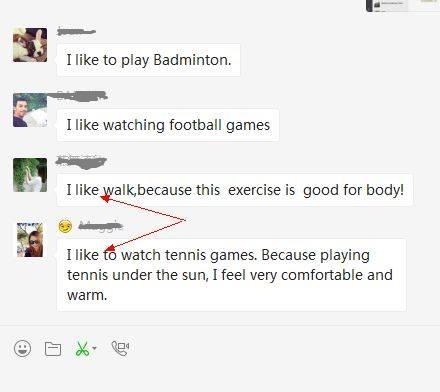
Figure 2. WeChat screen capture with teacher annotation (but not correction) - Encourage students to immediately ask questions, in or out of class, by text or by voice, about anything they have not understood, thereby creating an ongoing dialog with the teacher that enriches and personalizes the learning experience. Note that texting and voice-recording have the great advantage of being both immediate, taking advantage of the student’s spike in interest or curiosity in the moment, and also repeatable after the fact in case of a student’s time constraints, or the desire to understand better by repeated reading/hearing, etc. This has the advantages of both written and spoken corrections, but rolled into one seamless app.
The key advantages of IM over traditional writing classes are several and notable. Many are mentioned by Bouhnik and Deshen (2014, p. 226), such as the ability to get to know the students in-depth, the creation of a positive atmosphere in the class, and students feeling more comfortable about approaching their teachers and each other. Other benefits have been discovered by my students and me by trial and error. Here are some we felt to be especially noteworthy.
- Students and teacher see others’ writing immediately and can respond immediately, thereby changing writing assignments from a chore to a living exchange of ideas using English as the medium. It’s writing to communicate important ideas rather than writing to satisfy a homework requirement. Writing becomes an ongoing (but guided) conversation rather than a solitary activity. When students use English to communicate something meaningful or interesting to them, that’s when they really appreciate the value of learning the language. When they receive immediate feedback from the other students on their ideas, they are motivated to respond themselves. That motivation generates far more writing than one sees in the traditional class.
- The teacher can signal errors and suggest corrections and/or improvements on the fly, nipping errors “in the bud” and getting students to write correctly in real time, instead of them passively viewing their errors “cold” perhaps days later after the teacher has returned homework and the student no longer remembers clearly what he/she was even writing about.
- Students are strongly psychologically motivated to make their writing look good, knowing that their classmates and teacher can immediately see what they have written and can respond to it. In addition, the apps allow the student to recall any piece of writing and correct and resubmit it almost immediately. No harm, no foul!
- Students can more easily help each other in real time, allowing the more proficient students to encourage those who need more assistance. In addition, students start to use their internal monitors more, seeing their own errors after they’ve made them and correcting them themselves. That self-monitoring is of course a vital step on the way to correct, cogent writing.
- The ability to create subgroups allows for competition and debate–in writing–between groups of students, something easy to achieve in the traditional speaking class but difficult in the traditional writing class, particularly if the teacher wants the debate to proceed in real time with all the excitement that generates.
- The line between in-class work and homework becomes fairly seamless, and that seamlessness provides a sense of continuity and of community, whether the student is in or out of the classroom. Even ill students often participate from home.
In a nutshell, messaging apps are more than just another tool in the writing teacher’s’ arsenal. They change writing from the often tiresome chore it is for many students into an activity they eagerly engage in, with the result that their writing ability improves more rapidly and with far more enthusiasm and buy-in on the students’ part.
Conclusion
The future looks bright for the use of mobile instant messaging apps in ESL writing classes, and using them seems well-advised, given the huge increase in the quantity of writing already being generated outside class because of those very apps. Prejudices against using a tool because it just happens to be also used for non-educational purposes are in my view unwarranted and unsupported.
In this article we have seen how writing and grammar teachers can, simply by adopting a free mobile instant messaging app, both speed up the learning process and increase students’ satisfaction with it–a veritable double whammy!
We don’t know what further tools and improvements to existing tools will come to be, but mobile instant messaging can and should be used here and now for the boost it gives to learning, motivation and personalization of the classroom experience. The medium is the message, and the message is: try the new medium!
References
Andujar, A. (2016). Benefits of mobile instant messaging to develop ESL writing. System 62. Available http://www.sciencedirect.com/science/article/pii/S0346251X16300835.
Bouhnik, D., & Deshen, M. (2014). WhatsApp goes to school: Mobile instant messaging between teachers and students. Journal of Information Technology Education 13, Research, 217-231. Retrieved from http://www.jite.org/documents/Vol13/JITEv13ResearchP217-231Bouhnik0601.pdf.
Godwin-Jones, R. (2011). Emerging technologies: Mobile apps for language learning. Language Learning & Technology 15, 2 (2–11). Available http://llt.msu.edu/issues/june2011/emerging.pdf.
McLuhan, M. (1964). Understanding media, Routledge, London.
Statista (2016). Most famous social network sites worldwide as of September 2016, ranked by number of active users (in millions). Available http://www.statista.com/statistics/272014/global-social-networks-ranked-by-number-of-users/.
Tomaszewski, J. (2016). Do texting and “cyber slang” harm students’ writing skills? Education World. Available http://www.educationworld.com/a_admin/arcives/texting_impacts_student-writing.shtml.
Zaki, A. A., & Yunus, M. M. (2015). Potential of Mobile Learning in Teaching of ESL Academic Writing. English Language Teaching 8, 6 (11-19). Available http://www.ccsenet.org/journal/index.php/elt/article/view/49403/26587.
|
© Copyright rests with authors. Please cite TESL-EJ appropriately.
Editor’s Note: The HTML version contains no page numbers. Please use the PDF version of this article for citations. |