

November 2017 – Volume 21, Number 3
Technology Implementation Second Language Teaching and Translation StudiesNew Tools, New Approaches |
|||
| Editor: | María Luisa Carrió-Pastor (2016) | 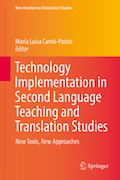 |
|
| Publisher: | Springer Science and Business Media Singapore | ||
| Pages | ISBN | Price | |
|---|---|---|---|
| pp. ix + 349 pages | 2197-8689 | $99.99 USD | |
Technology Implementation in Second Language Teaching and Translation Studies, New Tools, New Approaches is about innovation and creativity in higher education pedagogy and translation studies. This volume also discusses how universities, through the lens of practitioners, are one of the best places for the analysis of knowledge acquisition in the majority of educational areas. This book considers two standpoints to be of pivotal importance in higher education research: language teaching and translation studies. In a similar vein, a great number of research studies discussed in this book has focused on the output that the learners produce, rather than the teaching methodologies and techniques that actually lead to appropriate input for instance by encouraging language learners to interact, to discover, and to solve learning problems. This book paid particular attention to second language acquisition techniques, focusing more on input than on the output of language teaching.
The audience of this work is mainly language teachers, translators, and translator trainers. Reading this book, they will discover that the many contributing authors in this edition unanimously believe that the knowledge acquired by language teachers via professional development programs is well associated with language teaching, philology or translation with its main focus on communication. The topic of each chapter in this book connects with the tenets of second language learning, teaching and translation training, but particular attention is given to the implementation and integration of technology and its effectiveness on the ways language teachers and translators develop.
Part I includes the first five chapters. Chapter 1 discusses the recent integration of Computer Assisted Language Learning (CALL) into areas of L2 teaching and translation. This chapter proposes that similar to advancements in information technology and science, the methods of knowledge delivery should be revised and renewed, particularly in higher education. The chapter also asserts that teachers and trainers might be better off if they prioritize the use of technology in their teaching.
Chapter 2 provides an overview of second language teaching and technology. Then, the authors discuss current trends in second language teaching, addressing some criticism of Communicative Language Teaching. A cursory look is also granted to other methods of language teaching, including discourse-based teaching, task-based teaching, form-focused instruction, and instructed language learning.
Chapter 3 focuses on the role of language in intercultural communication and the potential role of technology in English language teaching. The author proposes that learners need a lingua franca alongside an intercultural communicative competence and suggests that teaching methodologies should be revised to comply with a more authentic and engaging style of teaching. Chapter 4 discusses how information processing and transfer have received more attention in the past decades as the use of technology in translation work is rapidly spreading worldwide. Finally, Chapter 5 argues that social networking sites (SNSs) and virtual worlds can improve language learning. The authors maintained that the degree of their effectiveness depends on the level of contextual saturation that the specific form of interaction within the online tool offers.
The set of four chapters in Part II mainly focuses on discussions of implementing technology in translation studies. Chapter 6 discusses the increasing development of a vast range of competencies which have made language teaching and learning a challenging yet exciting undertaking. This has led to the exploration of ways that can make learners more autonomous and teachers more creative. The authors propose that language teachers should be more open-minded and embrace CALL in their approach to language teaching.
Chapter 7 describes the current European Conversion Process and the ultimate goal of education as learning. The authors argue that students should become more autonomous learners because they will be involved in active educational strategies such as team playing, private tutoring, and using technology. Then, the authors offer some new strategies for including technology in the curriculum.
Chapter 8 is about digital portfolios and offers two aims for this chapter: first, to widen the horizons of knowledge on the use of virtual portfolios and their application in training and assessment, and second, to demonstrate an actual experience of digital portfolio application in an English as a Foreign Language (EFL) classroom employing a virtual learning platform at the University of Valencia.
Chapter 9 depicts how online pedagogical approaches can be more user-friendly to language learners than traditional approaches. The author explains how non-native speakers of an L2 benefit from telecollaboration with an aim of creating meaningful learning processes characterized by more motivation, more self-confidence, and less anxiety.
The last four chapters of this book form Part III, which is mainly about the case studies conducted in the area of technology and translator training. Chapter 10 highlights the prominence of Phraseological Units (PUs), as they have recently become a part of core linguistic studies and are of crucial importance for successful integration into new ESL/EFL communities and for those who aim to master their translation skills. Therefore, the author recommends that real examples of PUs be included in online dictionaries which are extracted from computerized language corpora and show the different levels of description (i.e., semantic, syntactic, pragmatic, stylistic, discourse) that have to be taken into account when a PU is used in a communicative context.
Chapter 11 notes that the market demands the development of competencies and specialization in the field of translation. Therefore, sources that can contribute to translation knowledge should necessarily find their way into translator training programs and become an inseparable part of teaching methodology. Chapter 12 reiterates that technology has become more and more integrated with education by improving our interactions, work, and production. The authors believed that digital tools are forming an inseparable part of translation work to an extent that there needs to be a paradigm entitled Computer Assisted Translation (CAT). Lastly, in Chapter 13, the closing notes of this volume refer to all contributions to theoretical and empirical facets of technology application in higher education for second language teaching and translation studies.
I would recommend that readers in the fields of translation studies and English language teaching (ELT) in higher education read this book because its categorization into three main sections makes the concepts of this volume easy to follow and understand. Additionally, this book covers multiple concepts that comprise heated debates in the field of ELT and technology, such as learners’ interaction, discourse, identity, and assessment, and their relationship to translation studies. The book also discusses the application of technology in education and translation. And finally, the book offers an eye-catching design of the cover page and an informative title that makes it attractive for readers who are interested in technology and translation studies.
This book concentrates on the idea that language teaching in universities involves using new methodologies and innovation and gives readers what is needed to improve the quality of instruction in the field of second language acquisition and computer-assisted translation. On account of its one-of-a kind viewpoint, the book offers a unique way to deal with empirical research on second language teaching and translator training and technology. Instructors can use this book to learn how to conduct pilot studies and take in more about students’ reactions to new teaching and translation strategies. Yet, one trivial limitation to the book is the lack of thought-provoking questions, tasks, and follow-up activities that would make this volume a textbook in graduate and post-graduate studies.
An aid for researchers and students with an academic concern for getting the fundamental standards of language instruction and translation, this book provides real cases in which the usage of technology was helpful to second language educators and translation trainers. Because the writers are experienced researchers, readers will not only come to understand how to employ innovative teaching strategies, but also find that the proposition depicted in each section can be valuable to any level of second language training for both teachers and translators.
Reviewed by
Amin Shahini
Department of English Language Teaching,
Gorgan Branch, Islamic Azad University, Gorgan, Iran
<shahiniamin gmail.com>
| © Copyright rests with authors. Please cite TESL-EJ appropriately. Editor’s Note: The HTML version contains no page numbers. Please use the PDF version of this article for citations. |