

August 2020 – Volume 24, Number 2
Language Assessment for Classroom Teachers |
|||
| Author: | Lyle Bachman & Barbara Damböck (2018) | 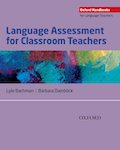 |
|
| Publisher: | Oxford, UK: Oxford University Press | ||
| Pages | ISBN | Price | |
|---|---|---|---|
| Pp. 304 | 978-0-19-421839-9 (paper) | $50.00 U.S. | |
Language Assessment for Classroom Teachers, by Lyle Bachman and Barbara Damböck, presents a new approach to classroom-based language assessment: the assessment use argument (AUA) based approach. This approach is based on Bachman and Palmer’s (2010) conceptual framework for test development and use but is adapted to better suit the needs of classroom language teachers. The authors recognize that the principles and techniques typical in teacher training courses or workshops are those developed primarily for large-scale tests. For classroom teachers whose interests are in developing and using language assessments that help improve instruction and learning, the general principles of large-scale assessment may not be entirely relevant. Therefore, this book aims to bridge the gap between large-scale assessments and classroom-based assessments, empowering teachers to assess their students’ language ability more effectively and confidently. As a title in the Oxford Handbooks for Language Teachers series, the book includes a variety of examples to help readers not only understand the theories underlying the authors’ approach, but also to see how they can be used in practice. The book is divided into four parts and twelve chapters. From the introduction (Part I), through the approach (Part II), to applications (Part III), and then on to examples (Part IV), each part builds on the previous, which scaffolds readers to understand the need for such an approach, what the approach is, and how the approach can be applied to classroom settings.
Part I consists of two chapters that provide an introduction to the book and an overview of concepts relevant to classroom-based assessment (i.e., purposes of using a language assessment, modes of classroom-based assessments, links between assessment performance and consequences, test developers/users, and the practicality of assessment use). These first two chapters establish the context for understanding the AUA framework that the authors present in Part II. For example, the difference between formative and summative decisions, the concept of stakeholders, and high-stakes and low-stakes decisions are explained to help readers understand their part in the assessment development process.
Part II begins with Chapter 3, in which the authors provide an overview of the AUA framework. The authors believe that an AUA provides a solid conceptual framework, guiding test developers and users through the process of assessment development and justification. Consequences (Claim 1), decisions (Claim 2), interpretations (Claim 3), and assessment records (Claim 4), the outcomes and the qualities of the four claims, as well as the ways to provide support for the claims, are described in detail in Chapters 4-7.
In Part III, more specific procedures that can be used to develop assessment tasks based on the AUA are discussed. Chapter 8 explains the development of an assessment task template, which includes selecting, describing, and modifying target language use tasks so that they are more practical to use as an assessment task. In Chapter 9, the authors show how to create multiple tasks from a single assessment task template. Once a model task is created following the specifications in an assessment task template, additional tasks can be created by changing one or more of the task characteristics (e.g., topical content), while the language ability to be assessed and the attributes of the students (e.g., age, ability level, etc.) are maintained. Then, Chapter 10 describes how to combine these individual tasks to use as a classroom-based assessment by creating a blueprint that specifies the content and format of an assessment, the procedures and instructions for the assessment, and the assessment task templates for each task type. The procedures to follow in administering classroom-based assessments, along with considerations for scoring performance and reporting results, are discussed in Chapters 11 and 12.
The final section of this book, Part IV, is devoted to specific examples illustrating the development of classroom-based language assessments described in the book’s previous parts. The examples include assessment tasks for all four skills (i.e., speaking, listening, writing, and reading), for different age groups, and for different levels of English as a Second Language/English as a foreign language students.
The book has several features that are particularly informative and useful to readers. First, almost every chapter begins with thought-provoking questions, effectively and meaningfully engaging readers with the discussions that follow. The authors also provide numerous illustrative examples. Showing how AUA-based language assessment can be adopted in practice, the examples make the somewhat abstract conceptual discussion more concrete and easier to grasp. In addition, exercises at the end of each chapter make reading more interactive, allowing readers to solidify concepts with practice.
Another strength of the book lies in the assessment approach that is presented. The AUA provides teachers with a conceptual framework that guides the development and justification of classroom-based language assessments. It is beneficial to consider the process by first thinking about the test consequences, and then linking the claim about the intended consequences to the claims about decisions, interpretations, and assessment records. Stating the claims in the AUA and backing them with evidence will help classroom language teachers become more confident with their assessments and allow them to convince stakeholders that intended uses of the assessment are justified.
Specific procedures for assessment task development based on the AUA, however, could have been more detailed. Although Part III is meant to provide such information, the amount and depth of explanation is not sufficient to answer questions that teachers have or address challenges they face while creating assessment tasks. For instance, while explaining assessment records (Claim 4) in the AUA, the authors emphasize the importance of minimizing sources of inconsistency. To support the claim that assessment records are consistent, the authors suggest that teachers provide appropriate analyses of test data as evidence. While acknowledging that such analyses will provide strong evidence to Claim 4, the authors simply redirect readers to Bachman (2004) and Carr (2011). Many teachers would want to know how to analyze reliability of ratings with regard to student performance by reading this book. Teachers may also desire information on rater training procedures, how to develop a rubric with descriptions that clearly define different ability levels, and how to set a cut score to make equitable decisions. These topics are not answered in the book’s relevant chapters. For readers who approach with such expectations, they may find the contents to be too general.
Nevertheless, despite the above limitations, Language Assessment for Classroom Teachers is a great resource for language teachers who are interested in assessing their students’ language ability in a principled way. Although the intentions that go into development and use of language assessments do not always ensure fair test use, the process of specifying an AUA and trying to provide backing for the claims will increase the chances of making right decisions and achieving beneficial consequences. The book would also be good for teacher preparation courses, in-service training courses, and workshops in language assessment for classroom teachers. Anyone involved in classroom-based language assessment will be able to enhance their knowledge and skills of assessment development and justification by referencing this book.
References
Bachman, L. F. (2004). Statistical analyses for language assessment. Cambridge: Cambridge University Press.
Bachman, L. F., & Palmer, A. (2010). Language assessment in practice: Developing language assessments and justifying their use in the real world. Oxford: Oxford University Press.
Carr, N. T. (2011). Designing and analyzing language tests. Oxford: Oxford University Press.
Reviewed by
Haeun Kim
Iowa State University, USA
<haeunkim iastate.edu>
| © Copyright rests with authors. Please cite TESL-EJ appropriately. Editor’s Note: The HTML version contains no page numbers. Please use the PDF version of this article for citations. |