

August 2022 – Volume 26, Number 2
English Learners at Home and at School: Stories and Strategies |
|||
| Author: | Joyce W. Nutta (2021) | 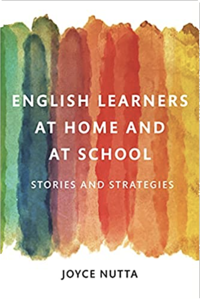 |
|
| Publisher: | Harvard Education Press | ||
| Pages | ISBN | Price | |
|---|---|---|---|
| Pp. xx + 138 | 978-1-68253-690-2 | $33.00 U.S | |
The number of students classified as English language learners, or “ELLs,” in U.S. public schools has been steadily increasing over the past decade, rising from four and a half million in the fall of 2010 to five million in the fall of 2018 (Irwin et al., 2021). This shift in student demographics has led educators to grapple with meeting the diverse needs of multilingual learners in their content-based classrooms with varying levels of financial support and training (Benuto, 2017). Many teachers seek out sources, such as books, in order to supplement their professional development. However, while many of these books are able to capture a more holistic picture of students’ needs, they leave a gap between theory and practice that many teachers find confusing and difficult to decode (e.g., Paris & Alim, 2017). Other books are geared towards specific classroom activities or teaching styles to utilize in an ESL classroom but may leave out connections to theory (e.g., Vogt, Echevarri & Short, 2010).
To offer educators who work with multilingual learners a bridge between theory and practice, Joyce W. Nutta presents six fictional stories of multilingual learners, their families, and their educators within a year of their attending school in the United States in her new book, English Learners at Home and at School: Stories and Strategies. She presents the particular cultural, social, and linguistic challenges and victories that newcomers experience while they and their families adjust to the cultural and linguistic differences in their schools and communities. Nutta wrote this book with teachers and administrators who work with multilingual learners in mind, offering specific insight for working with multilingual learners. By including students of all ages (from elementary school to college), there are specific pedagogical approaches teachers can identify and employ in their particular age group. Through these stories, she is able to bridge the gap that educators often find between theory and practice by presenting her ideas within the context of student stories.
The six stories Nutta presented in English Learners at Home and at School: Stories and Strategies, while fictionalized, are based on the real experiences of Nutta and her colleagues. In the first three chapters, Nutta focuses on the challenges and particular needs of very young learners by presenting the stories of a pre-K student, a kindergarten student, and a third grader. All three of these students and their families have settled in the Chicago area after immigrating to the United States through various means. In these stories, we see how educators were able to support each student in the classroom regardless of their first language. This included specific pedagogical approaches including how to teach young learners Spanish and English vowels in a dual immersion classroom, how to recognize and foster a student’s above-average aptitude in a subject despite inexperience with English, and how to address gaps in formal education. Beyond these specific classroom practices, the other major focus of these first three chapters was how teachers and administrators were able to support students’ families. Each of the families in these chapters struggled financially. In response, teachers and administrators found creative solutions to relieve some of this financial strain by helping parents find employment, attend English classes to improve employment opportunities, and provide child care before school for students whose parents worked in agriculture.
In chapters four through six, Nutta explores the needs of adolescent and young adult learners by focusing on the experiences of a sixth grader, an eleventh grader, and a freshman in college. These students exemplify the challenges older English learners face in the United States. These three students had more experience and proficiency in the English language, but in these stories, we see how they struggle to navigate cultural differences between their home life and their school life. In terms of linguistic approaches in the classroom, these stories examine how a student’s apparent or conversational proficiency can make it more difficult for teachers to recognize a student’s needs for language support in the classroom. Despite this difficulty, we see examples of teachers adapting and reducing unnecessary linguistic complexity from content instruction and assessment. In these chapters, teachers have an even harder time recognizing the cultural differences and subsequent needs of their students. One such difference is teachers expecting students to express their opinions openly, even if they disagree with the teacher, something that is seen as disrespectful in other cultures. In another instance, a teacher groups two students who speak the same language, oblivious to the fact that these two students are from different ethnic minorities that have a strained history.
Although there are only six stories included in Nutta’s book, the wide range of student experiences gives the clear impression that no two multilingual learners share the same background and experiences, challenging any stereotypes teachers and administrators may be tempted to apply to students. Nutta is able to do this by describing students who came to the United States for a variety of reasons, from their parents attending university to fleeing war-torn countries. Readers can see how these diverse backgrounds affected student-teacher relationships and how those working with English learners need to be sensitive to the individual needs and experiences of their students. Nutta also artfully addresses the idea that students are greatly affected by their home life and the ways in which teachers can support students’ families to have a more successful transition into U.S. culture and learning the English language.
The teachers’ successes are not the only focus of each story, as the book describes the shortcomings and challenges the teachers face. There are examples of teachers finding themselves falling short and causing offense, and times when teachers are able to change the course of a student’s and their family’s lives for the better. At times, however, the fictional educators described in these stories go far beyond what would be expected of them, to an extreme and unrealistic degree. For example, in one chapter, an administrator used $8,000 of her own savings to buy a student and their family a mobile home to live in. While this is a commendable gesture, educators should not feel pressured to deprive themselves of their personal assets. With that said, while the same classroom strategies and cultural supports found in English Learners at Home and at School: Stories and Strategies can be found within other ELL literature, the way that Nutta embeds and contextualizes them in these vibrant stories is unconventional and original. This book gives readers an accessible and digestible form of current theory and practice. Using these very personal and touching stories also conveys a sense of urgency in addressing individual issues multilingual learners face in ways other books cannot.
Upon finishing this book, readers will feel equipped to implement new strategies in their classes, support teachers in their classrooms, and build their theoretical framework for multilingual learner education. Educators can gain more insight into experiences of multilingual learners, especially students from the particular countries discussed in the book. Teachers, administrators, and others that interact with ELL students and their families directly will find this book especially useful in finding individualized solutions for their contexts. Whether they find these solutions explicitly in the stories shared or find the empowerment to reach for creative and individualized solutions, this book makes a great addition to any educator’s toolbox when working with ELL students and their families.
To cite this article
Dexter, T. (2022), English learners at home and at school: Stories and strategies, Joyce W. Nutta (2021). Teaching English as a Second Language Electronic Journal (TESL-EJ), 26(2). https://doi.org/10.55593/ej.26102r2
References
Benuto, L. T. (2017). A qualitative examination of factors for success in a content-based English language learner classroom. International Journal of Learning, Teaching and Educational Research, 16(8), 18–36.
Irwin, V., Zhang, J., Wang, X., Hein, S., Wang, K., Roberts, A., York, C., Barmer, A., Bullock Mann, F., Dilig, R., & Parker, S. (2021). Report on the Condition of Education 2021 (NCES 2021-144). U.S. Department of Education. National Center for Education Statistics. https://nces.ed.gov/pubsearch/pubsinfo.asp?pubid=2021144.
Paris, D., & Alim, H. S. (2017). Culturally sustaining pedagogies: Teaching and learning for justice in a changing world. Teachers College Press.
Vogt, M. E., Echevarri, A. J., & Short, D. (2010). The SIOP model for teaching English-language arts to English learners. Pearson.
About the reviewer
Taylor Dexter is a PhD student at Utah State University, having received her M.S. in Instruction and Curriculum from Utah State University. Her research interests primarily lie in applied linguistics and critical discourse analysis in educational contexts. ORCID ID: 0000-0002-7786-5518 <taylor.dean93@gmail.com
| © Copyright rests with authors. Please cite TESL-EJ appropriately. Editor’s Note: The HTML version contains no page numbers. Please use the PDF version of this article for citations. |