

August 2026 – Volume 30, Number 2
https://doi.org/10.55593/ej.30118r1
Digital Multimodal Composing: Connecting Theory, Research
|
|||
| Author: | Matt Kessler (2024) | 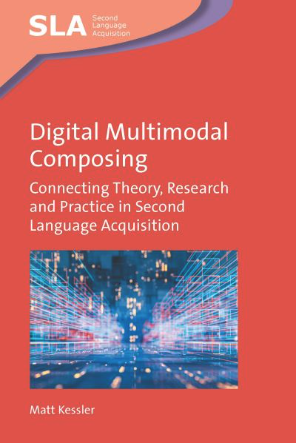 |
|
| Publisher: | Multilingual Matters | ||
| Pages | ISBN | Price | |
|---|---|---|---|
| pp 160 | 9781800410428 978180041667 |
$36.95 U.S. (paper) $149.95 (Hardback) |
|
Since the beginning of the 21st century, along with the development and applications of digital technology, the importance of digital multimodal composing (DMC) has gained increasing attention, especially in second language acquisition (SLA) (Jiang & Ren, 2021; Yu et al., 2024). In this scenario, the book Digital Multimodal Composing: Connecting Theory, Research and Practice in Second Language Acquisition by Matt Kessler (2024) emerges as a guidebook, offering a comprehensive introduction to the theory, research, and practice of DMC in SLA, and emphasizing the relationship among them.
This book consists of nine chapters and explores the subject of DMC by concentrating on the areas where theory, research, and practice converge in the field of SLA. The first two chapters introduce the basic concepts and development of multimodality and DMC, and their roots in seven key theories, including systemic functional linguistics (SFL), social semiotics, multiliteracies, interactionist approaches, sociocultural theory, activity theory, and metacognition theory. Chapter 3 discusses the shift of focus from written products to the writing process in second language writing, and foregrounds two strands of research on DMC that speak directly to major SLA concerns. Following the discussion of the composing process, the next three chapters illustrate the effectiveness of DMC tasks in promoting L2 learners’ language development, teachers’ and students’ perceptions, and influence on L2 learners’ identity, motivation, and metacognition. Chapter 7 systematically reviews the results and practical applications of seven types of DMC tasks in previous studies. Chapter 8 focuses on product-based and process-based assessment approaches and provides practical recommendations for teachers. In the final chapter, Kessler draws together the book’s key findings and proposes seven directions for future research, particularly the need to examine DMC tasks across a wider range of educational contexts.
One major strength of this book is its organization, highlighting the interplay of theory, research, and practice of DMC within SLA. The book is logically divided into three parts, with Part 1 laying the theoretical foundation, Part 2 presenting research on DMC, and Part 3 addressing the pedagogical applications of DMC tasks and activities, as well as assessment. It has been argued that theoretical discussions and investigations of DMC tasks sometimes remain detached from everyday teaching realities (e.g., Hong & Hua, 2020). Preempting such critiques, Kessler successfully demonstrates how theories influence research and how empirical findings inform classroom implementation of DMC tasks rather than treating these dimensions in isolation. The integration of theory, research and teaching practice is not only evident in the overall structure of the book but also applied within each chapter, which helps readers understand why and how DMC tasks should be adopted in different instructional contexts.
Another important contribution lies in its critical reflection on prevailing trends in DMC research. Kessler not only synthesizes major strands of DMC work but also outlines future research trajectories. More specifically, he delineates concrete research tasks for scholars, especially novice researchers, to undertake. For example, Kessler notes that many DMC studies lack a clear theoretical grounding and thus encourages researchers to investigate DMC by drawing more explicitly on relevant theoretical perspectives, including those introduced in the book. He also calls for more teacher-initiated action studies that connect DMC research more closely with classroom-based inquiry. This contributes valuable insights for strengthening DMC scholarship within SLA.
In addition, the book provides operational guidance for teachers seeking to design, implement, and assess DMC tasks in classroom contexts. It outlines clear procedures for DMC task selection, instructional implementation, and assessment, thereby transforming abstract principles into actionable steps. Notably, this book lists available platforms for completing DMC tasks, such as Venngage for digital posters. Moreover, the book also provides resources and tools for assessing both learners’ final products and their engagement throughout the composing process, which can help teachers evaluate DMC tasks in a principled and systematic manner. Teachers can better integrate DMC tasks into their teaching with this book.
Despite its valuable contributions to this field, the book has certain limitations. Though this book provides abundant resources and tools for conducting DMC tasks and assessing students’ products and processes, some of them are not free to use or easy to access, as the author acknowledges. The challenges posed by technological access are not adequately considered in some resource-constrained educational settings. Moreover, given that the uses and meanings of multimodality are invariably shaped by diverse cultural and community contexts, more guidance on navigating these dimensions in cross-cultural settings would enhance the volume’s practical utility. In classroom settings, students’ use of images, colors, music, or narrative organization may be interpreted differently by teachers and peers from diverse cultural backgrounds. Although the author has acknowledged the role of cultural factors in the implementation of DMC tasks, this insight is not sufficiently operationalized in the chapters on pedagogical applications. More examples of culture-sensitive scenarios would better assist teachers in the design and assessment of DMC tasks. While those constraints warrant consideration, they do not overshadow the work’s substantial academic merits.
In conclusion, Matt Kessler’s Digital Multimodal Composing: Connecting Theory, Research and Practice in Second Language Acquisition is a valuable contribution to DMC within the scope of SLA. It stresses the nexus between theory, research, and practice, reviews studies related to DMC in SLA showing a positive effect of DMC tasks on second language acquisition, and offers educators practical tools and strategies for the successful implementation of DMC tasks. Overall, the book serves as a useful guidebook for teachers who are interested in implementing DMC tasks in L2 classes and is highly recommended for readers interested in theoretical, research, and pedagogical aspects of DMC in SLA.
About the Reviewers
Yingliang Liu teaches EAP courses at South-Central Minzu University (China). Her research interests include second language writing and computer-assisted language learning. <yliu@mail.scuec.edu.cn> ORCID ID: 0000-0002-0538-2752
Huihui Li studies applied linguistics in the MA program at Wuhan University of Technology (China). Her research interests include second language acquisition and TESOL pedagogy. <huihuili0328@foxmail.com> ORCID ID: 0009-0008-1009-1758
To Cite this Review
Liu. Y., & Li, H. (2026). [Review of the book Digital Multimodal Composing: Connecting Theory, Research and Practice in Second Language Acquisition by Matt Kessler]. Teaching English as a Second Language Electronic Journal (TESL-EJ), 30 (2). https://doi.org/10.55593/ej.30118r1
References
Hong, A. L., & Hua, T. K. (2020). A Review of theories and practices of multiliteracies in classroom: Issues and trends. International Journal of Learning, Teaching and Educational Research, 19(11), 41–52. https://doi.org/10.26803/ijlter.19.11.3
Jiang, L., & Ren, W. (2021). Digital multimodal composing in L2 learning: Ideologies and impact. Journal of Language, Identity & Education, 20(3), 167–182. https://doi.org/10.1080/15348458.2020.1753192
Kessler, M. (2024). Digital Multimodal Composing: Connecting Theory, Research and Practice in Second Language Acquisition, Multilingual Matters. https://doi.org/10.21832/kessle6673
Yu, S., Zhang, E. D., & Liu, C. (2024). Research into practice: Digital multimodal composition in second language writing. Language Teaching, 1–17. https://doi.org/10.1017/S0261444824000375
| © Copyright rests with authors. Please cite TESL-EJ appropriately. Editor’s Note: The HTML version contains no page numbers. Please use the PDF version of this article for citations. |