• Skip to primary navigation
  • Skip to main content

site logo
The Electronic Journal for English as a Second Language
search
  • Home
  • About TESL-EJ
  • Vols. 1-15 (1994-2012)
    • Volume 1
      • Volume 1, Number 1
      • Volume 1, Number 2
      • Volume 1, Number 3
      • Volume 1, Number 4
    • Volume 2
      • Volume 2, Number 1 — March 1996
      • Volume 2, Number 2 — September 1996
      • Volume 2, Number 3 — January 1997
      • Volume 2, Number 4 — June 1997
    • Volume 3
      • Volume 3, Number 1 — November 1997
      • Volume 3, Number 2 — March 1998
      • Volume 3, Number 3 — September 1998
      • Volume 3, Number 4 — January 1999
    • Volume 4
      • Volume 4, Number 1 — July 1999
      • Volume 4, Number 2 — November 1999
      • Volume 4, Number 3 — May 2000
      • Volume 4, Number 4 — December 2000
    • Volume 5
      • Volume 5, Number 1 — April 2001
      • Volume 5, Number 2 — September 2001
      • Volume 5, Number 3 — December 2001
      • Volume 5, Number 4 — March 2002
    • Volume 6
      • Volume 6, Number 1 — June 2002
      • Volume 6, Number 2 — September 2002
      • Volume 6, Number 3 — December 2002
      • Volume 6, Number 4 — March 2003
    • Volume 7
      • Volume 7, Number 1 — June 2003
      • Volume 7, Number 2 — September 2003
      • Volume 7, Number 3 — December 2003
      • Volume 7, Number 4 — March 2004
    • Volume 8
      • Volume 8, Number 1 — June 2004
      • Volume 8, Number 2 — September 2004
      • Volume 8, Number 3 — December 2004
      • Volume 8, Number 4 — March 2005
    • Volume 9
      • Volume 9, Number 1 — June 2005
      • Volume 9, Number 2 — September 2005
      • Volume 9, Number 3 — December 2005
      • Volume 9, Number 4 — March 2006
    • Volume 10
      • Volume 10, Number 1 — June 2006
      • Volume 10, Number 2 — September 2006
      • Volume 10, Number 3 — December 2006
      • Volume 10, Number 4 — March 2007
    • Volume 11
      • Volume 11, Number 1 — June 2007
      • Volume 11, Number 2 — September 2007
      • Volume 11, Number 3 — December 2007
      • Volume 11, Number 4 — March 2008
    • Volume 12
      • Volume 12, Number 1 — June 2008
      • Volume 12, Number 2 — September 2008
      • Volume 12, Number 3 — December 2008
      • Volume 12, Number 4 — March 2009
    • Volume 13
      • Volume 13, Number 1 — June 2009
      • Volume 13, Number 2 — September 2009
      • Volume 13, Number 3 — December 2009
      • Volume 13, Number 4 — March 2010
    • Volume 14
      • Volume 14, Number 1 — June 2010
      • Volume 14, Number 2 – September 2010
      • Volume 14, Number 3 – December 2010
      • Volume 14, Number 4 – March 2011
    • Volume 15
      • Volume 15, Number 1 — June 2011
      • Volume 15, Number 2 — September 2011
      • Volume 15, Number 3 — December 2011
      • Volume 15, Number 4 — March 2012
  • Vols. 16-Current
    • Volume 16
      • Volume 16, Number 1 — June 2012
      • Volume 16, Number 2 — September 2012
      • Volume 16, Number 3 — December 2012
      • Volume 16, Number 4 – March 2013
    • Volume 17
      • Volume 17, Number 1 – May 2013
      • Volume 17, Number 2 – August 2013
      • Volume 17, Number 3 – November 2013
      • Volume 17, Number 4 – February 2014
    • Volume 18
      • Volume 18, Number 1 – May 2014
      • Volume 18, Number 2 – August 2014
      • Volume 18, Number 3 – November 2014
      • Volume 18, Number 4 – February 2015
    • Volume 19
      • Volume 19, Number 1 – May 2015
      • Volume 19, Number 2 – August 2015
      • Volume 19, Number 3 – November 2015
      • Volume 19, Number 4 – February 2016
    • Volume 20
      • Volume 20, Number 1 – May 2016
      • Volume 20, Number 2 – August 2016
      • Volume 20, Number 3 – November 2016
      • Volume 20, Number 4 – February 2017
    • Volume 21
      • Volume 21, Number 1 – May 2017
      • Volume 21, Number 2 – August 2017
      • Volume 21, Number 3 – November 2017
      • Volume 21, Number 4 – February 2018
    • Volume 22
      • Volume 22, Number 1 – May 2018
      • Volume 22, Number 2 – August 2018
      • Volume 22, Number 3 – November 2018
      • Volume 22, Number 4 – February 2019
    • Volume 23
      • Volume 23, Number 1 – May 2019
      • Volume 23, Number 2 – August 2019
      • Volume 23, Number 3 – November 2019
      • Volume 23, Number 4 – February 2020
    • Volume 24
      • Volume 24, Number 1 – May 2020
      • Volume 24, Number 2 – August 2020
      • Volume 24, Number 3 – November 2020
      • Volume 24, Number 4 – February 2021
    • Volume 25
      • Volume 25, Number 1 – May 2021
      • Volume 25, Number 2 – August 2021
      • Volume 25, Number 3 – November 2021
      • Volume 25, Number 4 – February 2022
    • Volume 26
      • Volume 26, Number 1 – May 2022
      • Volume 26, Number 2 – August 2022
      • Volume 26, Number 3 – November 2022
      • Volume 26, Number 4 – February 2023
    • Volume 27
      • Volume 27, Number 1 – May 2023
      • Volume 27, Number 2 – August 2023
      • Volume 27, Number 3 – November 2023
      • Volume 27, Number 4 – February 2024
    • Volume 28
      • Volume 28, Number 1 – May 2024
      • Volume 28, Number 2 – August 2024
      • Volume 28, Number 3 – November 2024
      • Volume 28, Number 4 – February 2025
    • Volume 29
      • Volume 29, Number 1 – May 2025
      • Volume 29, Number 2 – August 2025
      • Volume 29, Number 3 – November 2025
      • Volume 29, Number 4 – February 2026
    • Volume 30
      • Volume 30, Number 1 – May 2026
      • Volume 30, Number 2 – August 2026
  • Books
  • How to Submit
    • Submission Info
    • Ethical Standards for Authors and Reviewers
    • TESL-EJ Style Sheet for Authors
    • TESL-EJ Tips for Authors
    • Book Review Policy
    • Media Review Policy
    • TESL-EJ Special issues
    • APA Style Guide
  • Editorial Board
  • Support

Great Debates: Language and Culture Skills for ESL Students

September 2005 — Volume 9, Number 2

Great Debates: Language and Culture Skills for ESL Students

Author: Meredith Westfall & John McCarthy (2004) &nbsp:
Publisher: Ann Arbor: University of Michigan Press.
Pages ISBN Price
Pp. vi + 256 ISBN 0-472-08955-2 (paper) $18.95

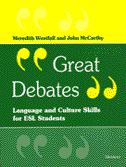
Great Debates: Language and Culture Skills for ESL Students by Meredith Westfall and John McCarthy is a classroom text published by the University of Michigan Press which offers ESL learners the opportunity to engage in spoken English through the activity of debating. This is an interesting teaching technique, which introduces English in the ESL classroom in a way that is both challenging and interesting to the learner as well as to the teacher.

The textis divided into thirty chapters, each focusing on a carefully-selected topic that can generate debate by stimulating thought and promoting discussion. The topics cover a broad range of areas, such as animals, food, technology, health, and culture. They are of common interest, and learners will find that they can easily relate to them, since they are all concerned with the real world and involve experiences that the learners themselves may have gone through. Some of the topics included are Summer or Winter? (Chapter 5), Bagels or Doughnuts? (Chapter 11), Diet or Exercise? (Chapter 15), Cats or Dogs? (Chapter 21), Trains or Planes? (Chapter 27), and Phone or E-mail? (Chapter 30).

Conversational Tips and Language Learning Tips are provided throughout the text. These features present the learners with alternative phrases and expressions for such communicative functions as agreeing, disagreeing, asking for more information, giving more information, and disagreeing while adding one’s own opinion. Teachers will find these tips invaluable in getting the learners to express themselves in new ways during the debates.

Each chapter follows the same format, and is divided into the following sections: Starting Off prepares the learners to discuss the topic of the chapter; Vocabulary introduces five new vocabulary items, with part of speech, definition, and two example sentences provided for each item; Reading presents the two sides of the issue in a two-paragraph passage on the topic; Comprehension Questions checks the learner’s understanding of the reading passage by means of four questions; Discussion Activities provides three activities through which the learners can debate the topic; Write about It encourages the learners to practice their writing skills by writing short answers to three questions based on the topic; People Say presents two idioms or expressions related to the topic; and Vocabulary Review tests the learners’ vocabulary recall with a series of fill-in-the-blank questions. Two useful features provided in an appendix are a vocabulary list and an Answer Key.

One of the strengths of this book is that it provides practice in several of the language skills, integrating these skills in such a way that they support and enhance one another. Another excellent feature of the book is that it exposes the learner to the culture of English-speaking peoples, something that is essential in developing communicative competence in English. Finally, it brings all the various elements of language learning together into a unified whole though the medium of debate, in which the learner not only develops communicative competence in English but also acquires thinking skills that have a wide range of applications in everyday life.

One danger in writing a book that aims to "teach" culture to "outsiders" is that the material may be presented in such a way that it inadvertently offends some learners. In Great Debates: Language and Culture Skills for ESL Students, however, the cultural material is presented with great sensitivity so as not to offend anyone. In addition, the authors provide the sources of the information used in the reading passages so that the learners can track them down if they are interested and get further details on the topic if they wish. The authors have been careful to use only the most reliable sources, and this gives the book a high degree of credibility.

Great Debates: Language and Culture Skills for ESL Students is an excellent classroom resource for both the ESL teacher and the ESL learner. By getting the learners to engage in the valuable learning technique of debate and integrating this with other activities and skills, it develops a firm foundation both linguistically and culturally. The authors and publisher have collaborated to create an excellent text that should prove to be an unqualified success in the classroom. I strongly recommend it to any ESL teacher who is looking to enhance and enrich the learning experience of his or her learners.

Thinan Sangpanasthada
Brock University
<ts98ahbrocku.ca>

© Copyright rests with authors. Please cite TESL-EJ appropriately.

Editor’s Note: The HTML version contains no page numbers. Please use the PDF version of this article for citations.

© 1994–2026 TESL-EJ, ISSN 1072-4303
Copyright of articles rests with the authors.