

September 2005 — Volume 9, Number 2
Reclaiming the Local in Language Policy and Practice
|
|||
| Author: | A. Suresh Canagarajah (Ed.) (2005) | 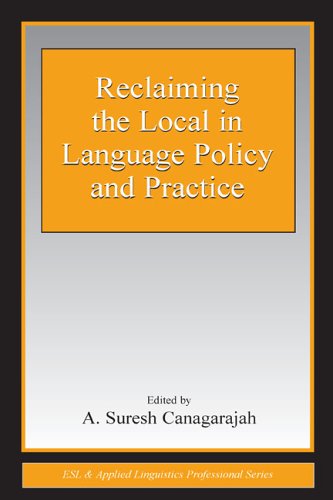 |
|
| Publisher: | Mahwah, New Jersey: Lawrence Erlbaum | ||
| Pages | ISBN | Price | |
|---|---|---|---|
| Pp. xxx + 271 | ISBN 0-8058-4593-3 (paper) | $32.50 | |
As the series editor points out, this book identifies the urgent local concerns caused by the increasing linguistic and social homogeneity in the representation of literacy and expertise, and also brings to the foreground the rising issues of power inequality.
The popular discourse is that globalization is ushering in a new life of border-free, unrestricted relationships between communities, but the contributors to this book argue that the local is getting “shortchanged by the social processes and intellectual discourses of contemporary globalization” (p. xiv) and their intent is “to complicate the dominant discourses on language policies and practices” (p. xi). Themes that they interrogate include: English as global language, the native English speaker’s fading hegemony, marginalization of local knowledges, western linguists’ power to name and determine curriculum and pedagogies, and resistance of the local/marginalized to the global/powerful.
The editor, Suresh Canagarajah, warns that local language practices, discourses, and values will be engulfed by the sweeping economic and political forces brought about by globalization. In Chapter 1, he posits that local knowledge that constitutes the practices and perspectives of the disempowered has historically not been considered real knowledge, thus showing the interconnection between knowledge and power. He argues that although there has always been a tussle between oppositional discourse of the local/ minority communities against the global/majority community, the most concerted campaign to denigrate local knowledge at the global level begins with modernism; for a community to be considered civilized, it has to discard the practices associated with its locale, which, for modernism, is a sign of backwardness. Colonialism spread these values of modernism beyond Europe, so that the local knowledge of colonized communities began to be suppressed in the name of civilization by European nations. He further argues that the postmodernist movement is carrying out the interests of the status quo. Focusing the discussion on Applied Linguistics (AL), he posits that primary constructs used by western linguists such as mother tongue and native speaker, which are based on the notion of unitary language identification, are not relevant to multilingual speech communities.
The struggle between the local and the global is prominent in Chapter 2, in which Rakesh Bhatt uses Indian Englishes as a case study of English in postcolonial contexts. The new Englishes continue to be challenged as deviant varieties by native speaker linguists who use western varieties of English as the standard, yet another example of the local being managed by the global powerful. Bhatt argues that these dichotomies of standard and nonstandard English have resulted in many class differences within India, and that the richer classes in India use the construct of standard English to maintain their hegemony over the lower classes, who speak a local variety. By using these dichotomies, Bhatt argues, Indian elites are reinforcing the biased expert discourses that sustain the hegemony of standard English worldwide.
In Chapter 12, Elisabeth-Mermann Jozwiak and Nancy Sullivan continue this critique of the constructs of western AL in their discussion of Mexican Americans living in the borderlands–that is, between the languages and cultures of the United States and Mexico–who are facing inequity in education and whose children are underperforming in school. The writers a) make a case for teachers acquiring the skills that help them understand minority students’ home cultures and b) ask for curriculum inclusion of the language and literatures of Chicano writers in order to validate Mexican students’ knowledges and cultures. They make important points about the connections between colonization, assimilation and the privileging of standard English over the local variety.
In Chapter 5, Kanavillil Rajgopalan underscores a recurring theme in this book: that local knowledge often finds itself in confrontation with the knowledge that specialists bring to local issues, but which is isolated from the community. He argues that the discipline of linguistics is founded on a dismissal of ordinary people’s beliefs about language; the writer focuses on one such example of conflict between expert and local knowledge in Brazil. The struggle between various left wing and right wing factions as well as local and national politics resulted in English being seen as a threat to the preservation of the national language. The controversy is whether or nor to enact laws to protect Portuguese from the onslaught of English, the global language. This chapter notes that there are many radical and reactionary stands on this issue among the local people, showing that local knowledge is often riddled with internal contradictions.
Chapter 4 zeroes in on another aspect of local and global tensions in Brazil. Lynn Mario de Souza deconstructs the dominant model of literacy to expose its word-based bias, a model that has been propagated globally by the colonization activities of Europe, and leading to the suppression of diverse alternate literacies. Focusing on the writing processes of the Kashinawa indigenous community in Brazil, she warns that non-indigenous well-wishers underestimate the complexity and importance of the meaning-making potential of non-alphabetic forms of writing. The model of writing used in Kashniwa-Portuguese translations for courses in indigenous education is not sensitive to the content of indigenous cultures, as content is understood as theme or topic, rather than as substantial appreciation of local knowledge, and hence these books give a distorted view of local cultures.
Chapter 6 has a similar theme–language policy–but in Malaysia. Maya David and Subra Govindasamy write that Malay was promoted as the national language during the latter half of the 20th century to bring about national identity and unity among the Malay and non-Malay ethnic communities despite resistance from non-Malay ethnic minority groups. They look at the earlier emphasis given to Malay, resistance to English, and current and recent attempts to revive English-medium education in order to maintain a competitive edge in global business. They question the earlier use of Malay replacing English as both Chinese and Tamil are local languages, and posit that the Malaysian experience can serve as a cautionary lesson for other postcolonial multilingual societies who opt for affirmative action.
Another theme in this book is the power linguists have to name. In Chapter 3, Dominique Ryon discusses the case of Cajun French in Louisiana as a case study in which linguists have the power to decide that a language is dying. She queries the current trend in academic discourse of classifying linguistic minorities as dying, instead of resisting or struggling, and says that local knowledge on language loss in Louisiana tells a different story; recent creative texts written in Cajun French and popular songs are to her a sign of resistance and struggle to survive. She critically analyzes the ideological slant in language death studies that ignores local resistance and assumes assimilation into the dominant language of the nation-state as the norm. And finally she points to the fact that the story is told from the victor’s point of view while linguistic minorities’ perspectives and issues are marginalized.
Chapter 9, by Angel Lin, Wendy Wang, Nobuhiko Akamatsu and Mehdi Riazi, is an important contribution to this book. It addresses a number of current issues in AL, among them the implications of these four EFL learners’ experiences with English on their own teaching. The chapter analyzes the many ways in which the authors’ language learning experience can reformulate the teaching of English as informed by local norms and functions. One of the issues the learners/teachers raise is the ongoing hegemony of western linguists on TESOL pedagogy, whereby western pedagogies are exported to periphery countries even when they are inappropriate. They stress the importance of interrogating the use of western methods in the east and say that local situations and knowledges should determine the right pedagogy for a particular situation. Dichotomies that the writers want to undo include the native-nonnative speaker of English and learner-teacher of EFL.
In Chapter 11, Jasmine Luk picks up on some of the themes of Chapter 9. She points out that the global nature of the Communicative Approach to Language Teaching (CLT) is similar to that of the English language, and both emanate from the west. She is critical of native English speaker teachers who promote CLT in the Far East, a region hungry for appropriate methodologies, and emphasizes the need for locally relevant and culturally sensitive CLT methodology. Drawing on a study of CLT of two secondary schools in Hong Kong, Luk discusses the implications for a locally relevant pedagogical practice.
She makes a case for language learners to negotiate self-relevant local perspectives. Luk also reiterates the messages in Chapter 9 – that the role of the native speaker needs to be reconsidered and that the EFL learner needs to negotiate local perspectives.
Directly relevant to this theme of TESOL methods is Chapter 8, in which David Block looks at the teaching of expatriate teachers. Whereas Chapters 9 and 11 critique the export of western pedagogies which are often unsuitable for other communities, Block writes about the challenges faced by French language teachers in England, and their desire to introduce pedagogies used in France in their new classrooms. Among the questions that this chapter raises are: What teaching philosophies and pedagogical practices should transnational teachers use in their host country? Should they follow the dominant policies and practices of the host country, or draw on their expertise and pedagogical insights from their previous experience? How best can language teacher practices and identities be negotiated across national borders?
Writing in the context of Brunei, Peter Martin in Chapter 10 gestures to the importance of the local. As he puts it, this chapter tells a local story of a classroom where the pupils are members of a small community in a rural area of Brunei, but the story is told within the wider context of the power of the Malay center as well as the increasing power of globalization. The study focuses on the pedagogies observed in one classroom, but locates it within the power dynamics of how the locals contest the educational agenda controlled by the Malay center, and hence the study shows a “struggle for survival in the quest for knowledge” (p. 244). In this way, the chapter is a powerful study of a small local people struggling with the global center.
Chapter 7, by Sharon Utakis and Marianne Pita, looks at language among Dominicans who live both in New York City and the Dominican Republic (DR), maintaining strong ties with both places, and hence creating a community that “transcend[s] national boundaries” (p. 147). These children need to be bilingual and bicultural so that they can live in both New York and the DR. The authors, both English teachers at a community college, express dissatisfaction with the language policies in education and argue that the transnational nature of their students merits that the current assimilationist policy goal of bilingual programs for immigrants in the United States be rethought.
The many writers of this book succeed in their aim of troubling the dominant discourse on language policies and practices, and hence this book is an invaluable contribution to the literature in this area, which presents globalization as a positive phenomenon. It makes us rethink the connections between AL, globalization, and the hegemony of the global over the local, and makes us also cognizant of how majority communities within developing countries use similar tropes to maintain their power over minority communities within their own countries. Finally, we applied linguists who struggle against global/dominant practices in our own teaching and research should take heart from the fact that is well demonstrated by this book: local/minority communities are not passive recipients of the global/majority but have always waged resistance to the hegemony of the powerful.
Nuzhat Amin
Department of Curriculum and Instruction, School of Education
C.W. Post Campus, Long Island University
<Nuzhat.Amin liu.edu>
|
© Copyright rests with authors. Please cite TESL-EJ appropriately. Editor’s Note: The HTML version contains no page numbers. Please use the PDF version of this article for citations. |