• Skip to primary navigation
  • Skip to main content

site logo
The Electronic Journal for English as a Second Language
search
  • Home
  • About TESL-EJ
  • Vols. 1-15 (1994-2012)
    • Volume 1
      • Volume 1, Number 1
      • Volume 1, Number 2
      • Volume 1, Number 3
      • Volume 1, Number 4
    • Volume 2
      • Volume 2, Number 1 — March 1996
      • Volume 2, Number 2 — September 1996
      • Volume 2, Number 3 — January 1997
      • Volume 2, Number 4 — June 1997
    • Volume 3
      • Volume 3, Number 1 — November 1997
      • Volume 3, Number 2 — March 1998
      • Volume 3, Number 3 — September 1998
      • Volume 3, Number 4 — January 1999
    • Volume 4
      • Volume 4, Number 1 — July 1999
      • Volume 4, Number 2 — November 1999
      • Volume 4, Number 3 — May 2000
      • Volume 4, Number 4 — December 2000
    • Volume 5
      • Volume 5, Number 1 — April 2001
      • Volume 5, Number 2 — September 2001
      • Volume 5, Number 3 — December 2001
      • Volume 5, Number 4 — March 2002
    • Volume 6
      • Volume 6, Number 1 — June 2002
      • Volume 6, Number 2 — September 2002
      • Volume 6, Number 3 — December 2002
      • Volume 6, Number 4 — March 2003
    • Volume 7
      • Volume 7, Number 1 — June 2003
      • Volume 7, Number 2 — September 2003
      • Volume 7, Number 3 — December 2003
      • Volume 7, Number 4 — March 2004
    • Volume 8
      • Volume 8, Number 1 — June 2004
      • Volume 8, Number 2 — September 2004
      • Volume 8, Number 3 — December 2004
      • Volume 8, Number 4 — March 2005
    • Volume 9
      • Volume 9, Number 1 — June 2005
      • Volume 9, Number 2 — September 2005
      • Volume 9, Number 3 — December 2005
      • Volume 9, Number 4 — March 2006
    • Volume 10
      • Volume 10, Number 1 — June 2006
      • Volume 10, Number 2 — September 2006
      • Volume 10, Number 3 — December 2006
      • Volume 10, Number 4 — March 2007
    • Volume 11
      • Volume 11, Number 1 — June 2007
      • Volume 11, Number 2 — September 2007
      • Volume 11, Number 3 — December 2007
      • Volume 11, Number 4 — March 2008
    • Volume 12
      • Volume 12, Number 1 — June 2008
      • Volume 12, Number 2 — September 2008
      • Volume 12, Number 3 — December 2008
      • Volume 12, Number 4 — March 2009
    • Volume 13
      • Volume 13, Number 1 — June 2009
      • Volume 13, Number 2 — September 2009
      • Volume 13, Number 3 — December 2009
      • Volume 13, Number 4 — March 2010
    • Volume 14
      • Volume 14, Number 1 — June 2010
      • Volume 14, Number 2 – September 2010
      • Volume 14, Number 3 – December 2010
      • Volume 14, Number 4 – March 2011
    • Volume 15
      • Volume 15, Number 1 — June 2011
      • Volume 15, Number 2 — September 2011
      • Volume 15, Number 3 — December 2011
      • Volume 15, Number 4 — March 2012
  • Vols. 16-Current
    • Volume 16
      • Volume 16, Number 1 — June 2012
      • Volume 16, Number 2 — September 2012
      • Volume 16, Number 3 — December 2012
      • Volume 16, Number 4 – March 2013
    • Volume 17
      • Volume 17, Number 1 – May 2013
      • Volume 17, Number 2 – August 2013
      • Volume 17, Number 3 – November 2013
      • Volume 17, Number 4 – February 2014
    • Volume 18
      • Volume 18, Number 1 – May 2014
      • Volume 18, Number 2 – August 2014
      • Volume 18, Number 3 – November 2014
      • Volume 18, Number 4 – February 2015
    • Volume 19
      • Volume 19, Number 1 – May 2015
      • Volume 19, Number 2 – August 2015
      • Volume 19, Number 3 – November 2015
      • Volume 19, Number 4 – February 2016
    • Volume 20
      • Volume 20, Number 1 – May 2016
      • Volume 20, Number 2 – August 2016
      • Volume 20, Number 3 – November 2016
      • Volume 20, Number 4 – February 2017
    • Volume 21
      • Volume 21, Number 1 – May 2017
      • Volume 21, Number 2 – August 2017
      • Volume 21, Number 3 – November 2017
      • Volume 21, Number 4 – February 2018
    • Volume 22
      • Volume 22, Number 1 – May 2018
      • Volume 22, Number 2 – August 2018
      • Volume 22, Number 3 – November 2018
      • Volume 22, Number 4 – February 2019
    • Volume 23
      • Volume 23, Number 1 – May 2019
      • Volume 23, Number 2 – August 2019
      • Volume 23, Number 3 – November 2019
      • Volume 23, Number 4 – February 2020
    • Volume 24
      • Volume 24, Number 1 – May 2020
      • Volume 24, Number 2 – August 2020
      • Volume 24, Number 3 – November 2020
      • Volume 24, Number 4 – February 2021
    • Volume 25
      • Volume 25, Number 1 – May 2021
      • Volume 25, Number 2 – August 2021
      • Volume 25, Number 3 – November 2021
      • Volume 25, Number 4 – February 2022
    • Volume 26
      • Volume 26, Number 1 – May 2022
      • Volume 26, Number 2 – August 2022
      • Volume 26, Number 3 – November 2022
      • Volume 26, Number 4 – February 2023
    • Volume 27
      • Volume 27, Number 1 – May 2023
      • Volume 27, Number 2 – August 2023
      • Volume 27, Number 3 – November 2023
      • Volume 27, Number 4 – February 2024
    • Volume 28
      • Volume 28, Number 1 – May 2024
      • Volume 28, Number 2 – August 2024
      • Volume 28, Number 3 – November 2024
      • Volume 28, Number 4 – February 2025
    • Volume 29
      • Volume 29, Number 1 – May 2025
      • Volume 29, Number 2 – August 2025
      • Volume 29, Number 3 – November 2025
      • Volume 29, Number 4 – February 2026
    • Volume 30
      • Volume 30, Number 1 – May 2026
      • Volume 30, Number 2 – August 2026
  • Books
  • How to Submit
    • Submission Info
    • Ethical Standards for Authors and Reviewers
    • TESL-EJ Style Sheet for Authors
    • TESL-EJ Tips for Authors
    • Book Review Policy
    • Media Review Policy
    • TESL-EJ Special issues
    • APA Style Guide
  • Editorial Board
  • Support

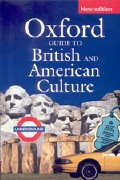
Oxford Guide to British and American Culture (New Edition)

March 2006 — Volume 9, Number 4


Oxford Guide to British and American Culture (New Edition)

Author: Jonathan Crowther (2005)  
Publisher: Oxford: Oxford University Press
Pages ISBN Price
Pp. viii + 534 019-4311295 (paper) £16.95

Culture encompasses all the activities of a given society. It includes art, folklore, customs, beliefs, and other products of human thought. It may be difficult for individuals from one culture to understand and appreciate the ways of thinking and products of another culture, especially if the other culture is very different from the one that the individual grew up in; but the task can be made easier if the learner has tools that can facilitate the process. The Oxford Guide to British and American Culture (New Edition) is just such a tool.

This book offers learners of English as a Second Language the most up-to-date guide to contemporary British and American culture. It is recommended for upper-intermediate to advanced learners of English; however, it can be used to some extent at other levels. It can also be a valuable source of information for those who are not enrolled in a language-learning program but would like to become familiar with British or American culture. Additionally, language teachers might find this guide an excellent source of supplementary material.

The Oxford Guide to British and American Culture provides insights into what is important or popular in present-day Britain and America in an engaging manner, focusing on the practical applications of such information. Thus, the book is a handy guide for those who are interested in exploring the “real-world” environment of these two major countries.

The information in the Guide is organized under various headings arranged in alphabetical order, like a dictionary. It consists of 10,000 entries. In addition, there are hundreds of illustrations, including color photographs and maps, to help the learner get a visual sense of what he or she is reading about. The abbreviations, symbols, and labels used in the guide are explained in the beginning of the text. Such useful features make accessing the material convenient and allow the reader to use the Guide as one would use other reference books.

This Guide is an excellent source of supplementary material for the ESL teacher in the language classroom since it can be applied effectively to the teaching of all four language skills: reading, writing, speaking, and listening. In teaching reading skills, the Guide can be used to provide students with practice in scanning for specific information. In teaching writing skills, the teacher can use information from the Guide, such as that on American and British breakfasts, as a springboard for writing comparisons-in this case, comparing American and British breakfasts with breakfast in the learner’s home country. This exercise could be adapted to speaking and listening, with learners being asked to do a presentation on breakfast in their home country, or to participate in a classroom discussion about the relative health benefits of different kinds of breakfasts.

The Guide allows learners to (1) discover facts and figures about Britain and America in the 21st century (e.g., “Timeline of Britain History,” p. C4-5 or “Timeline of US History,” p. C18-19); (2) explore the lives of the rich, the famous and the infamous, history, legends, festivals, music, food, shopping, and attitudes (e.g., “muffin,” p. 313; “Radiohead,” p. 389); (3) look up famous quotations and sayings and find out who said what (e.g., “Just do it,” Nike advertising slogan under “Nike&trade:,” p. 323); and (4) get ideas of what to read-choose from lists of books that won the Booker, Pulitzer and other prizes plus suggestions for further reading (e.g., Winners of the Orange Prize for Fiction under ‘the Orange Fiction,’ p. 344).

While the Guide is well-organized and thoughtfully put together, its usefulness would have been enhanced by the inclusion of a category (or topic) index, a handy tool which would benefit both instructors and learners. Such an index could be modeled on the “Yellow Pages” of the telephone book, with all the entries containing geographical information, for example, listed together under that topic. Other categories might be people, quotations, books, television series, and so on. Another thing that would have enhanced the value of the Guide is information about certain aspects of other cultures that are considered offensive or come across negatively in American or British culture, for example, certain gestures or mannerisms such as clicking one’s fingers to get a waiter’s attention in a restaurant. Also, being made aware of interpersonal communication practices, such as the amount of personal space that people in American and British culture expect others to give them, might save learners from other cultures embarrassment in social situations. Information of this nature would have added to the book’s real, practical value to students from the increasingly broad range of cultures in our classrooms.

Overall, I find the Oxford Guide to British and American Culture an excellent reference book for learners of English as a Second Language, since it contains informative and practical materials and presents these materials in an effective manner emphasizing ease of use. I strongly recommend this book to both learners and instructors.

Thinan Sangpanasthada
Brock University
<ts98ahbrocku.ca>

© 1994–2026 TESL-EJ, ISSN 1072-4303
Copyright of articles rests with the authors.

© Copyright rests with authors. Please cite TESL-EJ appropriately.

Editor’s Note: The HTML version contains no page numbers. Please use the PDF version of this article for citations.